
I am text block. Click edit button to change this text. Lorem ipsum dolor sit amet, consectetur adipiscing elit. Ut elit tellus, luctus nec ullamcorper mattis, pulvinar dapibus leo.
-15%Sold out

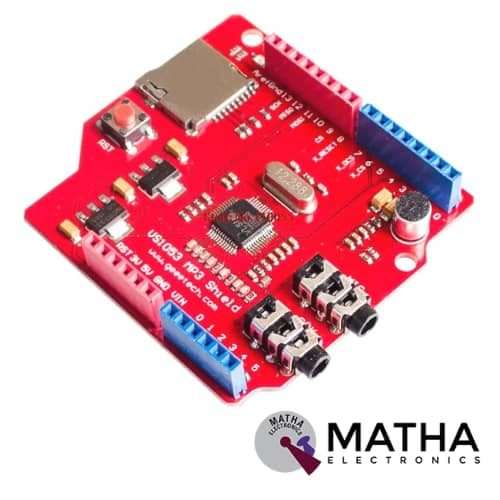
VS1053 MP3 Recording Module Development Board with Onboard Recording For UNO
Original price was: ₹1,855.00.₹1,400.00Current price is: ₹1,400.00. inc. GST
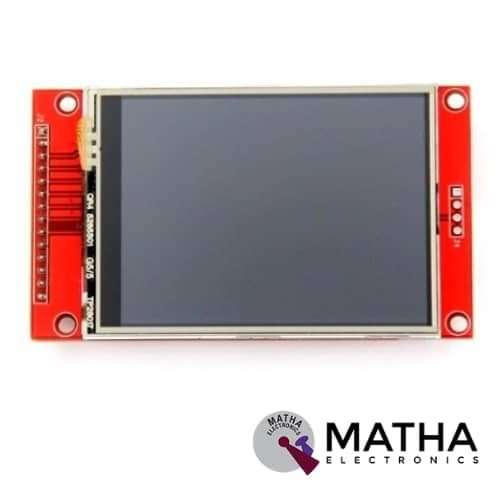
2.8 inch SPI Screen Module TFT Interface 240 x 320 without Touch
Original price was: ₹1,725.00.₹1,500.00Current price is: ₹1,500.00. inc. GST
“PWM Generator Module for Stepper Motor Driver with Forward and Reverse Function “
Original price was: ₹1,825.00.₹1,550.00Current price is: ₹1,550.00. inc. GST
- Board can be used to generate PWM signals for the stepper motor driver
- Operating Voltage: 12VDC
- Three Frequency Range
- Forward and Reverse Function.
- It has three frequency ranges selectable via onboard jumpers.
- Frequency can be measured via PUL and common cathode (GND) ports.
- The board has two sets of power input
Out of stock
Description
The TOSHIBA 2SC5200 was used to create this PWM Stepper Motor Controller Board. This board is used to create PWM signals for the stepper motor driver, and it features onboard buttons for rotating the stepper motor in both CW and CCW directions. The motor’s speed may be adjusted using the onboard potentiometer. The onboard jumper can be used to choose the high and low frequency signals when the board creates a frequency pulse signal.
In the speed control of DC motors, pulse-width modulation (PWM) or duty-cycle variation techniques are often utilised. During a PWM period, the duty cycle is defined as the fraction of digital ‘high’ to digital ‘low,’ as well as the digital ‘high’ pulse-width. This great method of controlling the amount of power delivered to a load without dissipating any wasted power.
Note:
- In order to use the start or stop function, the ENA enable terminal on the controller must be connected to the driver with a common cathode or a common anode.
- The forward and reverse rotation and the start and stop of the motor can be controlled by pressing the button.
- Changing the frequency of the motor may be regulated by altering the potentiometer.
- An ordinary switch with self-locking is used to control the motor’s forward/reverse rotation and start/stop function.
- Incase, If you want to connect the switches that control forward and reverse, and open or stop, to the chassis panel, you can refer to the following instructions.
- Change the forward and backward buttons, as well as the start-stop button, into a lead-wire switch, as shown on the rear.
Reviews (0)
Shipping & Delivery

Related products
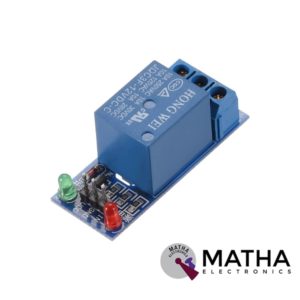
1 CHANNEL 12V RELAY
- 1-Channel relay interface board
- Operating voltage: 12V DC
- Provide high current relay of 15A
- For quick and easy connection high-quality screw terminals provided
- Can control both AC & DC appliances
- LED status indicates relay ON/OFF state.
- High current relay of 10A @250 V AC/10A@ 30V DC
- Standard interface that can be controlled by a microcontroller (Arduino, 8051, PIC, AVR, DSP, ARM)
- For easy accessibility input signal pin connected to burg sticks
- Dimension: 43*17*17mm
- Weight: 150gm

1 CHANNEL 5V RELAY
- 1 channel relay board
- Operating voltage: 5V
- Maximum current: 2 A
- Relay contact current capacity of 10A @250 V AC/10A@ 30V AC
- configured as SINGLE POLE DOUBLE THROW( SPDT)
- LED status indicates relay ON/OFF state.
- Standard TTL level logic controlled
- One normally closed and one normally opened contact
- Compatible with any 5V microcontroller
- Dimension: 43*17*17mm
- Weight: 150gm

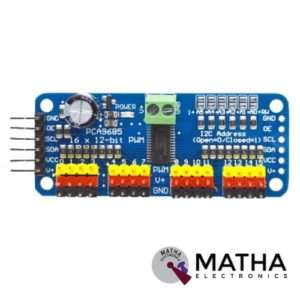
16-Channel 12-bit PWM/Servo Driver I2C interface PCA9685 for Arduino Raspberry Pi
- Adjustable frequency PWM up to about 1.6 kHz
- 12-bit resolution for each output – for servos, that means about 4us resolution at a 60Hz update rate
- Configurable push-pull or an open-drain output
- The output enable pin to quickly disable all the outputs
- Terminal block for power input
- Reverse polarity protection on the terminal block input
- Green power-good LED
- 3 pin connectors in groups of 4 so you can plug in 16 servos at once
- Chainable design
- A spot to place a big capacitor on the V+ line
- 220-ohm series resistors on all the output lines to protect them, and to make driving LEDs trivial.
- This board/chip uses an I2C 7-bit address between 0x60-0x80, selectable with jumpers.

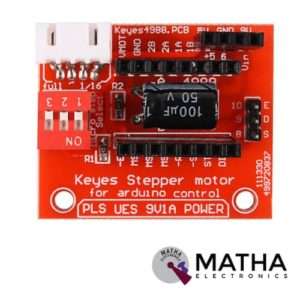
A4988 STEPPER MOTOR DRIVE CONTROLLER BOARD
- Operating voltage supply: 8 V to 35 V
- Continuous current per phase: 1 Amp
- Maximum current per phase: 2 Amp
- Minimum logic voltage: 3V
- Maximum logic voltage: 5.5V
- Microstep resolutions: Full, 1/2, 1/4, 1/8, and 1/16
- Compact size, easy to install and use.
- All jumpers hit the ON position to indicate 16 subdivisions (4988) or 32 subdivisions (8825).
- Jm connection motor; Jv Connects 5V and 12V-24V Power Supply.
- E /S /D /G of Jc corresponds to Enable /Step /Dir /Gnd driving signal output on the connection respectively.
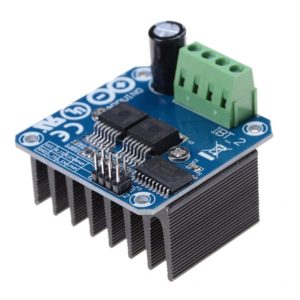
BTS7960 43A High Power Motor Driver Module/Smart Car Driver Module for Arduino Current Limit
- Input voltage: 6V-27V
- Maximum current: 43A
- Input level: 3.3-5V
- Control mode: PWM or level
- Duty cycle: 0-100%
- Double BTS7960 large current (43 A) H bridge driver
- 5V isolate with MCU and effectively protect MCU
- 5V power indicator on board
- Four lines from MCU to driver module (GND. 5V. PWM1. PWM2)
- Reverse the motor forward, two PWM input frequency up to 25kHZ
- Two heat flow passing through an error signal output
- Dimension: Approx. 4 * 5 * 1.2cm


DM556 Digital Stepper Motor Driver with Micro Stepping 20 to 50V 5.6A
- Good high-speed performance
- Supply voltage: +50VDC
- Output current from 0.5A to 5.6A
- Pulse input frequency up to 200 kHz
- Extremely cost-effective
- Automatic idle-current reduction
- Self-test and Auto-configuration technology TTL compatible and optically isolated input
- Micro step resolutions programmable, from full-step to 102,400 steps/rev
- Suitable for 2-phase and 4-phase motors
- Support PUL/DIR and CW/CCW modes
- Anti-Resonance provides optimum torque and nulls mid-range instability
- Extra-low motor noise offers excellent quietness
- Over-voltage, over-current protection and phase error protection
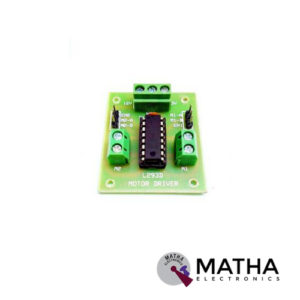
L293D MOTOR DRIVER
- Can be used to run two dc motors with the same IC
- Speed and direction control is possible
- Supply voltage: 4.5 V to 7V
- Motor voltage: 4.5 v to 36v
- Maximum peak motor current: 1.2 A
- Maximum continuous motor current: 600 milli ampere
- Screw terminal connectors for easy connection
- Transition time: 300 ns (at 5v and 24v)
- High noise immunity inputs
- Automatic thermal shutdown
- Available in 16 pin DIP, TSSOP, SOIC package
- Dimension: 48*34*14mm
- Weight: 15gm


L293D Motor Driver Shield
- L293D motor driver chip & 74HC595 shift register
- Four H-bridges
- Terminal blocks and jumper to connect external power, for separate logic/motor supplies
- Up to 4 bi-directional DC motors with individual 8-bit speed selection
- Up to 2 stepper motors (unipolar or bipolar) with single coil, double coil or interleaved stepping.
- 2 connections for 5V ‘hobby’ servos connected to the Arduino’s high-resolution dedicated timer
- 4 H-Bridges: L293D chipset provides 0.6A per bridge (1.2A peak) with thermal shutdown protection, internal kickback protection diodes. Can run motors on 4.5VDC to 25VDC.
- Pull-down resistors keep motors disabled during power-up
- Big terminal block connectors to easily hook up wires (18-26AWG) and power
- Arduino reset button brought up top
- Tested compatible with Arduino Mega 1280 & 2560, Diecimila, Duemilanove, and UNO
- PCB Size: 69 x 53 mm
Reviews
There are no reviews yet.