
Which is the Best? OLED Vs Nano Cell

For a long time, LG’s OLED has been among the most advanced and reliable screen technologies. When it comes to picture quality and colour accuracy, OLED is unrivalled, and that’s true whether it’s utilised in an LG OLED TV or one from another manufacturer (Sony, Panasonic). In contrast, LG employs nano cell technology in their high-end LED TVs to improve picture quality and colour gamut, bringing them closer in performance to OLED TVs. This essay will delve into the world of organic light-emitting diodes (OLEDs) and nano-cell technologies, contrasting the benefits of each.
We will also see the differences between OLED and NanoCell TVs with respect to some important specifications (display type, viewing angles, burn-in, etc.). Finally, we will try to figure out which is the best for you in OLED vs NanoCell. So, let’s get started.
What is OLED TV?
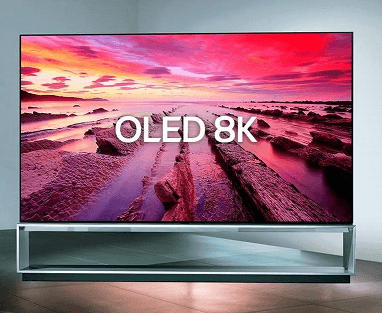
Organic Light Emitting Diode is commonly abbreviated as “OLED.” Despite the inclusion of the word “LED” (light emitting diode), organic LEDs (OLEDs) are often employed in the realm of display technology rather than illumination.
Unlike conventional displays, OLED screens generate their own light. In an OLED TV, each individual pixel can provide its own light source. In contrast, the pixels on common LCD TVs need to be illuminated by a backlight, which must be supplied externally (in the past by fluorescent lamps but now by LEDs in practically all LCD TVs).
Since OLED TVs generate their own illumination, they are self-lit and don’t need a backlight. How does this help, exactly? Due to the fact that each pixel is responsible for producing its own light, we may switch off individual pixels to create truly impressive black levels in low-light situations. However, the dark areas of the image will be entirely black while the remainder of the picture will show its original colours.
Because of this, the contrast of the display is enhanced, and OLEDs never experience the common problem of backlight bleeding. OLED also has superior viewing angles, which is a major plus. There has always been an issue with viewing angles on LCD TVs, to the point that the picture quality suffers and the viewer needs to sit almost perfectly still to avoid seeing any colour shift.
What is NanoCell TV?
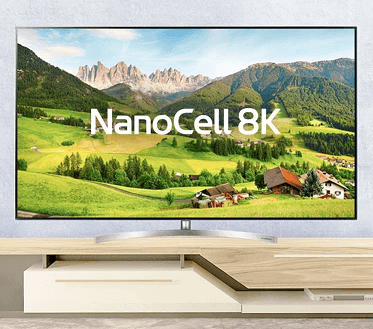
NanoCell TVs, manufactured by LG, are a specific variety of LCD / LED TV. NanoCell technology cannot be comprehended without first knowing something about IPS technology (In-plane Switching).
Early generations of liquid crystal display televisions (LCDs) oriented their panels vertically. As a result, the picture quality suffers and the colours on the screen appear washed out if you sit even slightly off centre.
The IPS method involves shifting the orientation of liquid crystals from vertical to horizontal. The viewing angle and colour accuracy both benefit greatly from this alignment. Therefore, the picture quality remains high and quality loss is minimal even if you sit in a non-ideal viewing position.
Why bother using NanoCell technology if IPS already outperforms earlier generations of LCDs? There is still room for improvement in LCD TV colour reproduction, even if IPS has solved the problem of glare. Nano particles at each pixel in a NanoCell TV filter out ambient light, allowing the primary hues of Red, Green, and Blue to stand out more vividly.
The end effect is a more vibrant colour palette that retains its vibrancy and sharpness regardless of the viewer’s position in relation to the screen.
Pros and Cons of OLED and NanoCell
Pros of OLED
- Stunning black levels
- Extremely thin TVs, in fact one of the thinnest available right now
- Superior field of view
Cons of OLED
- Expensive
- Burn-in problem
- Less peak brightness than LCD TVs
Pros of Nano Cell
- Improved color reproduction from regular IPS LCD TVs
- Affordable than OLED but slightly expensive than regular LCD TVs
- Good for HDR content due to higher peak brightness than OLED TVs
Cons of Nano Cell
- As they are essentially LCD TVs, you won’t get perfect blacks
- Slightly thicker and heavier than OLED TVs
Recommended OLED TVs
LG C1 55-inch 4K Smart OLED TV
One of the best-selling and highest-rated OLED TVs on the market is the 55-inch LG C1 model. This ultra-high-definition television has a native refresh rate of 120 frames per second (4K UHD). Furthermore, it has a response time of less than 1ms, is G-Sync and Free-Sync compatible, and has support for a range of refresh rates, making it an excellent choice for competitive gamers (VRR). LG’s OLED television is among the best deals in the industry.
Sony BRAVIA XR A80J 55 Inch 4K OLED TV
The Sony A80J, a follow-up to last year’s smash hit A8H, is yet another excellent OLED TV option. It’s a 4K TV with lots of extras like a fast refresh rate (120Hz), virtual reality (VRR), and HDMI 2.1 connectivity. It’s perfect for gaming and watching games.
Recommended NanoCell TVs
Since LG developed NanoCell and it is essentially LG’s unique technology, LG is the only company that produces NanoCell TVs. To date, LG has released three distinct lines of NanoCell televisions.
- LG Nano90 4K NanoCell (available in 86”, 75”, 65” and 55”)
- LG Nano80 4K NanoCell (available in 75”, 65”, 55” and 50”)
- LG Nano75 4K NanoCell (available in 86”, 75”, 65” and 55”)
Of the three, only Nano90 series of TC have full array local dimming while Nano80 series has regular local dimming and the Nano75 series doesn’t have any local diming at all. Also, Nano90 series has native 120Hz refresh rate, while the remining two have only 60Hz native refresh rate.
The 55” Nano90 NanoCell TV is cheaper than the 55” OLED TV mentioned earlier.
OLED vs Nano Cell: Comparison Table
In this section, we’ll examine the differences and similarities between OLED and Nano Cell TVs with respect to certain factors that consumers should consider before making a final decision.
| OLED | Nano Cell | |
| Display Type | Self-Emitting Pixels | LED Backlight |
| Viewing Angle | Very Wide (approx. 60o) | Wide (approx. 30o) |
| Color Accuracy | Very Good | Very Good |
| Contrast | Very High | Low |
| Blacks (Dimming) | Stunning Blacks | Greyish (Backlight Bleed) |
| Response Time | Very Low (<2ms) | Low (~10ms) |
| Burn-in | Possible burn-in problem | No burn-in problem |
| Screen Thickness | Ultra-Thin (<4mm) | 35 – 45mm |
| Cost | High | Medium – High (<OLED) |
Difference Between OLED vs Nano Cell
Let’s take a closer look at the distinctions between OLED and NanoCell TVs, building on the similarities we saw in the preceding table.
- Display Type
NanoCell TVs, a type of LCD TV with LED backlighting, are dubbed Transmissive Displays, whereas OLED TVs are nicknamed Emissive Displays due to the pixels in them that emit light on their own.
- Viewing Angles
You and your friends or family won’t have to jostle for position in front of the screen when watching a movie or TV show on an OLED or NanoCell TV because of the displays’ similarly generous viewing angles. However, due to their self-emitting pixels, OLED displays provide superior viewing angles and colour accuracy at wider viewing angles than NanoCell displays.
- Color Accuracy
NanoCell TVs, like OLED TVs, have exceptional colour accuracy, and the idea behind them is to further enhance the picture’s colour quality until it’s on par with that of an OLED.
- Contrast
OLED TVs, in comparison to NanoCell TVs, have a much higher contrast ratio since its pixels are turned off for black colours.
- Black Levels and Dimming
When it comes to achieving true darkness and controlling brightness down to the pixel level, OLED once again triumphs. NanoCell TVs with full-array local dimming are likewise great at reducing brightness, although their black depths aren’t quite as deep as those of OLEDs.
- Response Time
If you want to play video games on your television, this is a crucial requirement. The time it takes for a display to go from one colour to another, often from black to white or grey to grey, is known as its response time.
With response times as low as 1ms, OLED TVs are among the fastest on the market. Even while NanoCell TVs are great, their response times range from 5ms to 10ms, which isn’t ideal.
- Burn-in Problem
Burn-in is a major issue with OLED televisions. When one image (often a news channel logo or anything similar) is shown on the screen for an extended period of time, the display eventually becomes stuck on that image. If you view content with static pictures (like new channels) for an extended period of time, your OLED TV may experience a problem known as burn-in.
However, because to screen shifter technology, today’s OLED TVs are less likely to experience burn-in. In contrast, NanoCell TVs never experience burn-in.
- Screen Thickness
Since there is no need for a backlight system and there are just a few layers in the actual display screen, OLED TVs can be manufactured extremely small; for example, LG’s Wallpaper TV Series is one of the thinnest on the market at just a few millimetres.
Similar to LCD TVs, NanoCell TVs require a backlight system, which adds thickness to the device.
- Cost
The price difference between OLED and NanoCell TVs is the final and most critical consideration. The production cost of LCD TVs has decreased dramatically over the years, contributing to the widespread adoption of these displays. That’s why NanoCell TVs can be had for a fraction of the price of OLED models.
Interestingly, in certain countries, OLED televisions are still a luxury item. Although OLED televisions are still quite pricey, several models are beginning to see price reductions.
Conclusion: OLED vs Nano Cell – Which is Better?
Which television technology, OLED or NanoCell, is superior, and why? The only TV that can compare to an OLED in terms of picture quality and impressive black levels is an OLED. It’s the best movie-watching experience ever because to the lifelike colours, pinpoint control down to the pixel level, and inky blacks. OLED TVs have excellent images, little input latency, and quick response times, making them a great choice for gamers. The high price tag is the biggest drawback of OLED TVs. All these extras come at an additional cost.
On the other hand, NanoCell TVs are characterised by excellent colour accuracy and viewing angles (even though they are less than OLED counterparts). NanoCell TVs with full array local dimming are ideal for watching movies. Seeing HDR video on a NanoCell TV will be incredible because LCD TVs have higher peak brightness than OLED TVs.