
List of Arduino Compatible Temperature Sensors for DIY Projects

Every enthusiast who is actively creating DIY projects has the intention of establishing a weather station after manipulating relays and blinking LEDs with an Arduino. It only needs to measure the essentials, such as temperature and humidity, without having to forecast storms or precipitation.

The essential components of an Arduino weather station are a temperature sensor and a humidity sensor (typically they are packaged together, although discrete components are also available). Let’s concentrate on them as the topic of this essay is Arduino Compatible Temperature Sensors.
It’s a very helpful project to use an Arduino to measure the temperature of a space or an object. You can record the data for later analysis while continuously monitoring temperature changes.
There are many temperature sensors on the market that are compatible with Arduino. While some are pricey and simple to use, others are expensive and quite accurate.
Here is the list of a few popular temperature sensors for Arduino along with some basic information about each sensor. These sensors can be used with various development boards including the Raspberry Pi, ESP8266, ESP32, STM32F103C8T6 Blue Pill Board, and others.
.
- LM35
The DIY and hobbyist communities are currently targeted by a range of temperature sensors. But a few years ago, the LM35 was the sole option when it came to temperature sensors.

LM35 Analog Temperature Sensor IC
One of the most widely used temperature sensors on the market is still in use today. An analogue temperature sensor with a direct Celsius calibration is the LM35. The output analogue voltage is linearly related to the centigrade temperature.
The transfer function of LM35 is
VOUT = 10mV/0C x T,
where VOUT is the output voltage
T is the temperature in 0C.
The output voltage rises by 10mV for every degree Celsius that the temperature rises, according to the transfer function.
In addition to the LM35, there are two more temperature sensors. They are LM34, a thermometer calibrated for Fahrenheit, and LM335, a thermometer calibrated for Kelvin.
Specifications of LM35:
| Range | -550C to 1500C |
| Accuracy | ±0.50C at 250C |
| Operating Voltage Range | 4V to 30V |
| Communication Protocol | Analog Output |
| Applications | |
| HVAC Systems | |
| Consumer Appliances | |
| Battery Management Systems Power Supplies |
- DHT11
The DHT11 Sensor is one of the temperature sensors that are widely utilised in Arduino projects. It can monitor both temperature and humidity because it is a relative humidity sensor.

DHT11 Temperature and Humidity Sensor
The DHT11 Sensor’s internal components include an NTC thermistor (a temperature sensor), a resistive humidity sensor, and an 8-bit MCU that does an ADC operation to generate digital output.
Speaking of digital output, the DHT11 Sensor uses the one-wire protocol for communication. When compared to its larger brother DHT22, the DHT11 Temperature and Humidity Sensor’s range and accuracy numbers are not as spectacular.
Important Specifications of DHT11:
| Temperature Range | 00C to 500C |
| Temperature Accuracy | ±20C |
| Humidity Range | 20 – 90% RH |
| Humidity Accuracy | ±5% RH |
| Operating Voltage Range | 3.3V to 5.5V |
| Communication Protocol | One Wire |
| Applications | |
| HVAC Systems | |
| Weather Stations Home Automation Systems |
- DHT22
The DHT11 is a fantastic option for straightforward applications, but its range and accuracy could be a drawback. Because of this, it is thought that the DHT22, which also monitors relative humidity and temperature, is a preferable option.

DHT22 Temperature and Humidity Sensor
Although DHT11 and DHT22 appear to be identical, they actually differ primarily in one way. The DHT11 is a relative humidity sensor of the resistive type, while the DHT22 is one of the capacitive kind.
DHT11 is frequently offered in blue housing, while DHT22 is frequently offered in white housing. The DHT22 Sensor’s pinout is identical to that of the DHT11. The DHT22 costs more than the DHT11 due to its greater range and precision.
Specifications of DHT22:
| Temperature Range | -400C to 800C |
| Temperature Accuracy | ±0.50C |
| Humidity Range | 0 – 100% RH |
| Humidity Accuracy | ±2% RH |
| Operating Voltage Range | 3.3V to 6V |
| Communication Protocol | One Wire |
| Applications | Home Automation Systems |
| HVAC Systems | |
| Weather Stations Home Automation Systems |
Both DHT11 and DHT22 Temperature Sensor can be connected to a cable of length up to 20m for remote temperature measurement.
- TMP36
Another analogue temperature sensor, the TMP36, is quite similar to the well-known LM35 model. The operational voltage range for this low-voltage temperature sensor starts at 2.7V, and the temperature is calibrated in 0C.

TMP36 Temperature Sensor IC
TMP36 and LM35 both have scale factors of 10mV/0C, however TMP36’s range and accuracy numbers are a little lower. Nevertheless, if you’re looking to purchase an analogue temperature sensor, it is a fantastic substitute for the LM35.
Specifications of TMP36:
| Range | -400C to 1250C |
| Accuracy | ±20C at 250C |
| Operating Voltage Range | 2.7V to 5.5V |
| Communication Protocol | Analog Output |
| Applications | |
| Thermal Protection Systems | |
| Fire Alarms | |
| Power System Monitors | |
| CPU Thermal Management Power Supplies |
- BMP180
The Bosch BMP180, which is essentially a barometric pressure sensor, can also measure temperature. As a result, it is a superior sensor to incorporate into projects involving weather monitoring or weather stations.

BMP180 Pressure and Temperature Sensor Module
The BMP180 is a pressure sensor, thus we can further measure altitude with it (higher the altitude, lower the pressure). The BMP180 Sensor is frequently used in mobile phones, GPS navigation systems, and other outdoor devices because of its accuracy, stability, and resilience (with respect to EMC).
A piezo-resistive sensor, an ADC, a control module with EEPROM, and a Serial Interface in the form of I2C are all combined internally by the BMP180.
The sensor sends temperature and pressure data over the I2C bus
Specifications of BMP180:
| Pressure Range | 300hPa to 1100hPa (9000m to -500m relating to sea level) |
| Pressure Accuracy | -4hPa to 2hPa |
| Temperature Range | 00C to 650C |
| Temperature Accuracy | ±20C |
| Operating Voltage Range | 1.8V to 3.6V (for sensor)3.3V to 5V (for module) |
| Communication Protocol | I2C |
| Applications | |
| GPS Navigation Systems | |
| PDA | |
| Weather Forecast | |
| Sports Devices Mobile Phones |
- DS18B20
Another digital Temperature Sensor that is distinct in its own right is the DS18B20. First, it just needs a single data line to communicate since it uses the Dallas Semiconductor-developed 1-Wire bus (and of course, a GND wire).

DS18B20 Temperature Sensor IC and Waterproof Sensor
The DS18B20 Sensor can be powered by the data line itself, which is a second distinguishing characteristic (known as parasite power). This does away with the requirement for any outside source. The third distinctive characteristic is the choice of output resolution, which ranges from 9 to 12 bits.
The fact that every DS18B20 Sensor has a distinct 64-bit serial number assigned to it is another significant aspect. By utilising this functionality, you can link a large number of DS18B20 sensors to a single 1-Wire Bus and have them communicate with it.
Specifications of DS18B20:
| Range | -550C to 1250C |
| Accuracy | ±0.50C for -100C to 850C |
| Operating Voltage Range | 3V to 5.5V |
| Communication Protocol | 1-Wire |
| Applications | Thermostatic Controls |
| Industrial Systems | |
| Thermometers | |
| Consumer Products Thermostatic Controls |
- BME280
The Bosch BME280 Sensor is another all-in-one sensor. It has excellent measuring ranges and precision and can measure pressure, humidity, and temperature. Since it uses little power, battery-operated gadgets like mobile phones, fitness trackers, navigational systems, etc. can use it.
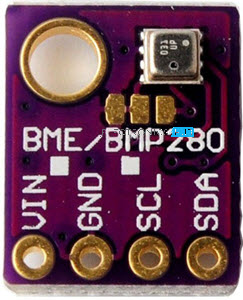
BME280 Humidity, Pressure and Temperature Sensor Module
The sensor is compatible with SPI and I2C communication interfaces. As a result, check that the module you choose has the necessary pinouts.
Specifications of BME280:
| Pressure Range | 300hPa to 1100hPa |
| Pressure Accuracy | ±1hPa |
| Temperature Range | -400C to 850C |
| Temperature Accuracy | ±10C |
| Humidity Range | 0% to 100% |
| Humidity Accuracy | ±3% |
| Operating Voltage Range | 1.8V to 3.6V (for sensor)3.3V to 5V (for module, if it has voltage regulator) |
| Communication Protocol | I2C or SPI (check for pinout) |
| Applications | |
| GPS Navigation Systems | |
| PDA | |
| Weather Forecast | |
| Sports Devices (fitness trackers) Mobile Phones |
- MCP9808
Microchip’s MCP9808 is a high-precision digital temperature sensor. Low power I2C or SMBus is used for communication by the sensor. It is one of the list’s most accurate temperature sensors with a typical accuracy of 0.250C.

MCP9808 Temperature Sensor Module
Up to 8 MCP9808 Temperature Sensors can be connected to the same I2C bus using its three programmable address pins. Applications for multizone temperature monitoring are suited for such a configuration.
Specifications of MCP9808:
| Range | -400C to 1250C |
| Accuracy | ±0.250C |
| Operating Voltage Range | 2.7V to 5.5V |
| Communication Protocol | I2C / SMBus |
| Applications | Industrial Freezer |
| Food Processing | |
| Personal Computers | |
| Portable Devices Industrial Freezer |
- Si7021
Silicon Labs’ Si7021 is an integrated humidity and temperature sensor. The IC includes an ADC, a temperature sensor, a humidity sensor, and an I2C communication interface.

Si7021 Temperature Sensor Module
There is no requirement for user calibration because the humidity and temperature sensors are both factory calibrated. The Si7021 is a low power temperature sensor with great accuracy.
Specifications of Si7021:
| Temperature Range | -100C to 850C |
| Temperature Accuracy | ±0.40C |
| Humidity Range | 0 – 80% RH |
| Humidity Accuracy | ±3% RH |
| Operating Voltage Range | 1.9V to 3.6V (for sensor) |
| Communication Protocol | I2C |
| Applications | |
| HVAC Systems | |
| Weather Stations | |
| Mobile Phones | |
| Automotive Climate Control Thermostats |
- TC74
The TC74 is one of the few temperature sensors available in a TO-220 format. It is a low-cost serial digital temperature sensor that is useful in applications. Although the TC74 is not a temperature sensor with great precision, its affordable price and TO-220 packaging (also available in SOT-23) make it an excellent option for a variety of projects.

TC74 Temperature Sensor IC
The TC74’s communication interface has a 100kHz I2C or SMBus speed.
Specifications of TC74:
| Range | 250C to 850C |
| Accuracy | ±20C |
| Operating Voltage Range | 2.7V to 5.5V |
| Communication Protocol | I2C / SMBus |
| Applications | |
| Power Supplies | |
| Personal Computers | |
| Thermostats Hard Disks |
- PCT2075
The NXP PCT2075 is a fantastic I2C-based digital temperature sensor. The PCT2075 is a very good substitute for the LM75 Temperature Sensor if you are familiar with it.

PCT2075 Temperature Sensor Module
An 11-bit Sigma-Delta ADC with a resolution of 0.1250C is built inside the PCT2075 Sensor. The PCT2075’s I2C bus may operate at frequencies of standard mode (100 kHz), fast mode (400 kHz), and fast mode plus (1 MHz).
Specifications of PCT2075:
| Range | -550C to 1250C |
| Accuracy | ±20C |
| Operating Voltage Range | 2.7V to 5.5V |
| Communication Protocol | I2C / SMBus |
| Applications | |
| Industrial Controllers | |
| Personal Computers | |
| Cooling Systems |
- AMT1001
The AMT1001 Sensor is a different combination sensor that measures both temperature and relative humidity. It is an analogue capacitive output sensor with distinct outputs for temperature and humidity.

AMT1001 Temperature and Humidity Sensor
Important Information: The AMT1001 sensor monitors temperature and relative humidity, whereas the AM1001 sensor just measures relative humidity. When making a purchase, use caution.
Specifications of AMT1001:
| Humidity Range | 20% to 90% RH |
| Humidity Accuracy | ±5% |
| Temperature Range | 00C to 500C |
| Temperature Accuracy | ±10C |
| Operating Voltage Range | 4V to 5.5V |
| Communication Protocol | Analog Output |
| Applications | |
| Humidifiers | |
| Dehumidifiers HVAC |
Conclusion
I hope all of you had understand the most popular Arduino temperature sensors. We MATHA ELECTRONICS will be back soon with more informative blogs soon.