
I am text block. Click edit button to change this text. Lorem ipsum dolor sit amet, consectetur adipiscing elit. Ut elit tellus, luctus nec ullamcorper mattis, pulvinar dapibus leo.
-17%
Nuclear Green PLA 1.75 mm 1 KG Filament-Wanhao
Original price was: ₹1,800.00.₹1,500.00Current price is: ₹1,500.00. inc. GST

Orange HIPS 1.75 mm 1 KG Filament-Wanhao
Original price was: ₹1,800.00.₹1,500.00Current price is: ₹1,500.00. inc. GST
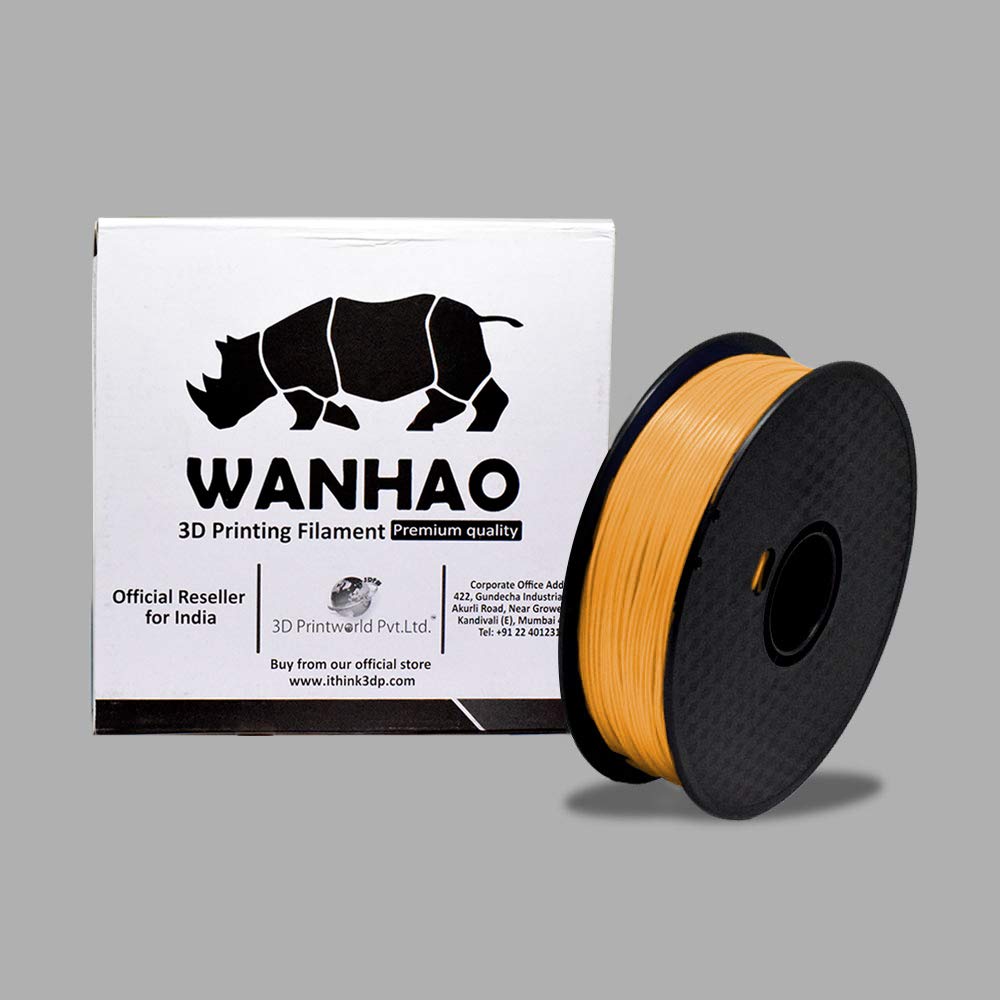
Orange ABS 1.75 mm 1 KG Filament-Wanhao
Original price was: ₹1,800.00.₹1,500.00Current price is: ₹1,500.00. inc. GST
- Material: ABS
- Color: Orange
- Material Diameter: 1.75mm
- Printing Temperature: 220° to 230°C
- Mounted: Spool Mounted
- Net weight: 1kg
- Packaging Vacuum-sealed with desiccant to protect the filament from humidity
- Highly Detailed & Quality Outputs.
- Tried and Tested by Makenica.com
- Compatible with any FDM 3D Printer.
- ABS is stronger than PLA
- Easy to post-process.
- Environment friendly – ISO 9001 and ROHS certified
Description
This orange ABS 1.75 mm 1 KG Filament-Wanhao designed to generate a highly detailed and quality output product using ABS filament. ABS, known as Acrylonitrile Butadiene Styrene, defined as a multipurpose material widely used in 3D printing. ABS is the same material that Lego bricks are made out of. And function as a great plastic for working parts. Basically, final products made up of ABS material are very durable, withstand a wide range of temperatures. And also tend to be more flexible and less ‘brittle’ than those made with PLA. This orange color ABS comes in 1 Kg (2.2 lbs) spool of 1.75mm ABS filament.
In order to provide a glossy look to our finished ABS product, acetone can be used for post-processing. ABS works perfectly with a heated bed as ABS contracts when cooled and large parts may pull off of a non-heated bed. This easy-to-process ABS filament comes in a vacuum-sealed bag with desiccant to protect the filament from humidity. Otherwise, it absorbs moisture, thereby affecting the dimensional tolerances of your 3D printer filament. So it is recommended to use the vacuum-sealed bag to keep the material free from humidity. ABS defined as a thermoplastic that easily molds when heated and hardens evenly when cooled.
Recommended temperatures when used with Wanhao 3D printers:
- First Layer: 210 ° C
- Printing temperature: 200 ° C
- Raft temperature: 190 ° C
- Heating bed temperature: 45-60 ° C
Applications Of Wanhao ABS Filament
- Everyday 3D prints
- Architecture mock-ups
- Educational 3D models
- Detailed conceptual models
- Professional quality enclosures
Reviews (0)
Shipping & Delivery

Related products

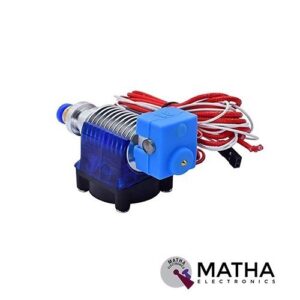
3D E3D V6 All Metal J-Head Hotend Extruder 1.75mm Filament 0.4mm Nozzle with Fan Duct
- Nozzle: 0.4mm
- Filament: 1.75MM
- Thermistor:100K NTC B 3950 ±1 %, 1m long wiring
- Heater: Ceramic heater 12V 40Watt. 1M long wiring
- High-Temperature Performance
- Easy No-solder, No-tape, No-adhesive Assembly And Maintenance
- Print The Widest Range Of Materials Possible
- High-Quality Printing
- Adaptable To Suit Your Needs
- Easy Mounting And Community Support
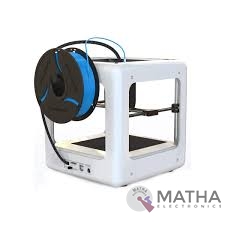
Easythreed NANO Fully Assembled Mini 3D Printer
- Print Technology: FDM
- Product Colour: White
- Print Size: 90*110*110mm
- Number of Nozzle: 1
- Nozzle Diameter:.4mm
- Layer Thickness: 0.1-0.3mm
- Filament Support: PLA
- Filament Size: 1.75mm
- Rotary technology: Belt drive, linear bearing technology
- Print accuracy: 0.1-0.3mm
- Support hotbed: No
- Slicing software: E3D NANO
- Feed Technology: Proximal feed
- Nozzle Temperature: 180-230℃
- Hotbed temperature: No
- Printing speed: 10-20MM/S
- Support file format Input: .Stl, Transfer: .gcode
- Power supply Input: 110~240V 50/60HZ Output: 12V, 60W
- Machine size: 188X188X198mm
- Package Size: 230x230x240mm
- Weight: (Aerospace Parts Required) 4KG
- Net weight / gross weight: 1KG/3KG
- Printing platform: Quick mounting and dismounting
- Support system : Windows XP/7/8/10 (32 bit/64bit) IOS(CURA)
- Display technology: One key printing technology (without display)
- Connectivity: TF Card, USB Cable
- Certificate: CE, FCC, RoHS
- Power Supply: Plug EU Standard(Default)

NEMA 23 10.1 kg-cm
- Operating Voltage : 2.3 Volts
- Step Angle : 1.8°
- Holding Torque : 10.1 kg-cm
- Supply Current (A) : 2.8 Ampere/Phase
- Number of Leads : 4
- Inductance : 2.2 mH/Phase
- Resistance : 0.83 Ohm
- Rotor Inertia : 275 gm-cm2
- Weight (gm) : 650
- Detent Torque (kg-cm) : 0.36
- Frame Size (mm) : 57 x 57
- Inductance Accuracy : ±20%
- Resistance Accuracy : ±10%
- Shaft Diameter (mm) : 6.35
- Shaft Length (mm) : 20.6
- Step Angle Accuracy : ±5%
- Comparably more powerful than NEMA17 motors.
- The input pulse decides the rotation angle of the motor.
- High accuracy of around 3 to 5% a step.
- It provides good starting, stopping, and reversing.
- Control of this motor is less costly because of the exclusion of complex control circuitry.
- The speed is proportional to the frequency of the input pulses.

PR34 2004 LCD Display Smart Controller W or Adapter for RAMPS1.4 Reprap 3D Printer
- RAMPS 1.4 2004 LCD Display intelligent controller.
- LED background light control circuit, a small function of the intelligent controller,
- With pin short time to decide on all LED turn or steering 30 seconds
- You can turn on the light time to do the long or short form of the adjustment TRIMM R4100K from 10 seconds to 2 minutes.
- Plug and play on the RAMPS, but need to modify the firmware to support.
- The product comes encoder parameter adjustment can be achieved, and the file selection print.
- With an SD card base on the back, put slicing file into the SD card and select the file on the LCD, then can be printing.


Stepper Motor Nema 23 kg 7.2 kg Dual shaft
- Rated Voltage: 6.6 V
- Current/ phase: 1A
- Resistance/ phase: 6.6ohms
- Inductance/ phase: 8.2 mH
- Holding Torque: 7.2 kg-cm
- of Leads - 6
- Rotor Inertia - 275
- Weight: 0.65kg
- Detent Torque: 0.36 kg-cm
- Step Angle - 1.8°
- Step Angle Accuracy - ±5% (full step, no load)
- Resistance Accuracy - ±10%
- Inductance Accuracy - ±20%
- Frame Size (mm) - 57x57
- Shaft Length (mm) - 20.6
- Shaft Diameter (mm) - 6.35
- Comparably more powerful than NEMA17 motors.
- Input pulse decides the rotation angle of the motor.
- High accuracy of around 3 to 5% a step.
- Provides good starting, stopping and reversing.
- Control of this motor is less costly because of exclusion of complex control circuitry.
- The speed is proportional to the frequency of the input pulses.

Reviews
There are no reviews yet.