
I am text block. Click edit button to change this text. Lorem ipsum dolor sit amet, consectetur adipiscing elit. Ut elit tellus, luctus nec ullamcorper mattis, pulvinar dapibus leo.
-6%


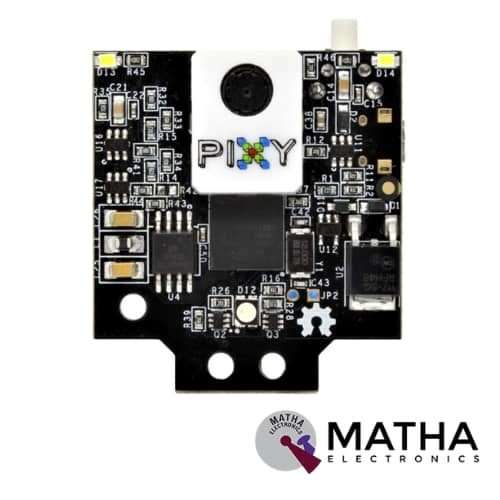
Pixy2 CMUcam5 Smart Vision Sensor - Object Tracking Camera for Arduino, Raspberry Pi, BeagleBone Black
Original price was: ₹7,500.00.₹7,200.00Current price is: ₹7,200.00. inc. GST
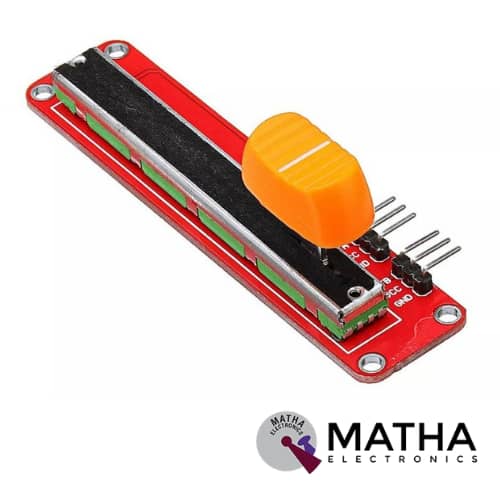
Double Analog Potentiometer Module With Slide Potentiometer Slip Adjustable Resistance For Arduino
Original price was: ₹300.00.₹250.00Current price is: ₹250.00. inc. GST
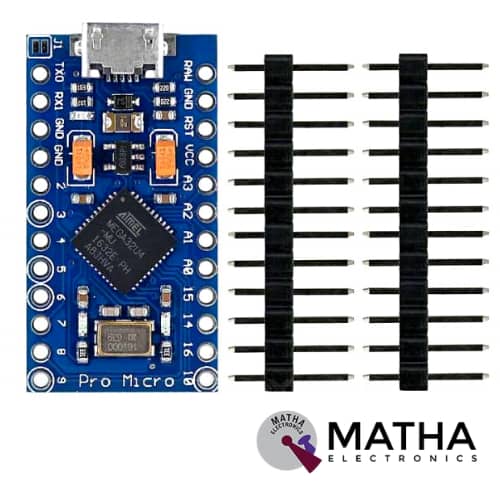
Pro Micro 5V 16M Mini Microcontroller Development Board For Arduino
Original price was: ₹850.00.₹800.00Current price is: ₹800.00. inc. GST
- ATMEGA32U4 chip
- Supply Voltage: 5VDC
- Frequency: 16Mhz
- Support Arduino IDE V1.0.1
- Four 10 bit ADC pins
- 12 pins Digital I/O(5 PWM capability)
- Micro USB interface programming on the board
- Rx and Tx hardware serial connection
- Dimension: 33mm x 18mm
Description
This Pro Micro 5V 16M Mini Leonardo Microcontroller Development Board For Arduino is designed based on integrated microcontroller ATMEGA32U4. It operates at a voltage of 5V and 16MHz frequency. This Arduino development board consists of 4 channel 10 bit ADC, 5 PWM pins, 12 DIO, and a hardware serial connection Transmitter and Receiver. The running features of this development board will remind you of a lot of other Arduino compatible boards that you like.
Moreover, there is a voltage regulator that is capable of accepting the voltage up to 12 VDC. And an extra pin on the board named the “RAW” used in place of VCC. In case if your power supply is not stable or unstable, connect to the “RAW”, not on the VCC pin. There also exists a PTC fuse and diode protection to the power circuit and to correct the RX and LED TX circuits.
The Micro is a microcontroller board based on the ATmega32U4 with 20 digital input/output pins. In which 7 are used as PWM outputs and 12 as analogue inputs. It operates at a frequency of 16 MHz crystal oscillator, micro USB connection, an ICSP header, and a reset button. This module consists of everything required to support the microcontroller. By simply connecting it to a computer with a micro USB cable, the board starts functioning. It has a form factor that enables it to be easily placed on a breadboard. This Micro board is similar to the Arduino Leonardo in that the ATmega32U4 has built-in USB communication. Thereby eliminating the need for a secondary processor. This allows the Micro to appear to a connected computer as a mouse and keyboard, in addition to a virtual (CDC) serial / COM port.
Reviews (0)
Shipping & Delivery

Related products

4*4 MATRIX KEYPAD
The maximum voltage across each button: 24v
- The maximum current across each button: 3mA
- Easy communication with any microcontroller
- Ultra-thin design
- Adhesive backing provides easy integration
- High price-performance ratio
- Allows microcontroller to scan 8 output pins to check which 16 button
- Long life
- Maximum operating temperature: 0 degrees to 50 degrees Celsius
- Dimension: 70*77*1mm
- Weight: 7.5gm
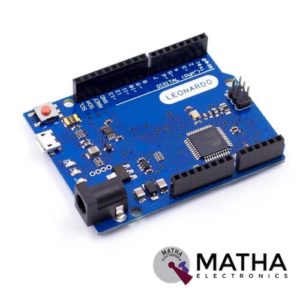

Arduino Leonardo R3
- Board Mode: LEONARDO R3
- Microcontroller: ATmega32u4
- Operating Voltage: 5V
- Input Voltage (Recommended): 7-12V
- Input Voltage (limits): 6-20V
- Digital I/O Pins: 20
- PWM Channels: 7
- Analog Input Channels: 12
- DC Current per I/O Pin: 40 mA
- DC Current for 3.3V Pin: 50 mA
- Flash Memory: 32 KB
- SRAM: 2.5 KB (ATmega32u4)
- EEPROM: 1 KB (ATmega32u4)
- Clock Speed: 16 MHz
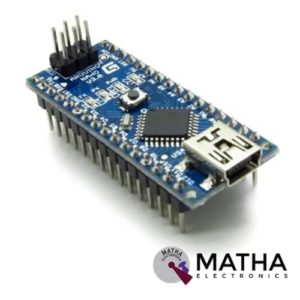

Arduino Nano V3.0
- Microcontroller: Atmel ATmega328 SMD Package
- Operating Voltage (logic level): 5 V
- Input Voltage (recommended): 7-12 V
- Input Voltage (limits): 6-20 V
- Digital I/O Pins: 14 (of which 6 provide PWM output)
- Analog Input Pins: 8
- DC Current per I/O Pin: 40 mA
- Flash Memory: 32 KB (of which 2KB used by bootloader)
- SRAM: 2 KB
- EEPROM: 1 KB
- Clock Speed: 16 MHz
- Automatic reset during program download
- Power OK blue LED
- Green (TX), red (RX) and orange (L) LED
- Auto-sensing/switching power input
- Small mini-B USB for programming and serial monitor
- ICSP header for direct program download
- Standard 0.1” spacing DIP (breadboard friendly)
- Manual reset switch
- Dimensions: 0.70” x 1.70”

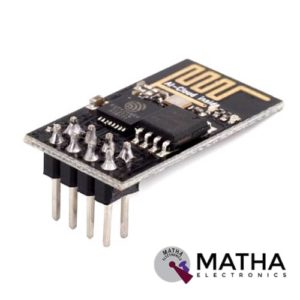
ESP8266 ESP – 01
- 11 b/g/n
- Wi-Fi Direct (P2P), soft-AP
- Integrated TCP/IP protocol stack
- Integrated TR switch, balun, LNA, power amplifier and matching network
- Integrated PLLs, regulators, DCXO and power management units
- +19.5dBm output power in 802.11b mode
- Power down leakage current of <10uA
- 1MB Flash Memory
- Dimensions: 25 x 15 x 11 mm (LxWxH)
- PCB Thickness: 1mm
- Weight: 2 gm
- SDIO 1.1 / 2.0, SPI, UART
- STBC, 1×1 MIMO, 2×1 MIMO
- A-MPDU & A-MSDU aggregation & 0.4ms guard interval
- Wake up and transmit packets in < 2ms
- Standby power consumption of < 1.0mW (DTIM3)
- Integrated low power 32-bit CPU could be used as an application processor
- A-MPDU & A-MSDU aggregation & 0.4ms guard interval
- Wake up and transmit packets in < 2ms
- Standby power consumption of < 1.0mW (DTIM3)


ESP8266 WIFI Shield
- Operating voltage 5V (supplied from the Arduino Board)
- Connection via: 802.11b/g networks
- Encryption types: WEP and WPA2 Personal
- Connection with Arduino on SPI port
- on-board micro SD slot
- ICSP headers
- FTDI connection for serial debugging of WiFi shield
- Mini-USB for updating WiFi shield firmware
- 32-bit RISC architecture
- The processor can operate at 80MHz / 160MHz
- 32MB flash memory
- 64kB for instructions
- 96kB for data
- Operates in AP, Station or AP + Station mode
- It has 11 digital pins
- It has 1 analogue pin with 10-bit resolution
- Digital pins except the D0 have interrupts, PWM, I2C and one wire
- Programmable through USB or WiFi (OTA)
- Compatible with Arduino IDE
- Compatible with modules and sensors used in Arduino

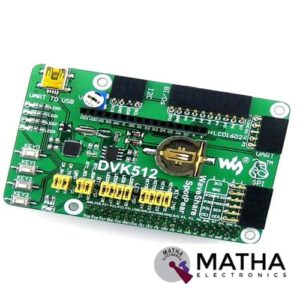
Evaluation Board For Pi
- Designed for Raspberry Pi
- UART interface: easily connects to UART modules such as RS232, RS485, USB TO UART, etc.
- 8 I/Os interface: easily connects to modules controlled by I/Os, such as 8 Push Buttons, Logic Level Converter, Mix Board, etc.
- SPI interface: easily connects to SPI modules such as AT45DBXX Data flash, L3G4200D Board, etc.
- I2C interface: easily connects to I2C modules such as PCF8574 Expansion Board, PCF8563 RTC Board, LSM303DLHC Board, etc.
- Character LCD interface: for connecting character LCDs like LCD1602
- USB connector: USB TO UART, supported by onboard converter CP2102
- Power indicator, User LEDs, User Keys
- Potentiometer: for LCD1602 contrast adjustment
- PCF8563 onboard RTC chip with battery holder and crystal


NODMCU Esp8266-12 USB CP2102
- 11 b/g/n Wi-Fi Direct (P2P), soft-AP
- Integrated TCP/IP protocol stack
- CP2102 Serial / USB Chip
- +19.5dBm output power in 802.11b mode
- 4MB Flash Memory
- Integrated low power 32-bit CPU
- SDIO 1.1 / 2.0, SPI, UART
- Dimensions – 49 x 24.5 x 13mm
- Integrated TR switch, balun, LNA, power amplifier and matching network
- Integrated PLLs, regulators, DCXO and power management units
- On board USB to serial chip to easily program and upload codes from the Arduino IDE
- Embeds logic level converter circuits
- Has on board 3.3V regulator to ensure enough power to function as your go-to WiFi chip!
- Easy access to the GPIO pins for easy prototyping
- ESP-12E Processor
- Easy to use breadboard friendly form factor
- Voltage Regulator / Converter, excellent DC to DC conversion, super efficientESP-12E Processor
- Easy to use breadboard friendly form factor

NUCLEO-64 STM32G071RBT6 Development Board Arduino & ST Morpho Connectivity
- STM32 microcontroller in LQFP64 package
- 1 user LED shared with ARDUINO®
- 1 user and 1 reset push-buttons
- 768 kHz crystal oscillator
- Board connectors: ARDUINO Uno V3 expansion connectors morpho extension pin headers for full access to all STM32 I/Os
- Flexible power-supply options: ST-LINK, USB VBUS, or external sources
- On-board ST-LINK debugger/programmer with USB re-enumeration capability: mass storage, Virtual COM port and debug port
- Comprehensive free software libraries and examples available with the STM32Cube MCU Package
- Support of a wide choice of Integrated Development Environments (IDEs) including IAR Embedded Workbench®, MDK-ARM, and STM32CubeIDE
- Board-specific features
- External SMPS to generate Vcore logic supply
- 24 MHz HSE
- Board connectors: External SMPS experimentation dedicated connector Micro-AB or Mini-AB USB connector for the ST-LINKMIPI® debug connector
- Arm® Mbed Enabled™ compliant
Reviews
There are no reviews yet.