
I am text block. Click edit button to change this text. Lorem ipsum dolor sit amet, consectetur adipiscing elit. Ut elit tellus, luctus nec ullamcorper mattis, pulvinar dapibus leo.
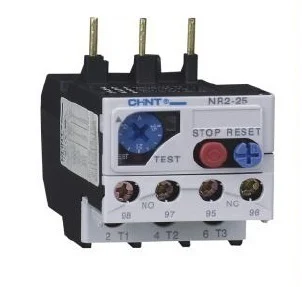
Thermal Overload Relay
Technical Specifications (Generic)
-
Type: Thermal overload relay
-
Rated Operational Voltage: Typically 220–690V AC
-
Current Adjustment Range: Depends on model (e.g., 0.1A–32A / 28A–40A / 48A–65A etc.)
-
Trip Class: Class 10/20/30
-
Reset Mode: Auto/Manual
-
Mounting Type: Contactor-mount or standalone
-
Protection: Overload, phase loss
-
Operating Temperature: –5°C to +55°C (varies by model)
-
Standards: IEC/EN compliant
Applications
-
Industrial automation
-
Motor starters
-
Pumps and compressors
-
HVAC systems
-
Conveyor systems
-
Machine tools
-
Electrical panels
Description
A Thermal Overload Relay is a protective device used in motor control systems to safeguard electric motors from overheating and damage caused by overload conditions. It automatically disconnects the motor circuit when excessive current flows for too long, ensuring safe operation and extending motor life.
Key Features
-
Reliable Motor Protection: Detects overloads and prevents motor damage by tripping the circuit at unsafe current levels.
-
Bimetallic Technology: Uses precision-engineered bimetal strips for accurate thermal sensing and stable performance.
-
Adjustable Current Range: Allows fine-tuning based on the motor’s rated current.
-
Auto/Manual Reset Options: Choose between manual or automatic reset modes for convenient operation.
-
Trip Class Options: Available in Class 10, 20, and 30 depending on application needs.
-
Phase Failure Protection: Ensures safe shutdown during phase loss.
-
Compact Design: Easily mounts with contactors for space-saving installation.
-
Indicator Display: Provides clear trip status for quick troubleshooting.
Reviews (0)
Shipping & Delivery

Related products

58mm Thermal Printer (Black)
- Heavy-duty 58mm direct thermal printer
- Inbuilt Adapter
- High speed printing of 90mm / Sec
- Free Drivers, USB, Adapter and Paper Roll
- Interface: usb + cash drawer support.
- Works with windows 7 / 8 /10
- High speed printing
- Long life thermal head.
- Perfect print quality
- Low cost,Low noise, fast speed print.
- Support cashbox drive.
- Compact and lightweight,beautiful design.
- Built in data bumper (data received when printing).
- Interface type parallel port or serial port.
- Support to enlarge characters and adjust characters spacing for printing.
- Compatible with esc/order pos.
- Operation temperature0~50 Degree C
- Relative humidity10~80%
- Item size 12.8 * 18 * 10.8cm

ESP8266 WIFI Industrial stable version A full test board cloud function test Black board T5
- Support 802.11b / n / g wireless standard
- Independent development MCU platform
- High cost performance
- Support UART / GPIO data communication interface
- Support STA / AP / STA + AP coexistence mode of operation
- Support SmartLink intelligent networking (APP)
- Support wireless upgrade firmware
- Support WPS network configuration
- Built-in onboard antenna &Temperature and humidity sensor
- RGB three-color light adjustable
- Provide rich AT command set configuration
- Free AiCloud cloud service for debugging
- 3 AA batteries / 5V adapter power supply
- Size: 61.6mm x 56.2mm;


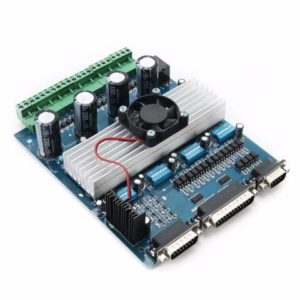
TB6560 4 Axis Cnc Controller 4 Axis Stepper Motor Driver DSP Controlled 3.5A 24V
- Rated maximum output: ± 4.5A, 40V, Peak 5A, low output impedance, source 0.5?,
- the receiving end of 0.4?, low voltage shutdown, thermal parking and circulation.
- circuit protection. After I design, you can set the current output of 0.5A 1A 1.8A 2.5A.
- 3.3A 4A 4.5A to accommodate more and different motor Current.
- The drive is suitable software mach2, mach3, (mach3 have support WIN7 system), KCAM4 like.
Reviews
There are no reviews yet.