
I am text block. Click edit button to change this text. Lorem ipsum dolor sit amet, consectetur adipiscing elit. Ut elit tellus, luctus nec ullamcorper mattis, pulvinar dapibus leo.
-20%Sold out


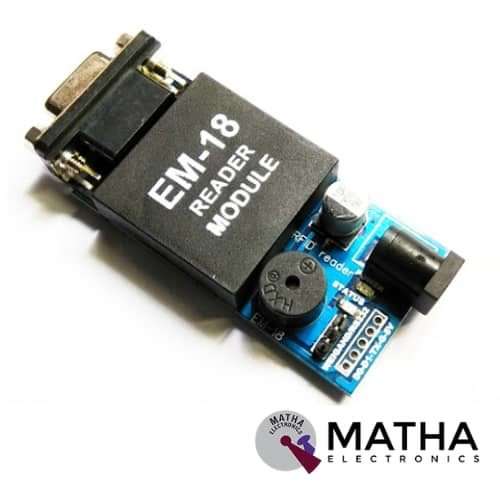
RFID EM18 125KHz RS232 Output
Original price was: ₹600.00.₹500.00Current price is: ₹500.00. inc. GST
ESP8266 ESP-12F
Original price was: ₹250.00.₹200.00Current price is: ₹200.00. inc. GST
- Communication interface voltage: 3.3V
- Working current: 240mA(MAX)
- Serial port baud rate: 115200 (default), can be modified to other values by AT command
- Serial communication format: 8N1
- Wireless Network Mode: station / softAP / SoftAP + station
- Wireless criteria: 802.11 b / g / n
- WIFI @ 2.4 GHz, support for WPA / WPA2 security mode
- +19.5dBm output power
- Compatible with ESP-12(ESP-202)
- It is very easy to develop projects with AT commands
- Surface Mount Package with 2mm Pitch Pads
- Mulitple GPIO’s for all your sensor needs
- Integrated TCP/IP protocol stac
- Integrated TR switch, balun, LNA, power amplifier and matching network
- Integrated PLL, regulators, DCXO and power management unit
- Power down leakage current of <10uA
- Integrated low power 32-bit CPU could be used as an application processor
- SDIO 1.1/2.0, SPI, UART
- STBC, 1×1 MIMO, 2×1 MIMO
- A-MPDU & A-MSDU aggregation & 0.4ms guard interval
- Wake up and transmit packets in < 2ms
- Standby power consumption of < 1.0mW (DTIM3)
- Both SMD and Inline package are available, and the pin pitch is 2.0mm.
Out of stock
Description
The Latest ESP-12F ESP8266 Wifi Module AP & Station Remote Serial Wireless IoT Board was designed based on an integrated chip specifically to fulfil the needs of a new connected world. It can handle all the necessary overhead for communicating with your network, such as TCP/IP stack and communicating with your 802.11 networks.
ESP8266 was designed as a Serial Wifi Wireless Transceiver Module with self-contained SOC and integrated TCP/IP protocol stack. It gives access to any microcontroller to your WiFi network. This Module is capable of either hosting an application or offloading all Wi-Fi networking functions from another application processor. This wireless module is completely addressable over SPI and UART protocols. As a result grants permission to connect your sensors or project directly to it through its GPIO’s.
Each ESP8266 ESP-12Fmodule is designed with pre-programmed AT command set firmware. This means that your Arduino device can be simply hooked up and get about as much WiFi-ability as a WiFi Shield offers. The ESP8266 is an extremely cost-effective board with a huge, and ever-growing, community with full TCP/IP stack and MCU capability.
ESP8266 ESP-12F features onboard processing and storage capability that allows it to integrate with the sensors and other application-specific devices through its GPIOs. This is achieved with minimal development up-front and minimal loading during runtime. This module with a high degree of on-chip integration minimizes the need for external circuitry, including the front-end module. Thus achieves minimal PCB area. The ESP8266 also supports APSD for VoIP applications and Bluetooth co-existence interfaces. Using a self-calibrated RF allows it to work under all operating conditions and requires no external RF parts.
Reviews (0)
Shipping & Delivery

Related products


ESP32MOD ESP-WROOM-32 Universal Wi-Fi-BT-BLE MCU Module
- Wi-Fi Protocols: 802.11 b/g/n
- Wi-Fi+BT+BLE MCU Module
- Bluetooth v4.2 BR/EDR and BLE specification
- Wi-Fi mode Station/softAP/SoftAP+station/P2P
- Security WPA/WPA2/WPA2-Enterprise/WPS
- Encryption AES/RSA/ECC/SHA
- Operating voltage: 2.2-3.6V
- Consumption: 80 mA Typ
- On-Chip Hall Sensor
- Integrated Crystal of 40 MHz
- Integrated SPI Flash of 4 MB
- Recommended Voltage: 3.3V
- Operating Current: Average 80 mA
- ESP32-WROOM-32 contains two low-power Xtensa 32-bit LX6 microprocessors
- 448 KBytes ROM for booting and core functions
- 520 KBytes on-chip SRAM
- 8 KBytes SRAM in RTC SLOW
- 8 KBytes SRAM in RTC FAST
- Dimensions: 18 mm* 25.5 * 2.8 mm

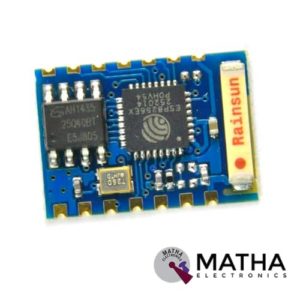
ESP8266 ESP – 03 WIFI Transreceiver Wireless Module
- Communication interface voltage: 3.3V
- Working current: 240mA(MAX)
- 802.11 b/g/n
- Wi-Fi Direct (P2P), soft-AP
- Integrated TCP/IP protocol stack
- Integrated TR switch, balun, LNA, power amplifier and matching network
- Integrated PLLs, regulators, DCXO and power management units
- +19.5dBm output power in 802.11b mode
- Power down leakage current of <10uA
- Integrated low power 32-bit CPU could be used as application processor
- SDIO 1.1/2.0, SPI, UART
- STBC, 1×1 MIMO, 2×1 MIMO
- A-MPDU & A-MSDU aggregation & 0.4ms guard interval
- Wake up and transmit packets in < 2ms
- Standby power consumption of < 1.0mW (DTIM3)
- SDIO 2.0, SPI, UART
- 32-pin QFN package
- Integrated RF switch, balun, 24dBm PA, DCXO, and PMU
- Integrated RISC processor, on-chip memory and external memory interfaces
- Integrated MAC/baseband processors
- Quality of Service management
- I2S interface for high fidelity audio applications
- On-chip low-dropout linear regulators for all internal supplies
- Proprietary spurious-free clock generation architecture
- Integrated WEP, TKIP, AES, and WAPI engines
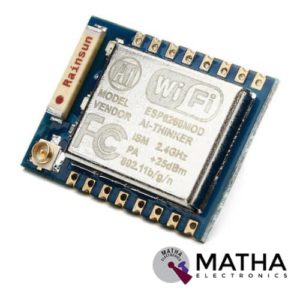
ESP8266 ESP – 07
- Smallest 802.11b/g/n Wi-Fi SOC module
- Low power 32-bit CPU, can also serve as the application processor
- Up to 160MHz clock speed
- Built-in 10 bit high precision ADC
- Supports UART/GPIO/IIC/PWM/ADC
- SMD-16 package for easy welding
- Integrated Wi-Fi MAC/BB/RF/PA/LNA
- Deep sleep current as low as 20uA
- Embedded LWIP protocol stack
- Supports STA/AP/STA + AP operation mode
- Support Smart Config/AirKiss technology
- UART baudrate up to 4Mbps
- General AT commands can be used quickly
- Supports remote firmware upgrade (FOTA)
- WIFI Direct (P2P),SOFT-AP
- Built-in TCP/IP
- The AT command is perfect, efficient, concise
- Support three modes: AP, STA and AP+STA coexistence mode
- Onboard Chip Antenna
- +19.5dBm output power in 802.11b mode
- Power down leakage current of <10uA
- SDIO 1.1/2.0, SPI, UART
- STBC, 1×1 MIMO, 2×1 MIMO
- A-MPDU & A-MSDU aggregation & 0.4ms guard interval
- Wake up and transmit packets in < 2ms
- Standby power consumption of < 1.0mW (DTIM3)


Mini ESP-M2 ESP8285 Serial Wireless WiFi Transmission Module SerialNET MODE Fully Compatible With ESP8266
ESP8285 M2 WiFi IoT Module :
- SOC characteristics.
- Built-in Tensilica L106 ultra-low power 32-bit CPU, main frequency supports 80MHz and160MHz and RTOS.
- Built-in TCP/IP protocol.
- Built-in one-channel 10-bit high precision ADC.
- Outboard interface: HSPI, UART, I2C, I2S, IR Remote Control, PWM, GPIO.
- The deep sleep current is 10uA, the cut-off current is smaller than 5uA.
- Wake, connect and transmit data package within 2ms.
- The consumer power is smaller 1.0Mw (DTIM3) when at standby status.
- Built-in 1M byte for SPI Flash.
- Ultra-small size.
- Support serial to WiFi.
- Wireless transparent transmission.
- Long-distance transmission with ultra-low power.
- Support outboard antenna.
- Bearing high temperature to 125 °C, compared to the 85°C for ESP8266.
- Support 802.11 b/g/n/e/I.
- Support Station, Soft AP, Soft AP+STA mode.
- Support WiFi Direct (P2P).
- Support CCMP (CBC-MAC, computation mode), TKIP (MIC, RC4), WAPI (SMS4), WEP (RC4), CRC etc., for hardware acceleration.
- P2P finding, P2P GO mode/ GC mode and P2P power management.
- WPA/PA2PSK and WPS.
- 11securitycertification: pre-certification and TSN.
- Support 802.11n (2.4GHz).
- 1h/RFC1042 frame encapsulation.
- Support seamless roaming.
- Support AT remote update and cloud update (OTA).
- Support Smart Config function (including Android and Ios device


NODEMCU ESP8266-12 USB CH340
- 11 b/g/n Wi-Fi Direct (P2P), soft-AP
- Power input: 4.5V to 9V (10VMAX), USB-powered
- Transfer rate: 110-460800bps
- Support UART / GPIO data communication interface
- Support Smart Link Smart Networking
- Working temperature: -40°C ~ + 125°C
- Drive Type: Dual high-power H-bridge
- Don’t need to download resetting
- A great set of tools to develop ESP8266
- Flash size: 4MByte
- Integrated TCP/IP protocol stack
- Use CH340G to replace the CP2102.
- Integrated low power 32-bit CPU
- Advanced API for hardware IO, which can dramatically reduce the redundant work for configuring and manipulating hardware.
- Integrated TR switch, balun, LNA, power amplifier, and matching network
- Integrated PLL, regulators, DCXO, and power management units
- On-board USB to serial chip to easily program and upload codes from the Arduino IDE
- Embeds logic level converter circuits
- Has onboard 3.3V regulator to ensure enough power to function as your go-to WiFi chip!
- Easy access to the GPIO pins for easy prototyping


NODMCU Esp8266-12 USB CP2102
- 11 b/g/n Wi-Fi Direct (P2P), soft-AP
- Integrated TCP/IP protocol stack
- CP2102 Serial / USB Chip
- +19.5dBm output power in 802.11b mode
- 4MB Flash Memory
- Integrated low power 32-bit CPU
- SDIO 1.1 / 2.0, SPI, UART
- Dimensions – 49 x 24.5 x 13mm
- Integrated TR switch, balun, LNA, power amplifier and matching network
- Integrated PLLs, regulators, DCXO and power management units
- On board USB to serial chip to easily program and upload codes from the Arduino IDE
- Embeds logic level converter circuits
- Has on board 3.3V regulator to ensure enough power to function as your go-to WiFi chip!
- Easy access to the GPIO pins for easy prototyping
- ESP-12E Processor
- Easy to use breadboard friendly form factor
- Voltage Regulator / Converter, excellent DC to DC conversion, super efficientESP-12E Processor
- Easy to use breadboard friendly form factor
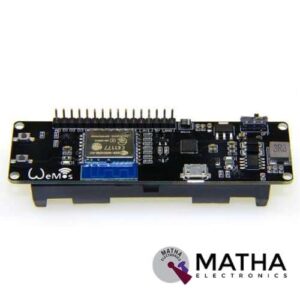
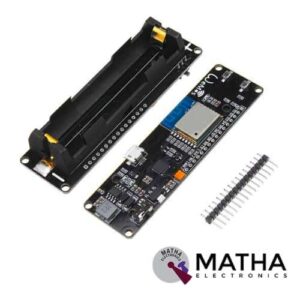
WeMos D1 ESP Wroom 02 Board ESP8266 Mini WiFi Nodemcu Module 18650 Battery
- One AD inputs.
- Micro USB inputs.
- One programmable LED (D0).
- AUTO PROGRAM circuit.
- ESP8266 (ESP-WROOM-02 With TELEC) is equivalent to the NodeMCU.
- Analog Input (AD): Built-in dividing resistor (AD = 220K ADC 100K = GND).
- There is a SOLDER terminal for SLEEP MODE.
- Compatible With Arduino andNodeMCU.
- Operation and charging are possible at the same time.
- 18650 charging circuit including the 5V boosting circuit with TP5410.
- Overcharge protection, over-discharge protection built-in.
- LED: Red = Charging, Green = Full charging.
- 3000 mA 18650 It is possible to operate for more than 17 hours on a battery.
- Integrated 18650 battery charging and discharging system.
- One switch controls whether the 18650 battery is on power or not.
- OLEDs SDA and SCL can connect to the D1 pin and the D2 pin respectively.
- The five buttons can be controlled by FLATH, RSET, D5, D6, and D7 respectively.
- The 5 Digital pins can configure the write/read/interrupt/PWM/I2C/one-wire supported separately.
- Operation and NodeMCU consistent, adding a programmable LED, you can use GPIO16 to control; display 8266 running status and other functions. Integrated OLED and five buttons, more convenient for development.
- The design concept originates from the open-source project NodeMCU; the development board integrates 18650 charging and discharging systems with charging and discharging protection. At the same time, an OLED and five directional buttons are integrated to facilitate the development.
Reviews
There are no reviews yet.