
I am text block. Click edit button to change this text. Lorem ipsum dolor sit amet, consectetur adipiscing elit. Ut elit tellus, luctus nec ullamcorper mattis, pulvinar dapibus leo.
-3%


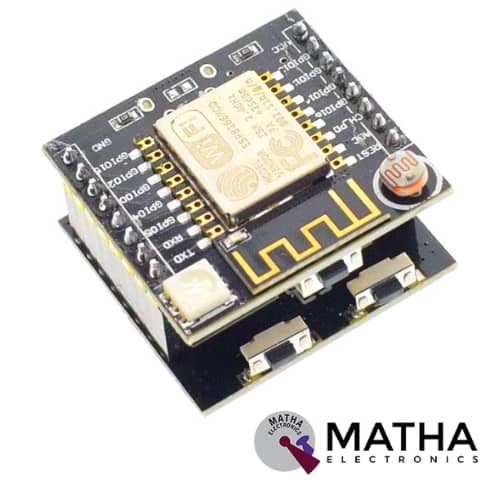
ESP8266 Serial WIFI Witty Cloud Development Board ESP-12F Module MINI Nodemcu
Original price was: ₹925.00.₹900.00Current price is: ₹900.00. inc. GST
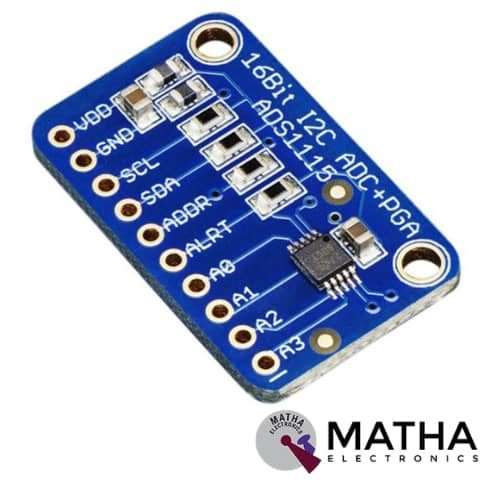
ADS1115
Original price was: ₹465.00.₹450.00Current price is: ₹450.00. inc. GST
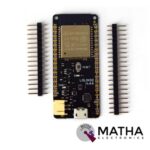
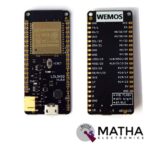
LOLIN32 V1.0.0 ESP32 Rev1 Wifi Bluetooth Board
Original price was: ₹1,345.00.₹1,300.00Current price is: ₹1,300.00. inc. GST
- Microcontroller: ESP-32
- Operating Voltage: 3.3V
- Digital I/O Pins: 26
- Analog Input Pins: 12
- Clock Speed(Max): 240MHz
- Flash: 4MB
- Lastest ESP32 Version: REV1
- Max serial baud rate: 256000bps
- WIFI
- Bluetooth
- 4MB Flash
- Lithium battery interface, 500mA Max charging current.
Description
This is WeMos LOLIN32 V1.0.0 based on the ESP32 Rev1 Wifi Bluetooth Board. This is a perfectly designed board that takes more than a little inspiration from Adafruit’s Feather series.
It comes with an onboard 4 MB flash memory, a USB serial adapter (cp210x), and a LiPo battery charger and connector. All the relevant pins on the board are broken out and well-labelled, especially on the bottom. Meanwhile, it consists of a central reset button, and even a single user LED for your blinking pleasure. Moreover, this development board fits perfectly into a standard breadboard. Can’t beat that with a stick.
ESP32 is designed as a series of low-cost, low-power systems on a chip microcontroller with integrated Wi-Fi and dual-mode Bluetooth. This highly-integrated module with in-built antenna switches, RF balun, power amplifier, low-noise receive amplifier, filters, and power management modules. Moreover, it provides priceless functionality and versatility to various applications with minimal Printed Circuit Board (PCB) requirements. ESP32 is capable of functioning as a complete standalone system or as a slave device to a host MCU. Thus reducing communication stack overhead on the main application processor. ESP32 can interface with other systems to provide Wi-Fi and Bluetooth functionality through its SPI / SDIO or I2C / UART interfaces.
Reviews (0)
Shipping & Delivery

Related products


ESP8266 ESP-12E
- LDR Light Sensor on board.
- WS2812 Led on board.
- Wireless Standard: IEEE 802.11 b/g/n protocol
- Frequency Range: 2.412 - 2.484 GHz
- Serial Transmission: 110 - 921600 bps, TCP Client 5
- SDIO 2.0, SPI and UART Interface available
- PWM available
- One ADC channel is available
- Programmable GPIO available
- Wireless Network Type: STA / AP / STA + AP
- Security Type: WEP / WPA-PSK / WPA2-PSK
- Encryption Type: WEP64 / WEP128 / TKIP / AES
- Network Protocol: IPv4, TCP / UDP / FTP / HTTP
- Operating Voltage: 3.3V
- Maximum current allowed to draw per pin: 15mA
- Power down leakage current of < 10uA
- Integrated low power 32-bit MCU
- Onboard PCB Antenna
- Wake up and transmit packets in < 2ms
- Standby power consumption of < 1.0mW
- Operating Temperature: -40ºC to +125 ºC

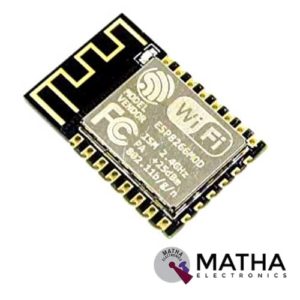
ESP8266 ESP-12F
- Communication interface voltage: 3.3V
- Working current: 240mA(MAX)
- Serial port baud rate: 115200 (default), can be modified to other values by AT command
- Serial communication format: 8N1
- Wireless Network Mode: station / softAP / SoftAP + station
- Wireless criteria: 802.11 b / g / n
- WIFI @ 2.4 GHz, support for WPA / WPA2 security mode
- +19.5dBm output power
- Compatible with ESP-12(ESP-202)
- It is very easy to develop projects with AT commands
- Surface Mount Package with 2mm Pitch Pads
- Mulitple GPIO’s for all your sensor needs
- Integrated TCP/IP protocol stac
- Integrated TR switch, balun, LNA, power amplifier and matching network
- Integrated PLL, regulators, DCXO and power management unit
- Power down leakage current of <10uA
- Integrated low power 32-bit CPU could be used as an application processor
- SDIO 1.1/2.0, SPI, UART
- STBC, 1×1 MIMO, 2×1 MIMO
- A-MPDU & A-MSDU aggregation & 0.4ms guard interval
- Wake up and transmit packets in < 2ms
- Standby power consumption of < 1.0mW (DTIM3)
- Both SMD and Inline package are available, and the pin pitch is 2.0mm.

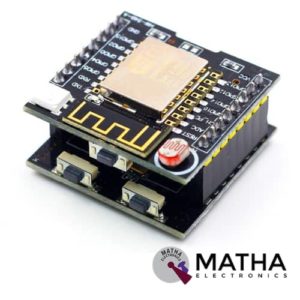
ESP8266 Serial WIFI Witty Cloud Development Board ESP-12F Module MINI Nodemcu
- LDR Light Sensor on board
- WS2812 Led on board
- 3x tactile buttons (1x in the Witty board and 2x in theCH340 board)
- Micro USB connection for power and/or programming
- Uses latest ESP-12F module with 4M flash and integrated antenna
- Includes CH340G USB-to-UART programmer
- Includes LDR (light dependent resistor a.k.a photoresistor) connected to ESP’s ADC pin
- RGB LED connected to GPIO 12,13 and 15
- It supports 3 modes AP, STA, AP+STA


ESP8266 WIFI Shield
- Operating voltage 5V (supplied from the Arduino Board)
- Connection via: 802.11b/g networks
- Encryption types: WEP and WPA2 Personal
- Connection with Arduino on SPI port
- on-board micro SD slot
- ICSP headers
- FTDI connection for serial debugging of WiFi shield
- Mini-USB for updating WiFi shield firmware
- 32-bit RISC architecture
- The processor can operate at 80MHz / 160MHz
- 32MB flash memory
- 64kB for instructions
- 96kB for data
- Operates in AP, Station or AP + Station mode
- It has 11 digital pins
- It has 1 analogue pin with 10-bit resolution
- Digital pins except the D0 have interrupts, PWM, I2C and one wire
- Programmable through USB or WiFi (OTA)
- Compatible with Arduino IDE
- Compatible with modules and sensors used in Arduino
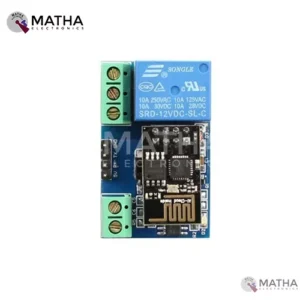
ESP8266- 01 5V WIFI RELAY MODULE TOI APP CONTROLLED FOR SMART HOME AUTOMATION
- Onboad module: ESP2866 WIFI module
- Onboard relay: 5v.10a/250v ac, 10a/30v dc
- Can connect 5 clients at the same time on AP mode
- The module has two work modes: Cell phone, carry on Wi-Fi module and Cell phone and Wi-Fi module carry on the same router
- Used in mobile phone, Wi-Fi module equipped with one router and control relay by APP
- Maximum transmission distance of 400 m when cell phone carry on wifi module directly, in the open environment
- Transmission distance depends on routers signal intensity when wifi and cell phone is carrying on the same router
- IN+, IN_: 5V power input
- TX, RX, and GND: serial port debug pins
- Baud rate: 115200
- Provide diode effusion protection
- Short response time
- Dimension: 45*28mm
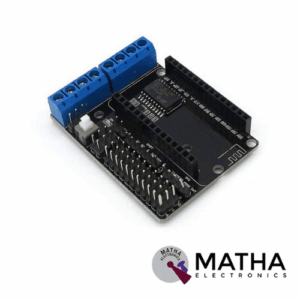
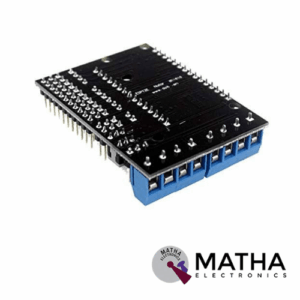
L293D Motor Driver Board for ESP8266 WiFi NodeMcu Lua ESP12E
- Motor power supply Range: 4.5V ~ 36V
- Control power Range: 4.5V ~ 9V (10VMAX)
- Logic Operating current: ≤60mA
- Drive part of the work current Io: ≤1.2A
- Maximum power dissipation: 4W
- Drive Type: Dual high-power H-bridge driver
- Working temperature: -25 ℃ ~ + 125 ℃
- ESP12 DEV KIT development board expansion module
- Lead ESP12 DEV KIT all the features of pins: SPI, UART, GPIO, AI, and 3.3V power connector
- Extend two-way motor-driven, two-way direct-drive motor
- on board power switch
- Motor power, control power separation
- Dimension: 60 x 45 x 13mm


Wemos D1 WiFi Esp8266 Development Board Uno Compatible Program
- Microcontroller: ESP-8266EX
- Operating Voltage: 3.3 V
- Digital I/O Pins: 11
- Analog Input Pins 1(Max input: 3.2V)
- Clock Speed: 80MHz/160MHz
- Flash: 4M bytes
- Good stability.
- 11 digital input/output pins, all pins have interrupt/PWM/I2C/one-wire supported(except for D0)
- 1 analog input(3.2V max input)
- Micro USB connection
- Compatible with Arduino
- Support OTA wireless uploading
- On-Board Switching Power Supply:
- Micro USB connection
- Compatible with Arduino
- Support OTA wireless uploading


XBee Module S2C XB24CZ7WIT-004
- Protocol: ZigBee®
- Transceiver chipset: Silicon Labs EM357 SoC
- RF Standard: 802.15.4
- Frequency (ISM Band): 2.4GHz
- Digital I/O: 15
- ADC Channels: (4) 10-bit ADC inputs
- Data Rate: RF 250 Kbps, Serial up to 1 Mbps
- Range: Indoor 200 ft (60 m), Outdoor (LOS) 4000 ft (1200 m)
- Transmit Power: 3.1 mW (+5 dBm)
- Channels: 16 channels
- Encryption: 128-bit AES
- Voltage requirements: 2.1 to 3.6 VDC
- Current requirements: ~33 mA @ 3.3VDC (transmit), ~28 mA @ 3.3VDC (receive), <1 uA @25ºC (sleep)
- Migratable to Digi Mesh and ZigBee PRO protocols
- Configuration Method: API or AT commands, local or over-the-air (OTA)
- Communication: CMOS UART / SPI
- Dimensions: 27.61 x 24.38 x 4.06 mm
- Operating temperature range: -40 to +85 °C
- Integrated, Wire Antenna
- Interoperable with other ZigBee-compliant devices
- Programmable versions with on-board microprocessor enable custom ZigBee application development
- Supports binding and multicasting for easy integration into a home automation platform
- Through-hole form factor enables flexible design
Reviews
There are no reviews yet.