
I am text block. Click edit button to change this text. Lorem ipsum dolor sit amet, consectetur adipiscing elit. Ut elit tellus, luctus nec ullamcorper mattis, pulvinar dapibus leo.
-13%

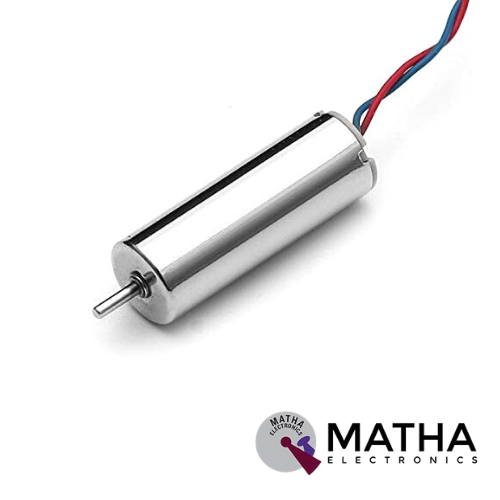
DC 3.7V Coreless Motor + Propeller 7x20
Original price was: ₹200.00.₹150.00Current price is: ₹150.00. inc. GST
Micro DC 3-6V Submersible Pump Mini water pump
Original price was: ₹180.00.₹150.00Current price is: ₹150.00. inc. GST
Vibrator Motor Button Type
Original price was: ₹80.00.₹70.00Current price is: ₹70.00. inc. GST
- Rated voltage: 3.0VDC
- Maximum Working Voltage Limits: 2.5-4.0VDC
- Rated load: eccentric hammer
- Rated speed: 12000+/-2500RPM
- Rated current: 70mA Max
- Stall current: 120mA Max
- Insulation resistance: 10M ohms Min
- Terminal resistance: 30 ohms
- Small size makes it easy to mount in or on your project
- Low noise level enables feedback without unwanted distractions
- Rotates both CW and CCW for ease of use and installation
Description
Vibrator Motor Button Type designed as a tiny motor with offset weights that make them vibrate. This motor is basically used to generate vibratory alerts. This Flat Button Type Cell Phone Vibration Motor is a shaft-less vibration motor. It is fully-enclosed with no exposed moving parts. It comes in a small size of 10 mm diameter and 3.4 mm height. Here shaftless design indicates that it can mount it on a PCB or even place it in a pocket to add quiet, easily.
These 3V-4.5V Micro Vibrators perfect for lightweight applications or where space is a constraint. This is a tiny motor consists of double-sided tape on the bottom side used to attach this motor to any flat surface. When power supplied, the vibration motor causes the attached surface to vibrate. This motor operates with an input voltage as low as 2.5V and at higher voltages, it vibrates like crazy. The support leads coming out from the motor body used to solder the motor to a PCB quite easily. Here the motor has a 3M adhesive backing on it for easy mounting and 1.5″ leads for making quick connections. In this motor, Polarity is not important; the motor can run CW or CCW. Moreover, this button-type vibrating motor shakes with a vibration amplitude of 0.75g and draws approximately 60 mA when 3 V applied to its leads.
Reviews (0)
Shipping & Delivery

Related products
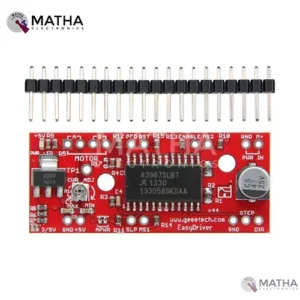
A3967 STEPPER MOTOR DRIVER
- A3967 precision micro-stepping driver
- Power supply: 7v to 30v
- Logic voltage: 5v to 3.3v
- Higher the voltage higher the torque at high speed
- Adjustable current control from 150Ma/ phase to 750ma phase
- Automatic current decay mode detection/selection
- Fast, slow, and mixed current decay modes
- Internal UVLO and thermal shutdown circuitry
- Crossover current protection
- Micro stepping resolution to full, half, quarter, and eighth steps by broken out MS1 and MS2 pins.
- Compatible with Arduino, GRBL G-Code interpreter for driving3-axis CNC machines
- Salington sink drivers used
- Compactible with 4, 6,8 wire stepper motor of any voltage

Bullet Connector 3.5MM
- Diameter: 3.5mm
- Length:1.5CM & 1.5CM
- Amperage Rating: 60A -180Amps
- Hook up RC Battery to Electronic
- Hook up Brushless motor to electronic speed control
- These have low resistance and gives the best electric flow
- 5mm gold connectors Male
- 5mm gold connectors Female
- Dimension: 2.7*2.1*3inch
- Weight: 67gm
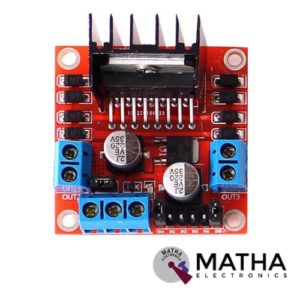

L298N MOTOR DRIVER
- Driver model: L298N 2A
- Driver chip: Double H bridge L298N
- Motor supply voltage: 46V(maximum)
- Motor supply current: 2A(maximum)
- Logic voltage: 5v
- Driver voltage: 5V-35V
- Driver current: 2A
- Logical current: 0-36mA
- Maximum power: 25W
- Current sensor for each motor
- LED indication for power status
- Heat sink for better performance
- Operating temperature: -25 degrees to 135 degrees Celsius
- Can be interfaced with simple manual switches, TTL logic gates, relays, etc.
- Dimension: 55*60*30mm
- Weight: 33gm
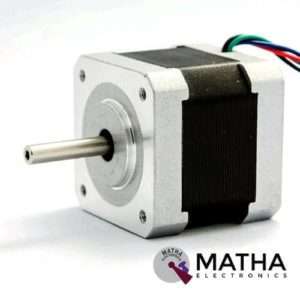

NEMA 17 1.6 kgcm
- Operating Voltage : 12~16 V
- Step Angle : 1.8°
- Holding Torque : 1.6 KgCm
- Operating Voltage : 12 - 16 volts
- Supply Current (A) :0.31 Ampere
- Number of Leads : 6
- Frame Size (mm) : 42 x 42
- Shaft Diameter (mm) : 5
- Shaft Length (mm) : 20
- Input pulse decides the rotation angle of the motor.
- High accuracy of around 3 to 5% a step.
- Provides good starting, stopping and reversing.
- Control of this motor is less costly because of the exclusion of complex control circuitry.
- The speed is proportional to the frequency of the input pulses.

NEMA 23 10.1 kg-cm
- Operating Voltage : 2.3 Volts
- Step Angle : 1.8°
- Holding Torque : 10.1 kg-cm
- Supply Current (A) : 2.8 Ampere/Phase
- Number of Leads : 4
- Inductance : 2.2 mH/Phase
- Resistance : 0.83 Ohm
- Rotor Inertia : 275 gm-cm2
- Weight (gm) : 650
- Detent Torque (kg-cm) : 0.36
- Frame Size (mm) : 57 x 57
- Inductance Accuracy : ±20%
- Resistance Accuracy : ±10%
- Shaft Diameter (mm) : 6.35
- Shaft Length (mm) : 20.6
- Step Angle Accuracy : ±5%
- Comparably more powerful than NEMA17 motors.
- The input pulse decides the rotation angle of the motor.
- High accuracy of around 3 to 5% a step.
- It provides good starting, stopping, and reversing.
- Control of this motor is less costly because of the exclusion of complex control circuitry.
- The speed is proportional to the frequency of the input pulses.

NEMA 23 18.9 kg-cm
- Step Angle : 1.8 °
- Holding Torque : 18.9 kg-cm
- Operating Voltage : 3.2 Volts
- Supply Current (A) : 2.8 A/Phase
- No. of Leads : 4
- Inductance: 3.6 mH/Phase
- Resistance : 1.13 O/Phase
- Rotor Inertia : 480 gm-cm2
- Inductance Accuracy : ±20%
- Resistance Accuracy : ±10%
- Shaft Diameter (mm) : 6.35
- Shaft Length (mm) : 20.6
- Cable Length: 30 CM
- Comparably more powerful than NEMA17 motors.
- Input pulse decides the rotation angle of the motor.
- High accuracy of around 3 to 5% a step.
- Provides good starting, stopping and reversing.
- Control of this motor is less costly because of exclusion of complex control circuitry.
- The speed is proportional to the frequency of the input pulses.

Stepper Motor NEMA 34 46 kg-cm Hybrid Bipolar
- Rated Voltage:4.2V
- Current/ phase: 4A
- Inductance/ phase: 7.3mH
- Resistance/ phase: 0.87ohms
- Holding Torque: 46 kg-cm
- Number of Leads: 4
- Step Angle: 1.8°
- Step Angle Accuracy: ±5% (full step, no load)
- Resistance Accuracy: ±10%
- Inductance Accuracy: ±20%
- Frame Size: 85x85mm
- Shaft Length: 32mm
- Shaft Diameter: 12mm
- They are high torque stepper motors.
- Input pulse decides the rotation angle of the motor.
- High accuracy of around 3 to 5% a step.
- Provides good starting, stopping and reversing

Reviews
There are no reviews yet.