
I am text block. Click edit button to change this text. Lorem ipsum dolor sit amet, consectetur adipiscing elit. Ut elit tellus, luctus nec ullamcorper mattis, pulvinar dapibus leo.
-14%

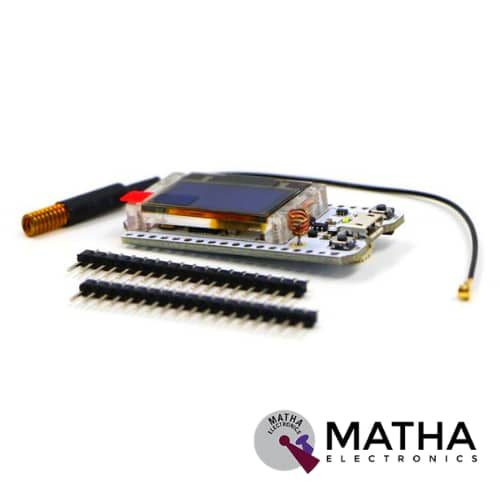
ESP32 LoRa SX1278 0.96 Inch Blue OLED Display BT WiFi Module for Arduino
Original price was: ₹2,450.00.₹2,200.00Current price is: ₹2,200.00. inc. GST
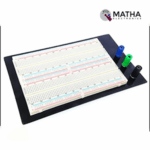
ZY-204 1660 Points Solderless Breadboard
Original price was: ₹820.00.₹650.00Current price is: ₹650.00. inc. GST
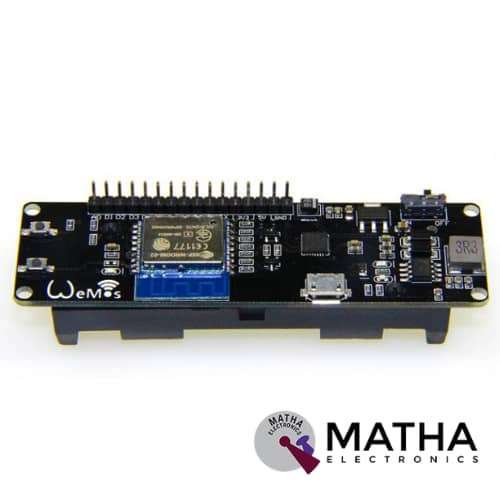
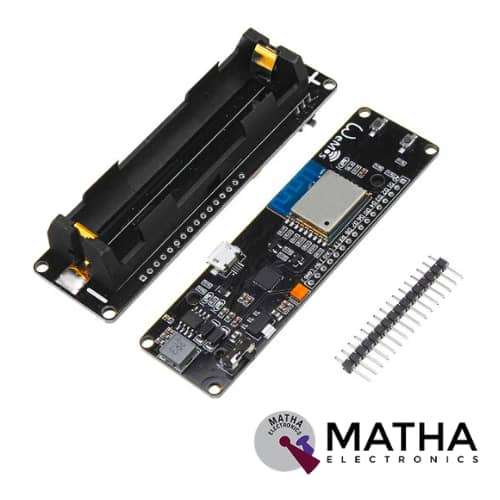
WeMos D1 ESP Wroom 02 Board ESP8266 Mini WiFi Nodemcu Module 18650 Battery
Original price was: ₹1,750.00.₹1,500.00Current price is: ₹1,500.00. inc. GST
- One AD inputs.
- Micro USB inputs.
- One programmable LED (D0).
- AUTO PROGRAM circuit.
- ESP8266 (ESP-WROOM-02 With TELEC) is equivalent to the NodeMCU.
- Analog Input (AD): Built-in dividing resistor (AD = 220K ADC 100K = GND).
- There is a SOLDER terminal for SLEEP MODE.
- Compatible With Arduino andNodeMCU.
- Operation and charging are possible at the same time.
- 18650 charging circuit including the 5V boosting circuit with TP5410.
- Overcharge protection, over-discharge protection built-in.
- LED: Red = Charging, Green = Full charging.
- 3000 mA 18650 It is possible to operate for more than 17 hours on a battery.
- Integrated 18650 battery charging and discharging system.
- One switch controls whether the 18650 battery is on power or not.
- OLEDs SDA and SCL can connect to the D1 pin and the D2 pin respectively.
- The five buttons can be controlled by FLATH, RSET, D5, D6, and D7 respectively.
- The 5 Digital pins can configure the write/read/interrupt/PWM/I2C/one-wire supported separately.
- Operation and NodeMCU consistent, adding a programmable LED, you can use GPIO16 to control; display 8266 running status and other functions. Integrated OLED and five buttons, more convenient for development.
- The design concept originates from the open-source project NodeMCU; the development board integrates 18650 charging and discharging systems with charging and discharging protection. At the same time, an OLED and five directional buttons are integrated to facilitate the development.
Description
This is WeMos D1 Esp Wroom 02 Board ESP8266 Mini-WiFi Nodemcu Module 18650 Battery. This development board integrates the ESP8266 18650 battery. It operates with a Sony 3000mah 18650 battery that can run for 17 hours. In some cases when we need to add some ESP8266 items you want to be hate to feature power to power. This miniature board can solve this problem.
The Sony 3000mah 18650 battery is capable of operating an ESP8266 for17 hours or more. With nodeMCU,18650 charging system integration and Indication LEDs (green means full and red means Charging) Charge and work are often done easily at an equivalent time. Meanwhile, this design concept rises from the open-source project NodeMCU. This development board integrates 18650 charging and discharging systems with charging and discharging protection. At the same time, an OLED and five directional buttons are integrated to facilitate the development.
Notes:
- This product doesn’t contain a 18650 battery. If the battery is placed in the wrong direction, the charging chip is destroyed.
- Please don’t burn the program during charging. Once you burn the program, please unplug the battery and verify the switch is in the ON position.
- Recommend the utilization of 5V 500mA charging charger, quite 5V 1A there’ll be fever, doesn’t affect the traditional work, but within the process of charging charging-chip don’t touch or carry, the measured charge charging will rise to about 60 degrees with the diode chip, no heat during normal working hours, rest assured to hold.
- Important!!! The charging tip (TP 5410) will destroy if the battery is connected reversibly.
Reviews (0)
Shipping & Delivery

Related products


ESP32MOD ESP-WROOM-32 Universal Wi-Fi-BT-BLE MCU Module
- Wi-Fi Protocols: 802.11 b/g/n
- Wi-Fi+BT+BLE MCU Module
- Bluetooth v4.2 BR/EDR and BLE specification
- Wi-Fi mode Station/softAP/SoftAP+station/P2P
- Security WPA/WPA2/WPA2-Enterprise/WPS
- Encryption AES/RSA/ECC/SHA
- Operating voltage: 2.2-3.6V
- Consumption: 80 mA Typ
- On-Chip Hall Sensor
- Integrated Crystal of 40 MHz
- Integrated SPI Flash of 4 MB
- Recommended Voltage: 3.3V
- Operating Current: Average 80 mA
- ESP32-WROOM-32 contains two low-power Xtensa 32-bit LX6 microprocessors
- 448 KBytes ROM for booting and core functions
- 520 KBytes on-chip SRAM
- 8 KBytes SRAM in RTC SLOW
- 8 KBytes SRAM in RTC FAST
- Dimensions: 18 mm* 25.5 * 2.8 mm
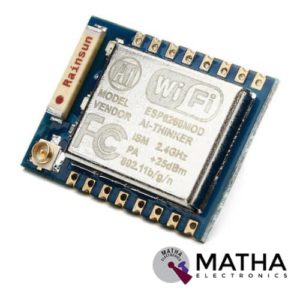
ESP8266 ESP – 07
- Smallest 802.11b/g/n Wi-Fi SOC module
- Low power 32-bit CPU, can also serve as the application processor
- Up to 160MHz clock speed
- Built-in 10 bit high precision ADC
- Supports UART/GPIO/IIC/PWM/ADC
- SMD-16 package for easy welding
- Integrated Wi-Fi MAC/BB/RF/PA/LNA
- Deep sleep current as low as 20uA
- Embedded LWIP protocol stack
- Supports STA/AP/STA + AP operation mode
- Support Smart Config/AirKiss technology
- UART baudrate up to 4Mbps
- General AT commands can be used quickly
- Supports remote firmware upgrade (FOTA)
- WIFI Direct (P2P),SOFT-AP
- Built-in TCP/IP
- The AT command is perfect, efficient, concise
- Support three modes: AP, STA and AP+STA coexistence mode
- Onboard Chip Antenna
- +19.5dBm output power in 802.11b mode
- Power down leakage current of <10uA
- SDIO 1.1/2.0, SPI, UART
- STBC, 1×1 MIMO, 2×1 MIMO
- A-MPDU & A-MSDU aggregation & 0.4ms guard interval
- Wake up and transmit packets in < 2ms
- Standby power consumption of < 1.0mW (DTIM3)


ESP8266 ESP-12E
- LDR Light Sensor on board.
- WS2812 Led on board.
- Wireless Standard: IEEE 802.11 b/g/n protocol
- Frequency Range: 2.412 - 2.484 GHz
- Serial Transmission: 110 - 921600 bps, TCP Client 5
- SDIO 2.0, SPI and UART Interface available
- PWM available
- One ADC channel is available
- Programmable GPIO available
- Wireless Network Type: STA / AP / STA + AP
- Security Type: WEP / WPA-PSK / WPA2-PSK
- Encryption Type: WEP64 / WEP128 / TKIP / AES
- Network Protocol: IPv4, TCP / UDP / FTP / HTTP
- Operating Voltage: 3.3V
- Maximum current allowed to draw per pin: 15mA
- Power down leakage current of < 10uA
- Integrated low power 32-bit MCU
- Onboard PCB Antenna
- Wake up and transmit packets in < 2ms
- Standby power consumption of < 1.0mW
- Operating Temperature: -40ºC to +125 ºC


MINI NODEMCU ESP8266 WIFI DEVELOPMENT BOARD BASED ON ESP-12F
- Communication interface voltage: 3.3V
- Working current: 240mA(MAX)
- Serial port baud rate: 115200 (default), can be modified to other values by AT command
- Serial communication format: 8N1
- Wireless Network Mode: station / softAP / SoftAP + station
- Wireless criteria: 802.11 b / g / n
- WIFI @ 2.4 GHz, support for WPA / WPA2 security mode
- +19.5dBm output power
- Compatible with ESP-12(ESP-202)
- It is very easy to develop projects with AT commands
- Surface Mount Package with 2mm Pitch Pads
- Multiple GPIO’s for all your sensor needs
- Integrated TCP/IP protocol stack
- Integrated TR switch, balun, LNA, power amplifier and matching network
- Integrated PLL, regulators, DCXO and power management unit
- Power down leakage current of <10uA
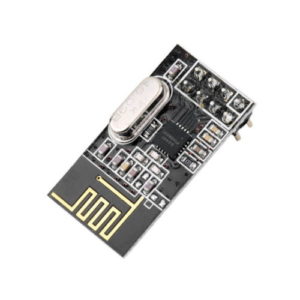
Mini SMD NRF24L01 2.4G Wireless Data Transmission Module
- Maximum operating speeds up to 2Mbps
- GFSK modulation efficiency, Anti-interference ability,
- Built-in hardware CRC error detection, Multipoint communication address control.
- Low-power 1.9 to 3.6V, only 1uA on Power-down mode
- Built-in 2.4Ghz antenna
- Built-in voltage regulator
- 125 Channels, Multi-point communication, and frequency hopping to meet the communication needs
- Wireless transceiver including Frequency generator, enhanced type, SchockBurstTM, mode controller, power amplifier, crystal amplifier, modulator, demodulator
- The output power channel selection and protocol settings can be set extremely low current consumption, through the SPI interface
- In the transmit mode, the transmit power is 6dBm, the current is 9.0mA, the accepted mode current is 12.3mA, the current consumption of the power-down mode and standby mode are lower
- Standard DIP Pitch Interface for embedded applications.NRF24L01 SPI interface: hardware SPI port, MCU I/O ports
- Internal FIFO compatible with a variety of microprocessor interface, micro-controller is convenient


NODMCU Esp8266-12 USB CP2102
- 11 b/g/n Wi-Fi Direct (P2P), soft-AP
- Integrated TCP/IP protocol stack
- CP2102 Serial / USB Chip
- +19.5dBm output power in 802.11b mode
- 4MB Flash Memory
- Integrated low power 32-bit CPU
- SDIO 1.1 / 2.0, SPI, UART
- Dimensions – 49 x 24.5 x 13mm
- Integrated TR switch, balun, LNA, power amplifier and matching network
- Integrated PLLs, regulators, DCXO and power management units
- On board USB to serial chip to easily program and upload codes from the Arduino IDE
- Embeds logic level converter circuits
- Has on board 3.3V regulator to ensure enough power to function as your go-to WiFi chip!
- Easy access to the GPIO pins for easy prototyping
- ESP-12E Processor
- Easy to use breadboard friendly form factor
- Voltage Regulator / Converter, excellent DC to DC conversion, super efficientESP-12E Processor
- Easy to use breadboard friendly form factor


Wemos D1 WiFi Esp8266 Development Board Uno Compatible Program
- Microcontroller: ESP-8266EX
- Operating Voltage: 3.3 V
- Digital I/O Pins: 11
- Analog Input Pins 1(Max input: 3.2V)
- Clock Speed: 80MHz/160MHz
- Flash: 4M bytes
- Good stability.
- 11 digital input/output pins, all pins have interrupt/PWM/I2C/one-wire supported(except for D0)
- 1 analog input(3.2V max input)
- Micro USB connection
- Compatible with Arduino
- Support OTA wireless uploading
- On-Board Switching Power Supply:
- Micro USB connection
- Compatible with Arduino
- Support OTA wireless uploading
Reviews
There are no reviews yet.