
I am text block. Click edit button to change this text. Lorem ipsum dolor sit amet, consectetur adipiscing elit. Ut elit tellus, luctus nec ullamcorper mattis, pulvinar dapibus leo.
-11%
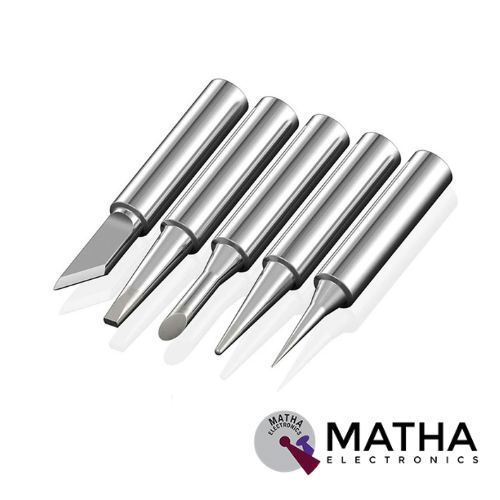
SMD Soldering Bits
Original price was: ₹250.00.₹225.00Current price is: ₹225.00. inc. GST
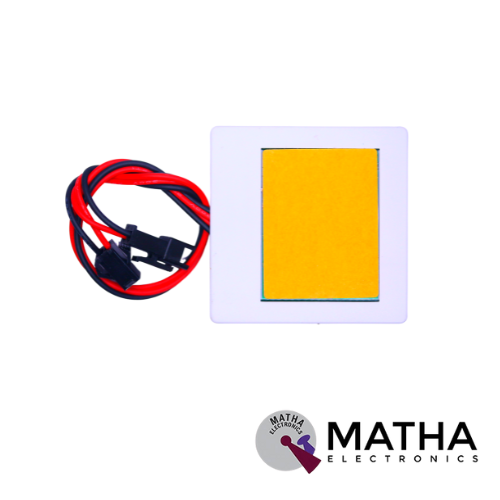
Touch Sensor For Mirror
Original price was: ₹550.00.₹525.00Current price is: ₹525.00. inc. GST
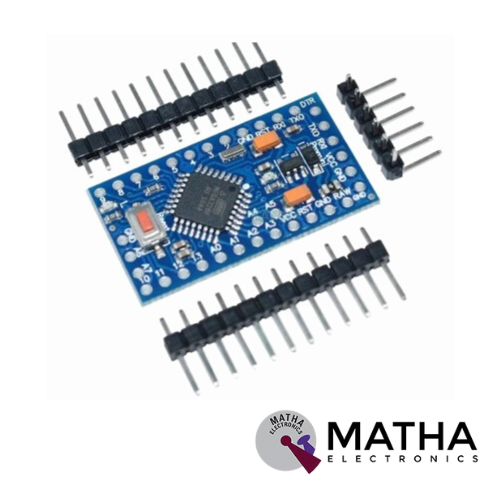
Arduino Pro Mini
Original price was: ₹899.00.₹799.00Current price is: ₹799.00. inc. GST
- Circuit Operating Voltage: 5V
- Clock frequency: 16MHz.
- Digital I/O Pins: 14
- 8 analog input port: A0 ~ A7.
- A pair of TTL level serial port transceivers: RX / TX.
- 6 PWM ports: D3, D5, D6, D9, D10, D11.
- Use For Atmel Atmega328P-AU microcontroller.
- Support serial download.
- Support 9V battery.
Description
This is an Arduino Pro Mini 5V running a 16MHz bootloader. The Pro Mini ATMEGA328P lacks connections. We advise new Arduino users to start with the Uno R3. It’s a fantastic board that will help you get going right away. The Arduino Pro series is intended for users who are aware of the system voltage (5V), connector deficiency, and USB off-board constraints.
An ATmega328-based microcontroller board is called the Pro Mini ATMEGA328P 5V/16M. It contains 6 analog inputs, an on-board resonator, 14 digital input/output pins (six of which can be used as PWM outputs), an on-board reset button, and mounting holes for pin headers. To supply the board with USB power and connectivity, an FTDI cable can be connected to a six pin header. The Pro Mini Arduino is designed for temporary installation in exhibits or physical things. The Mini Arduino can use this pin configuration.This board was created for installations and applications where there is a shortage of available space and when projects are meant to be permanent setups. The Pro Mini is available in two variations. One operates at 3.3V and 8 MHz, while the other operates at 5V and 16 MHz.
A computer, another Arduino, or other microcontrollers can all be communicated using the Arduino Pro Mini’s many communication features. UART TTL serial communication is offered by the ATmega328P and is accessible on digital pins 0 (RX) and 1. (TX). Simple textual data can be delivered to and received from the Arduino board using the serial monitor that is part of the Arduino software over a USB connection.
Reviews (0)
Shipping & Delivery

Related products

16×2 (1602) LCD Keypad Shield
- Operating Voltage:5V
- 5 Push buttons.
- RST button to reset Arduino program.
- Integrate a potentiometer for adjusting the backlight.
- Expanded available I/O pins.
- Blue light with white characters.
- Uses 4 Bit Arduino LCD Library
- Screen contrast adjustment
- Arduino Reset button
- The keypad consists of 6 keys select, up, right, down, left and reset.
- To save the digital IO pins, the keypad interface only uses one ADC channel.
- The key value is read out through a 5 stage voltage divider.

4*4 MATRIX KEYPAD
The maximum voltage across each button: 24v
- The maximum current across each button: 3mA
- Easy communication with any microcontroller
- Ultra-thin design
- Adhesive backing provides easy integration
- High price-performance ratio
- Allows microcontroller to scan 8 output pins to check which 16 button
- Long life
- Maximum operating temperature: 0 degrees to 50 degrees Celsius
- Dimension: 70*77*1mm
- Weight: 7.5gm
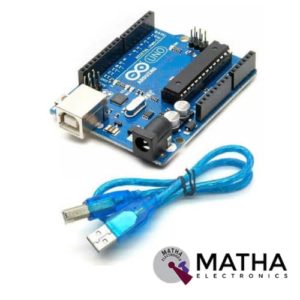

Arduino Duemilanove Development Board with USB Cable
- Microcontroller: ATmega168/ATmega 328
- Operating Voltage: 5V
- Input Voltage: 7-12V
- Input Voltage: 6-20V
- Digital I/O Pins: 14 (of which 6 provide PWM output)
- Analog Input Pins: 6
- DC Current per I/O Pin: 40 mA
- DC Current for 3.3V Pin: 50 mA
- Flash Memory: 16 KB (ATmega168) or 32 KB (ATmega328) of which 2 KB used by the bootloader
- SRAM: 1 KB (ATmega168) or 2 KB (ATmega328)
- EEPROM: 512 bytes (ATmega168) or 1 KB (ATmega328)
- Clock Speed: 16 MHz


CAN Bus Shield
- Implements CAN V2.0B at up to 1 Mb/s
- Industrial standard 9 pin sub-D connector
- OBD-II and CAN standard pinout selectable.
- Changeable chip select pin
- Changeable CS pin for TF card slot
- Changeable INT pin
- Screw terminal that easily to connect CAN_H and CAN_L
- Arduino Uno pin headers
- Grove connectors (I2C and UART)
- SPI Interface up to 10 MHz
- Standard (11 bit) and extended (29 bit) data and remote frames
- Two receive buffers with prioritized message storage

DTMF Shield
- MT8870 Decoder IC.
- 4 Output digital pins.
- Operates on 5V
- Includes MT8870 DTMF Receiver IC
- Receives and Converts Standard DTMF Codes
- Remotely Switch Devices from Anywhere Using the Phone
- Easily Connects to Most Microcontrollers or Roboduino Board
- Low Power Consumption
- 5 On-Board LED's For Data Received Indication
- Standard Header Connections for Control System Connection
- Audio socket for application
- Speaker connector for audio sound checking.
- Microphone connector for over the air remote control system( note, due to environmental noise, without any filtering system this method is not recommended)
- Dimension: 37x37x9mm

MEPUNO COMMUNICATION BOARD
- Microcontroller ATMEGA328 P
- Crystal for microcontroller: 16 MHZ
- USB type B connector
- On-Board Power LED Indicator
- 5volt, 12 volt regulated circuit
- Two separate regulated 5volt power supply
- On Board On/Off switch
- On Board DC jack for powering up using adaptors
- On Board Reset Switch
- On Board TX/RX indication LEDs
- On board FTDI Driver for adruino
- Berg headers for external interfacing
- Supports I2C /GSM /GPS/RF/USART serial communication
- Separate berg headers available for PIR, Servo motor, RTC/I2C, GPS_TTL, and USART-TTL
- Four 3pin PBT Connectors
- Four SPDT 12V Relays
- Onboard DB9 connectors for GPS, GSM and USART communication
- Berg slot for 16x4 LCD connections
- Onboard TRIM-POT for LCD
- Onboard RTC IC: IN1307 with crystal 32768 MHZ crystal and CR2302 battery
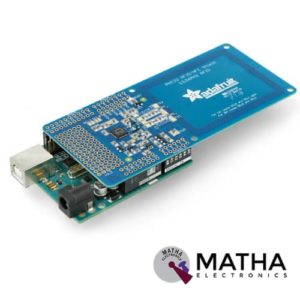

PN532 NFC/RFID Controller Shield for Arduino
- PN532 chip-set
- Operating Voltage : 3.3V ~ 5v
- Support I2C, SPI
- I2C: 3.3V ~ 24V TTL
- SPI: 3.3V TTL with 100-ohm resistors in series
- Plug and play, Arduino compatible
- Built-in PCB Antenna
- Communication distance:10cm
- Easy to change mode
- NFC/RFID PN532 shield including a tuned 13.56MHz stripline antenna
- 36-pin 0.1" header for attaching the shield to an Arduino.
- Compatible with Arduino Mega 1280 & 2560, Diecimila, Duemilanove, and UNO
Reviews
There are no reviews yet.