
I am text block. Click edit button to change this text. Lorem ipsum dolor sit amet, consectetur adipiscing elit. Ut elit tellus, luctus nec ullamcorper mattis, pulvinar dapibus leo.
-3%Sold out


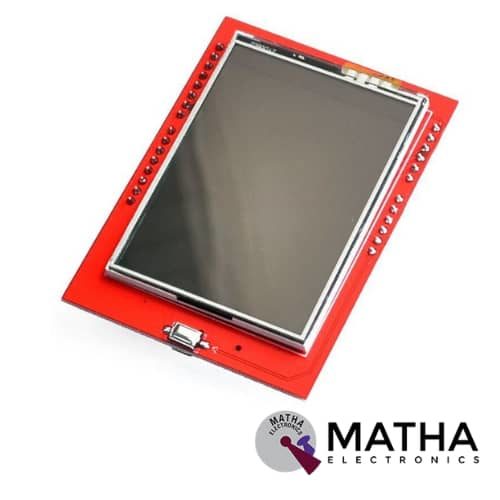
2.4″ Inch Touch Screen TFT Display Shield for Arduino
Original price was: ₹850.00.₹800.00Current price is: ₹800.00. inc. GST
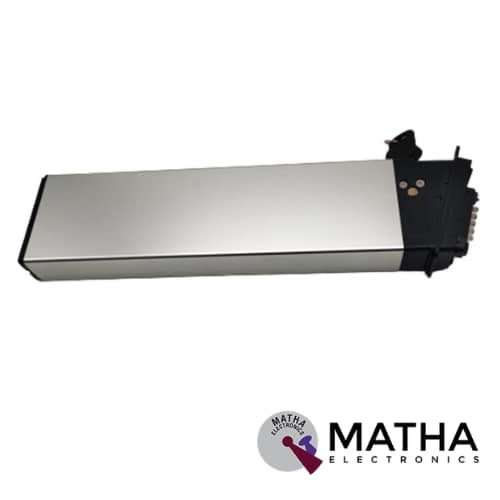
36V/48V Fold bike Lithium Battery Case 410*100*42mm Aluminum Alloy Material
Original price was: ₹2,825.00.₹2,499.00Current price is: ₹2,499.00. inc. GST
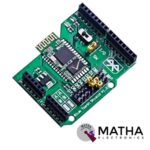
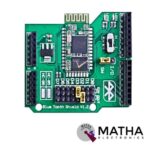
HC-05 Bluetooth Shield for Arduino
Original price was: ₹825.00.₹799.00Current price is: ₹799.00. inc. GST
- Bluetooth serial port Profile
- Bluetooth protocol: Bluetooth Specification v2.0+EDR
- Frequency: 2.4GHz ISM band
- Communication Range: 10M
- Serial Bluetooth module for Arduino
- Can operate in Master, Slave or Master/Slave mode
- UART interface (TTL) with programmable baud rate (SPP firmware installed)
- Default baud rate: 38400(CMD MODE) / 9600(DATA MODE), data bits: 8, stop bit: 1, Parity: No parity
- Onboard PCB antenna
- FCC ID certificated
Out of stock
Description
HC-05 Bluetooth Shield based on Bluetooth SPP (Serial Port Protocol) module designed as Wireless Serial Communication allows use with any microcontroller. It supports the UART protocol for easy transfer and receives data wirelessly. This module works as both Master and Slave Mode and easy switchable between these two modes. By default, Slave mode is configured. And the configured Modes changed using AT Commands. While working in slave mode, HC-05 cannot initiate a connection to another Bluetooth device but can accept connections. Whereas in Master mode, it initiates a connection to other devices.
This serial port Bluetooth module features fully qualified Bluetooth V2.0+EDR (Enhanced Data Rate) 3Mbps Modulation with a complete 2.4GHz radio transceiver and baseband. The module communicates using the USART protocol at a baud rate of 9600. Hence it is easy to interface with any microcontroller that supports USART. The onboard LED present on the board indicates the connection status, whether the Bluetooth connection or not. This red LED blinks continuously in a periodic manner before connecting to the module. When connected to any other Bluetooth device, its blinking slows down to two seconds.
This Bluetooth protocol is an affordable communication method in PAN network, with a maximum data rate of 1Mb/S, working in a nominal range of 100 meters using 2.4 G frequency is a common way of wireless communicating. HC05 module consists of an internal 3.3v regulator and that is why you can connect it to 5v voltage. But it is highly recommended 3.3V voltage since the logic of HC05 serial communication pins is 3.3V. Supplying 5V to the module can cause damage to the module. In order to prevent the module from being damaged and make it work properly, you should use a resistance division circuit (5v to 3.3v ) between the Arduino TX pin and the module RX pin.
Reviews (0)
Shipping & Delivery

Related products

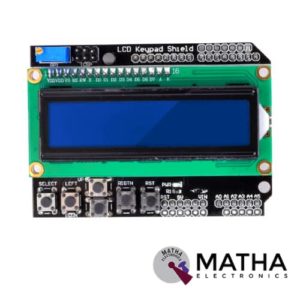
16×2 (1602) LCD Keypad Shield
- Operating Voltage:5V
- 5 Push buttons.
- RST button to reset Arduino program.
- Integrate a potentiometer for adjusting the backlight.
- Expanded available I/O pins.
- Blue light with white characters.
- Uses 4 Bit Arduino LCD Library
- Screen contrast adjustment
- Arduino Reset button
- The keypad consists of 6 keys select, up, right, down, left and reset.
- To save the digital IO pins, the keypad interface only uses one ADC channel.
- The key value is read out through a 5 stage voltage divider.

37 IN 1 Sensor Kit For Arduino
- For beginners who are interested in Arduino
- A complete set of Arduino’s most common and useful electronic components
- Infrared sensor receiving module
- Laser sensor module
- Temperature and humidity sensor module
- Infrared sensor module
- 5v relay module
- Obstacle avoidance sensor module. For beginners who are interested in Arduino
- A complete set of Arduino’s most common and useful electronic components
- Packaging Type: Box
- Material: Circuit board
- Dimensions: 98 x 0.59 x 0.24 inch
- Weight: 428 g
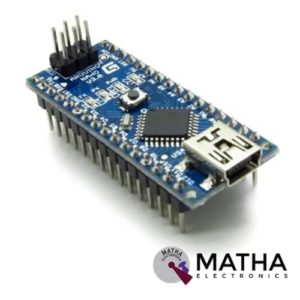

Arduino Nano V3.0
- Microcontroller: Atmel ATmega328 SMD Package
- Operating Voltage (logic level): 5 V
- Input Voltage (recommended): 7-12 V
- Input Voltage (limits): 6-20 V
- Digital I/O Pins: 14 (of which 6 provide PWM output)
- Analog Input Pins: 8
- DC Current per I/O Pin: 40 mA
- Flash Memory: 32 KB (of which 2KB used by bootloader)
- SRAM: 2 KB
- EEPROM: 1 KB
- Clock Speed: 16 MHz
- Automatic reset during program download
- Power OK blue LED
- Green (TX), red (RX) and orange (L) LED
- Auto-sensing/switching power input
- Small mini-B USB for programming and serial monitor
- ICSP header for direct program download
- Standard 0.1” spacing DIP (breadboard friendly)
- Manual reset switch
- Dimensions: 0.70” x 1.70”


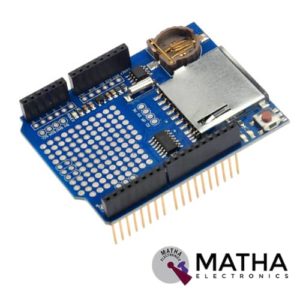

SD Card shield V4.0 for Arduino UNO
- Standard SD card, SDHC card and TF card compatible
- 3.3v and 5v logical voltage compatible
- 2.6-3.6v DC power supply
- UART Grove & I2C connection compatible
- Fully supported SD Library
- Minimal number of SPI port
- Jumpers provided for configuring Arduino SPI port pins
- Onboard toggle switch for SD card select type
- Truly stackable
- Prototype expand Library support
- Size: 53mm x 47mm
- Weight: 35g


Sensor Shield V5 Expansion Board For Arduino
- Retain the merits of the V4.0 version
- Laminated design
- PCB immersion gold processing technology
- IIC interface
- Bluetooth module communication interface
- SD card module communication interface
- APC220 Wireless RF modules communication interface
- RB URF v1.1 ultrasonic sensors interface
- 12864 LCD string of line and parallel interface
- 32 servo controller interface
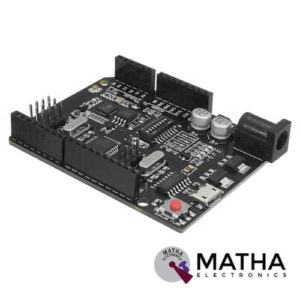

UNO R3 +WiFi ATmega328P+ESP8266 Module CH340G Compatible For Arduino Uno
- Microcontroller: ATmega328IC
- Wi-Fi: ESP8266
- USB-TTL converter: CH340G
- Power Output: 5V-800mA
- Power input USB: 5V (500mA max.)
- Power input VIN/DC Jack: 9-24V
- Power Consumption: 5V 800mA
- Logic Level: 5V
- WiFi: 802.11 b/g/n 2.4 GHz
- USB type: Micro USB
- USB Clock Frequency: 16MHz
- Operating Supply Voltage: 5V
- Digital I/O Pins: 14
- Analog I/O pins: 6
- Memory Size: 32Mb
- Interface Type: serial
- Operating temperature: −40С°/+125С°
- Dimensions (L×W)mm: 53.34×68.58
Reviews
There are no reviews yet.