
I am text block. Click edit button to change this text. Lorem ipsum dolor sit amet, consectetur adipiscing elit. Ut elit tellus, luctus nec ullamcorper mattis, pulvinar dapibus leo.
-20%Sold out


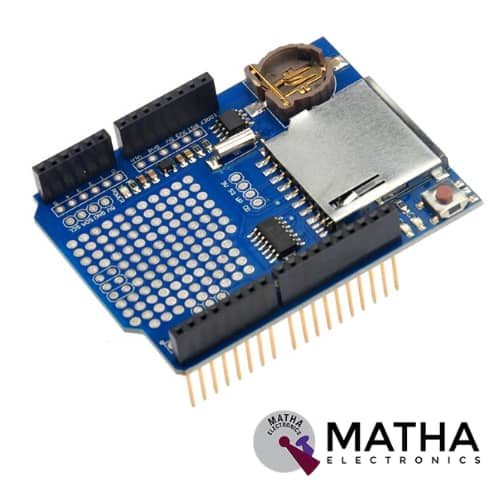
SD Card shield V4.0 for Arduino UNO
Original price was: ₹1,300.00.₹1,275.00Current price is: ₹1,275.00. inc. GST
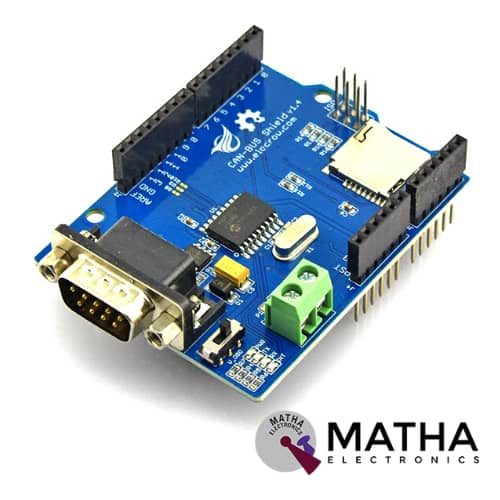
CAN Bus Shield
Original price was: ₹1,700.00.₹1,500.00Current price is: ₹1,500.00. inc. GST
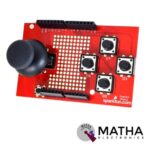
Joystick Shield
Original price was: ₹500.00.₹400.00Current price is: ₹400.00. inc. GST
- NRF24L01 RF interface.
- For Nokia 5110 LCD interface.
- Bluetooth interface I2C interface.
- For one PS2 joystick.
- 2-Axis joystick.
- Bluetooth / Serial interface.
- I2C interface.
- nRF24L01 interface.
- Nokia 5110 LCD interface.
- Interface connector.
- Power switch to switch between 3.3 and 5V
Out of stock
Description
This Joystick Shield Module Robotics Control is designed as an Uno-compatible shield. It allows to turn an Arduino Uno or compatible into a game console or robotic controller. In this module, the shield fits on the top of the Arduino and turns into a simple controller. The joystick shield comes with a 7 momentary push button. Among which 4 are big buttons, 2 small buttons, and 1 joystick select button. And a two-axis thumb joystick with a potentiometer gives your Arduino functionality on the level of old Nintendo controllers. The Joystick V2.0 features an added Nokia 5110 LCD and nRF24L01 interface. As a result, can easily develop your Joystick games, and even communicate with each other with wireless nRF24L01.
The joystick module is constructed by mounting two potentiometers at a 90-degree angle and hence can be used to sense movements in X & Y direction. The joystick is used for controlling outputs such as a melody or pixels on a screen. And also used for navigation or game control. Basically, a Joystick v 2.0 with Nokia 5110 does not support a standard Arduino board. This is because the standard Arduino 3.3 V can only supply a current of 50 mA, and the Nokia 5110 backlight requires more current.
The momentary push buttons are connected to Arduino digital pins 2-6. When the push-button is pressed, they will pull the pin low (utilizing the internal pull-ups of the Arduino). The two potentiometers on the joystick connect to analogue pins A0 and A1 on your Arduino. Y-axis movement of the joystick produces a proportional analogue voltage on analogue pin 0. Similarly, the horizontal movement of the joystick can be tracked on analogue pin 1.
Reviews (0)
Shipping & Delivery

Related products

37 IN 1 Sensor Kit For Arduino
- For beginners who are interested in Arduino
- A complete set of Arduino’s most common and useful electronic components
- Infrared sensor receiving module
- Laser sensor module
- Temperature and humidity sensor module
- Infrared sensor module
- 5v relay module
- Obstacle avoidance sensor module. For beginners who are interested in Arduino
- A complete set of Arduino’s most common and useful electronic components
- Packaging Type: Box
- Material: Circuit board
- Dimensions: 98 x 0.59 x 0.24 inch
- Weight: 428 g
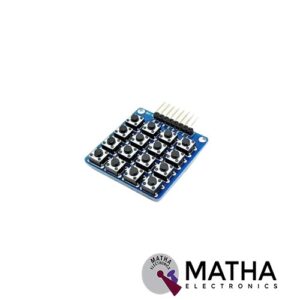

4×4 Keypad Board Matrix Keyboard 16 Key Buttons For Arduino
- 4×4 Matrix Keyboard Module with 16 buttons
- Small in size and hence Save space
- More convenient to use
- Expanded development application modules for single chip
- With 16 keys and an 8 pin
- The maximum voltage across each button: 24v
- The maximum current across each button: 3mA
- Easy communication with any microcontroller
- Ultra-thin design
- Adhesive backing provides easy integration
- High price-performance ratio
- Allows microcontroller to scan 8 output pins to check which 16 button
- Long life
- Maximum operating temperature: 0 degrees to 50 degrees Celsius
- Dimension: 70*77*1mm
- Weight: 7.5gm
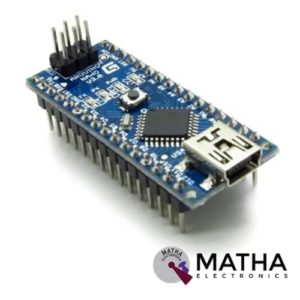

Arduino Nano V3.0
- Microcontroller: Atmel ATmega328 SMD Package
- Operating Voltage (logic level): 5 V
- Input Voltage (recommended): 7-12 V
- Input Voltage (limits): 6-20 V
- Digital I/O Pins: 14 (of which 6 provide PWM output)
- Analog Input Pins: 8
- DC Current per I/O Pin: 40 mA
- Flash Memory: 32 KB (of which 2KB used by bootloader)
- SRAM: 2 KB
- EEPROM: 1 KB
- Clock Speed: 16 MHz
- Automatic reset during program download
- Power OK blue LED
- Green (TX), red (RX) and orange (L) LED
- Auto-sensing/switching power input
- Small mini-B USB for programming and serial monitor
- ICSP header for direct program download
- Standard 0.1” spacing DIP (breadboard friendly)
- Manual reset switch
- Dimensions: 0.70” x 1.70”


ESP8266 WIFI Shield
- Operating voltage 5V (supplied from the Arduino Board)
- Connection via: 802.11b/g networks
- Encryption types: WEP and WPA2 Personal
- Connection with Arduino on SPI port
- on-board micro SD slot
- ICSP headers
- FTDI connection for serial debugging of WiFi shield
- Mini-USB for updating WiFi shield firmware
- 32-bit RISC architecture
- The processor can operate at 80MHz / 160MHz
- 32MB flash memory
- 64kB for instructions
- 96kB for data
- Operates in AP, Station or AP + Station mode
- It has 11 digital pins
- It has 1 analogue pin with 10-bit resolution
- Digital pins except the D0 have interrupts, PWM, I2C and one wire
- Programmable through USB or WiFi (OTA)
- Compatible with Arduino IDE
- Compatible with modules and sensors used in Arduino
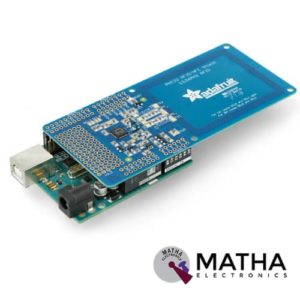

PN532 NFC/RFID Controller Shield for Arduino
- PN532 chip-set
- Operating Voltage : 3.3V ~ 5v
- Support I2C, SPI
- I2C: 3.3V ~ 24V TTL
- SPI: 3.3V TTL with 100-ohm resistors in series
- Plug and play, Arduino compatible
- Built-in PCB Antenna
- Communication distance:10cm
- Easy to change mode
- NFC/RFID PN532 shield including a tuned 13.56MHz stripline antenna
- 36-pin 0.1" header for attaching the shield to an Arduino.
- Compatible with Arduino Mega 1280 & 2560, Diecimila, Duemilanove, and UNO
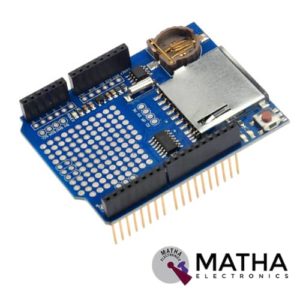

SD Card shield V4.0 for Arduino UNO
- Standard SD card, SDHC card and TF card compatible
- 3.3v and 5v logical voltage compatible
- 2.6-3.6v DC power supply
- UART Grove & I2C connection compatible
- Fully supported SD Library
- Minimal number of SPI port
- Jumpers provided for configuring Arduino SPI port pins
- Onboard toggle switch for SD card select type
- Truly stackable
- Prototype expand Library support
- Size: 53mm x 47mm
- Weight: 35g
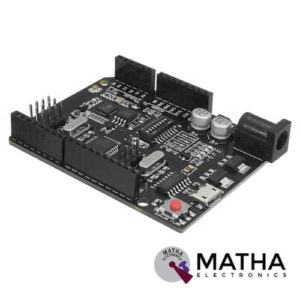

UNO R3 +WiFi ATmega328P+ESP8266 Module CH340G Compatible For Arduino Uno
- Microcontroller: ATmega328IC
- Wi-Fi: ESP8266
- USB-TTL converter: CH340G
- Power Output: 5V-800mA
- Power input USB: 5V (500mA max.)
- Power input VIN/DC Jack: 9-24V
- Power Consumption: 5V 800mA
- Logic Level: 5V
- WiFi: 802.11 b/g/n 2.4 GHz
- USB type: Micro USB
- USB Clock Frequency: 16MHz
- Operating Supply Voltage: 5V
- Digital I/O Pins: 14
- Analog I/O pins: 6
- Memory Size: 32Mb
- Interface Type: serial
- Operating temperature: −40С°/+125С°
- Dimensions (L×W)mm: 53.34×68.58
Reviews
There are no reviews yet.