
I am text block. Click edit button to change this text. Lorem ipsum dolor sit amet, consectetur adipiscing elit. Ut elit tellus, luctus nec ullamcorper mattis, pulvinar dapibus leo.
-14%Sold out


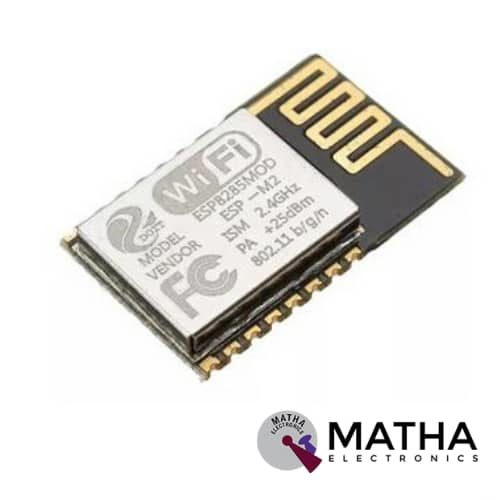
Mini ESP-M2 ESP8285 Serial Wireless WiFi Transmission Module SerialNET MODE Fully Compatible With ESP8266
Original price was: ₹350.00.₹300.00Current price is: ₹300.00. inc. GST
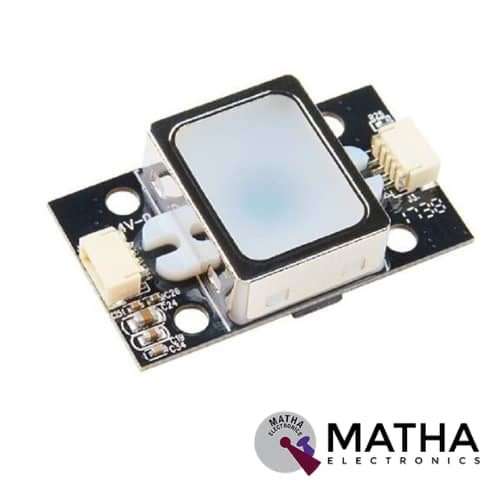
Finger Print Module Scanner - TTL (GT-521F52)
Original price was: ₹2,400.00.₹2,300.00Current price is: ₹2,300.00. inc. GST
Mini Ultra-small Size ESP-M3 From ESP8285 Serial Wireless WiFi Transmission Module Fully Compatible With ESP8266
Original price was: ₹350.00.₹300.00Current price is: ₹300.00. inc. GST
- Model: ESP8285 ESP-M3
- 32-bit Tensilica L106 microcontroller
- Ultra-low 16 bit RISC
- Fully Compatible with ESP8266
- Embedded TCP protocol
- channel high-precision 10-bit ADC
- Supporting the most commonly used networks (802.11 b / g / n)
- Support WPA, PA2PSK and WPS
- Working temperature: -40 ℃ – + 125 ℃
- Clock Speed: 80 MHz; (max 160 MHz)
- Flash memory: 1 MB
- Interface: HSPI, UART, I2C, I2S, Remote Control IR Control, PWM, GPIO
- Direct WiFi Support (P2P)
- Support mode: CCMP, TKIP (MIC, RC4), WAPI (SMS4), WEP (RC4), CRC etc
- Low consumption
- Easy access to the pins
Out of stock
Description
Mini Ultra-small Size ESP-M3 from ESP8285 Serial Wireless WiFi Transmission Module Fully Compatible with ESP8266 designed based on an integrated chip specifically to fulfil the needs of a new connected world. ESP8285 is capable of delivering highly integrated Wi-Fi SoC solutions to meet users’ continuous demands for efficient power usage, compact design, and reliable performance in the Internet of Things industry.
ESP-M2 module core processor designed based on high-performance chip ESP8285. Basically, the ESP8285 module is an ESP8266 Module with an additional 1 MB of Flash memory. And the ESP8285 can even bear high temperatures up to 125℃ (the one for ESP8266 is just 85℃). The more important feature is that the ESP8266 code programmed can also be used for ESP8285. The chip ESP825 is encapsulated in an advanced Tensilica’s L106 32-bit CPU, together with SRAM. ESP8285 has the full and complete WiFi function with self-contained SOC and integrated TCP/IP protocol stack. It gives access to any microcontroller to your WiFi network. This Module is capable of performing either as a standalone application or as a slave to a host MCU. When ESP8285 hosts the application, it promptly boots up from the flash. The integrated high-speed cache helps to increase system performance and optimize system memory.
This ESP8285 is interfaced with any microcontroller design as a Wi-Fi adaptor through SPI/SDIO or UART interfaces. This ESP8285 chip, supports the most commonly used networks (802.11 b / g / n), for low-power wireless communication, operating with the Wi-Fi network at 2.4GHz frequency, supporting WPA, PA2PSK, and WPS. Moreover, the ESP8285 M3 WiFi Module used to connect your projects to wireless data networks, where you can exchange information between microcontrollers, sensors or send them to a smartphone. Thereby helps to prevent the usage of tangled wires in your home, in the case of residential automation projects
Reviews (0)
Shipping & Delivery

Related products

1 CHANNEL 5V RELAY
- 1 channel relay board
- Operating voltage: 5V
- Maximum current: 2 A
- Relay contact current capacity of 10A @250 V AC/10A@ 30V AC
- configured as SINGLE POLE DOUBLE THROW( SPDT)
- LED status indicates relay ON/OFF state.
- Standard TTL level logic controlled
- One normally closed and one normally opened contact
- Compatible with any 5V microcontroller
- Dimension: 43*17*17mm
- Weight: 150gm


ESP32MOD ESP-WROOM-32 Universal Wi-Fi-BT-BLE MCU Module
- Wi-Fi Protocols: 802.11 b/g/n
- Wi-Fi+BT+BLE MCU Module
- Bluetooth v4.2 BR/EDR and BLE specification
- Wi-Fi mode Station/softAP/SoftAP+station/P2P
- Security WPA/WPA2/WPA2-Enterprise/WPS
- Encryption AES/RSA/ECC/SHA
- Operating voltage: 2.2-3.6V
- Consumption: 80 mA Typ
- On-Chip Hall Sensor
- Integrated Crystal of 40 MHz
- Integrated SPI Flash of 4 MB
- Recommended Voltage: 3.3V
- Operating Current: Average 80 mA
- ESP32-WROOM-32 contains two low-power Xtensa 32-bit LX6 microprocessors
- 448 KBytes ROM for booting and core functions
- 520 KBytes on-chip SRAM
- 8 KBytes SRAM in RTC SLOW
- 8 KBytes SRAM in RTC FAST
- Dimensions: 18 mm* 25.5 * 2.8 mm


ESP8266 WIFI Shield
- Operating voltage 5V (supplied from the Arduino Board)
- Connection via: 802.11b/g networks
- Encryption types: WEP and WPA2 Personal
- Connection with Arduino on SPI port
- on-board micro SD slot
- ICSP headers
- FTDI connection for serial debugging of WiFi shield
- Mini-USB for updating WiFi shield firmware
- 32-bit RISC architecture
- The processor can operate at 80MHz / 160MHz
- 32MB flash memory
- 64kB for instructions
- 96kB for data
- Operates in AP, Station or AP + Station mode
- It has 11 digital pins
- It has 1 analogue pin with 10-bit resolution
- Digital pins except the D0 have interrupts, PWM, I2C and one wire
- Programmable through USB or WiFi (OTA)
- Compatible with Arduino IDE
- Compatible with modules and sensors used in Arduino
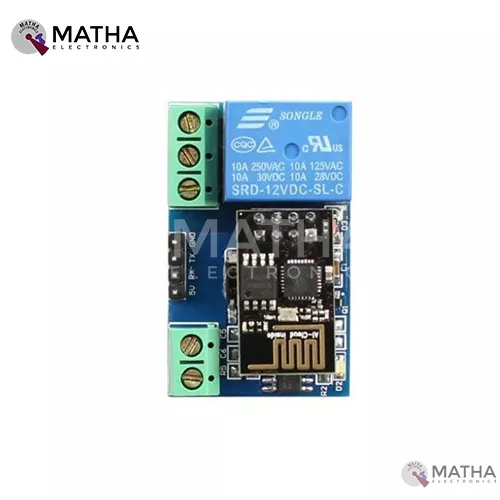
ESP8266- 01 5V WIFI RELAY MODULE TOI APP CONTROLLED FOR SMART HOME AUTOMATION
- Onboad module: ESP2866 WIFI module
- Onboard relay: 5v.10a/250v ac, 10a/30v dc
- Can connect 5 clients at the same time on AP mode
- The module has two work modes: Cell phone, carry on Wi-Fi module and Cell phone and Wi-Fi module carry on the same router
- Used in mobile phone, Wi-Fi module equipped with one router and control relay by APP
- Maximum transmission distance of 400 m when cell phone carry on wifi module directly, in the open environment
- Transmission distance depends on routers signal intensity when wifi and cell phone is carrying on the same router
- IN+, IN_: 5V power input
- TX, RX, and GND: serial port debug pins
- Baud rate: 115200
- Provide diode effusion protection
- Short response time
- Dimension: 45*28mm


MINI NODEMCU ESP8266 WIFI DEVELOPMENT BOARD BASED ON ESP-12F
- Communication interface voltage: 3.3V
- Working current: 240mA(MAX)
- Serial port baud rate: 115200 (default), can be modified to other values by AT command
- Serial communication format: 8N1
- Wireless Network Mode: station / softAP / SoftAP + station
- Wireless criteria: 802.11 b / g / n
- WIFI @ 2.4 GHz, support for WPA / WPA2 security mode
- +19.5dBm output power
- Compatible with ESP-12(ESP-202)
- It is very easy to develop projects with AT commands
- Surface Mount Package with 2mm Pitch Pads
- Multiple GPIO’s for all your sensor needs
- Integrated TCP/IP protocol stack
- Integrated TR switch, balun, LNA, power amplifier and matching network
- Integrated PLL, regulators, DCXO and power management unit
- Power down leakage current of <10uA
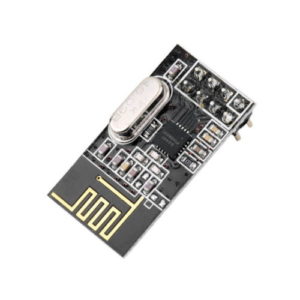
Mini SMD NRF24L01 2.4G Wireless Data Transmission Module
- Maximum operating speeds up to 2Mbps
- GFSK modulation efficiency, Anti-interference ability,
- Built-in hardware CRC error detection, Multipoint communication address control.
- Low-power 1.9 to 3.6V, only 1uA on Power-down mode
- Built-in 2.4Ghz antenna
- Built-in voltage regulator
- 125 Channels, Multi-point communication, and frequency hopping to meet the communication needs
- Wireless transceiver including Frequency generator, enhanced type, SchockBurstTM, mode controller, power amplifier, crystal amplifier, modulator, demodulator
- The output power channel selection and protocol settings can be set extremely low current consumption, through the SPI interface
- In the transmit mode, the transmit power is 6dBm, the current is 9.0mA, the accepted mode current is 12.3mA, the current consumption of the power-down mode and standby mode are lower
- Standard DIP Pitch Interface for embedded applications.NRF24L01 SPI interface: hardware SPI port, MCU I/O ports
- Internal FIFO compatible with a variety of microprocessor interface, micro-controller is convenient


NODMCU Esp8266-12 USB CP2102
- 11 b/g/n Wi-Fi Direct (P2P), soft-AP
- Integrated TCP/IP protocol stack
- CP2102 Serial / USB Chip
- +19.5dBm output power in 802.11b mode
- 4MB Flash Memory
- Integrated low power 32-bit CPU
- SDIO 1.1 / 2.0, SPI, UART
- Dimensions – 49 x 24.5 x 13mm
- Integrated TR switch, balun, LNA, power amplifier and matching network
- Integrated PLLs, regulators, DCXO and power management units
- On board USB to serial chip to easily program and upload codes from the Arduino IDE
- Embeds logic level converter circuits
- Has on board 3.3V regulator to ensure enough power to function as your go-to WiFi chip!
- Easy access to the GPIO pins for easy prototyping
- ESP-12E Processor
- Easy to use breadboard friendly form factor
- Voltage Regulator / Converter, excellent DC to DC conversion, super efficientESP-12E Processor
- Easy to use breadboard friendly form factor
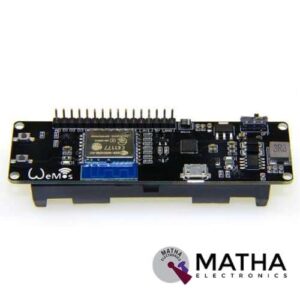
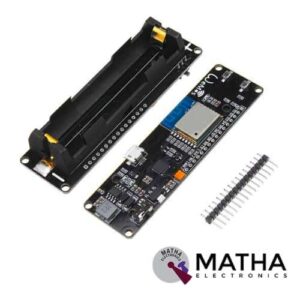
WeMos D1 ESP Wroom 02 Board ESP8266 Mini WiFi Nodemcu Module 18650 Battery
- One AD inputs.
- Micro USB inputs.
- One programmable LED (D0).
- AUTO PROGRAM circuit.
- ESP8266 (ESP-WROOM-02 With TELEC) is equivalent to the NodeMCU.
- Analog Input (AD): Built-in dividing resistor (AD = 220K ADC 100K = GND).
- There is a SOLDER terminal for SLEEP MODE.
- Compatible With Arduino andNodeMCU.
- Operation and charging are possible at the same time.
- 18650 charging circuit including the 5V boosting circuit with TP5410.
- Overcharge protection, over-discharge protection built-in.
- LED: Red = Charging, Green = Full charging.
- 3000 mA 18650 It is possible to operate for more than 17 hours on a battery.
- Integrated 18650 battery charging and discharging system.
- One switch controls whether the 18650 battery is on power or not.
- OLEDs SDA and SCL can connect to the D1 pin and the D2 pin respectively.
- The five buttons can be controlled by FLATH, RSET, D5, D6, and D7 respectively.
- The 5 Digital pins can configure the write/read/interrupt/PWM/I2C/one-wire supported separately.
- Operation and NodeMCU consistent, adding a programmable LED, you can use GPIO16 to control; display 8266 running status and other functions. Integrated OLED and five buttons, more convenient for development.
- The design concept originates from the open-source project NodeMCU; the development board integrates 18650 charging and discharging systems with charging and discharging protection. At the same time, an OLED and five directional buttons are integrated to facilitate the development.
Reviews
There are no reviews yet.