
I am text block. Click edit button to change this text. Lorem ipsum dolor sit amet, consectetur adipiscing elit. Ut elit tellus, luctus nec ullamcorper mattis, pulvinar dapibus leo.
-5%Sold out


Pixhawk 2.4.8 Drone Flight Controller PX4 32 Bit Autopilot
Original price was: ₹15,000.00.₹12,000.00Current price is: ₹12,000.00. inc. GST
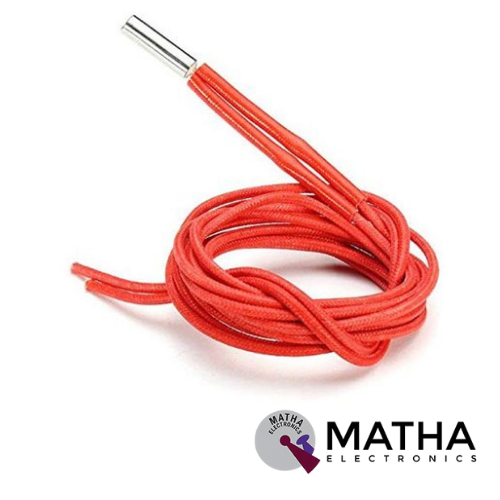
24V 40W Ceramic Cartridge Heater Wire For 3D Printer
Original price was: ₹185.00.₹175.00Current price is: ₹175.00. inc. GST
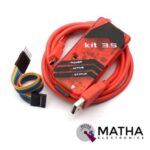
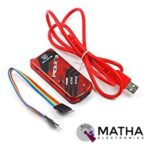
PICkit 3.5 Compatible Programmer with USB Cable and Jumper Wire- PIC Kit
Original price was: ₹2,000.00.₹1,900.00Current price is: ₹1,900.00. inc. GST
- Type: Debugger/Programmer
- Tool/Board Application: Debugging/Programming
- MCU Supported Families: Flash-based PIC MCUs
- Core Architecture: PIC, dsPIC
- IC Product Type: In-Circuit Debugger
- USB (Full speed 12 Mbits/s interface to host PC)
- Real-time execution
- MPLAB IDE compatible
- Built-in over-voltage/short circuit monitor
- Firmware upgradeable from PC/web download
- Supports low voltage to 2.0 volts (2.0v to 6.0v range)
- Diagnostic LEDs (power, busy, error)
- Read/write program and data memory of the microcontroller
- Erase of program memory space with verification
- Freeze-peripherals at breakpoint
- Program up to 512K byte flash with the Programmer-to-Go
- Easy to use Windows-based programming
- USB Interface
Out of stock
Description
The MPLAB PICkit 3.5 Development Programmer/Debugger was designed as a low-cost development tool with an easy-to-use interface for programming and debugging Microchip’s Flash families of microcontrollers. This allows debugging and programming of PIC and dsPIC Flash microcontrollers at a most affordable price point using the powerful graphical user interface of the MPLAB Integrated Development Environment (IDE).
Using a full-speed USB interface MPLAB PICkit 3 is connected to the design engineer’s PC and can be connected to the target via a Microchip debug (RJ-11) connector (compatible with MPLAB ICD 2, MPLAB ICD 3, and MPLAB REAL ICE). Moreover, it Supports Pickit3.5 software and, begins to support the Win7 system. This PICKIT 3.5 comes with a full patch design, thus the reflow soldering processing is performed through this patch, thereby acquiring more stable quality. The PICKit 3.5 programmer works at a full speed of 12 Mbits/s and interfaces to the host PC. It features real-time execution and is MPLAB IDE compatible. Meanwhile, this PICKit 3.5 programmer development board comes with built-in over-voltage/short circuit protection for the board.
Moreover, PICkit3 In-Circuit Debugger/Programmer uses in-circuit debugging logic. This programmer incorporated into each chip with Flash memory to provide a low-cost hardware debugger and programmer.
After the upgrade advantages:
- The firmware never lost, features self-healing to avoid demolition cases.
- Offline programming never collides, so download more smoothly and completely conquer all versions of MPLAB, MPLAB X.
- Can operate multiple Kit3.5, with each PICkit3.5 with a unique serial number, in MPLAB X.
- The output voltage is more stable, as the external power supply current increases.
- More and perfect interface protection
Reviews (0)
Shipping & Delivery

Related products

1 CHANNEL 5V RELAY
- 1 channel relay board
- Operating voltage: 5V
- Maximum current: 2 A
- Relay contact current capacity of 10A @250 V AC/10A@ 30V AC
- configured as SINGLE POLE DOUBLE THROW( SPDT)
- LED status indicates relay ON/OFF state.
- Standard TTL level logic controlled
- One normally closed and one normally opened contact
- Compatible with any 5V microcontroller
- Dimension: 43*17*17mm
- Weight: 150gm
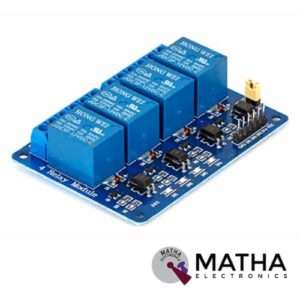

4 CHANNEL 12V RELAY
- 4-Channel relay interface board
- Relay input voltage: 12V DC
- Relay output: 5A/250V AC
- Signal input:5V DC from the microcontroller
- High current relay of 10A @250 V AC/10A@ 30V DC
- For quick and easy connection high-quality screw terminals provided
- Can control both AC & DC appliances such as DC motors, solenoid valves, lamps, etc.
- LED status indicates relay ON/OFF state.
- Power battery terminal for relay output and aux power connection
- Standard interface that can be controlled by a microcontroller (Arduino, 8051, PIC, AVR, DSP, ARM)
- Relay can directly control all equipment’s and loads
- For easy accessibility input signal pin connected to burg sticks
- Dimension: 165*65*1mm
- Weight: 7gm


4*3 MATRIX KEYPAD
- Operating voltage: 12V DC
- The maximum voltage across each button: 24v
- The maximum current across each button: 3mA
- Ultra-thin design
- Adhesive backing provides easy integration
- Easy communication with any microcontroller
- Flexible
- Only 7 microcontroller pins required to access 12 keys
- High price-performance ratio
- Allows microcontroller to scan 8 output pins to check which 16 button
- Long life
- Maximum operating temperature: 0 degrees to 50 degrees Celsius
- Dimension: 70*77*1mm
- Weight: 7.5gm

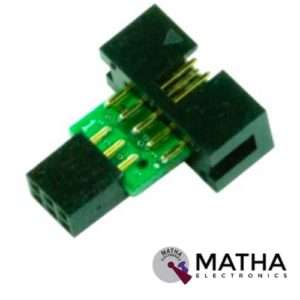


STC Automatic Programmer USB – TTL 5V 3.3V SCM Burning Programmer
- Supports 3.3V and 5V STC full range of all SCM burning procedures.
- Highest baud rate 115200
- Programmer automatically downloads without cold start, no need to frequently power down SCM.
- 4The burner with USB to TTL, USB to serial port function, can be used for USB to TTL electronic product upgrades, does not affect the normal serial communication debugging
- The success rate of STC12, STC15, STC11, STC10 series programs can be up to100%.
- Programmer uses CH340 + SCM control core.
- With 500MA self-recovery fuse, perfect to protect your computer motherboard!
- Metal aluminium shell protection burner motherboard.
- The interface definition is printed on the shell.
- When burning STC SCM, after clicking download, the light will go out, it will flash when there is data transmission, if no data transmission, it will always keep bright.
- Support win7 8 10 system (64-bit and 32-bit system)

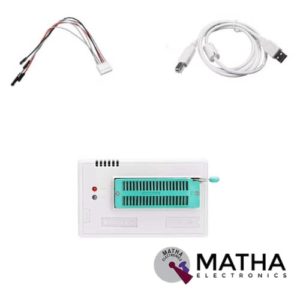
TL866CS USB Universal Programmer EEPROM FLASH 9 Adapters Extractor for 13000 Ics
- Model: TL866CS
- With a Multi-functional ICSP interface
- 40pin ZIF socket, fully automatic, support fast mode SPI
- USB interface for both data transfer and power supply
- With over-voltage and over current protection
- Supports the serial number of the chips two times development, built-in a variety of commonly used automatic numbering functions
- English Language Support
- It can program faster than another programmer 500%~1000%
- Programming EPROM, EEPROM, FLASH, SPI, I2C,93Cxx, ICSP etc.
- Supports thousands of most popular application devices (13071+)r
- Ideally suits the portable/convenient applications, which includes: car automotive field ECU chip tuning, airbag reset, mileage, satellite devices, BIOS refreshing, Xbox, Wii gaming machines EPROM sync, PIC / MCU development, newer laptop technology and newer desktop PC etc.
- Dimensions: 4.02 in x 2.48 in x 1.22 in (10.2 cm x 6.3 cm x 3.1 cm)
- Weight: 138 g
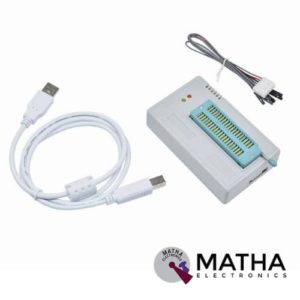
TL866II Plus Universal USB MiniPro USB Programmer for 15000+IC SPI Flash NAND EEPROM MCU PIC AVR
- High-Speed Programming - 12 Mbps
- Unique ultra-low power consumption
- Portable performance
- Programmable programming power supply
- Best overvoltage, overcurrent protection
- 40-pin universal pin
- Upgrade function
- 54/74F/LS/HC CMOS4000 series IC functional tests
- AVR microcontroller one-to-one soft encryption
- Unified and convenient user interface
- NAND Flash: Yes
- ISP for 24/93/25 MCU: Yes
- 25 NOR Flash Max. Capacity: 512M
- Multiprogramming: 4 programmers
- VPP Max. Voltage: 18 V
- VCC Voltage: 1.8 V to 6.5 V
- W29C020 P+V (s): 10.S+2.4S
- W25X80 P+V (s): 9.3S+1.7S
- W25W64 P+V (s): 69S+14.5S
- Device List: 15,000+
- Support simultaneously burn with 4 Programmers each computer
- Minimum Volume and the lowest Power Consumption and Do not Feel any Heat in Process.
- All chips do not need an external power supply, the low power consumption of its own to ensure that the USB port can provide enough power.
- Best internal 40 pins over-voltage protection, the strongest VCC/VPP 4-level overcurrent protection. The short-circuit do not reset the PC.
- Unique serial ICSP interface
- Test CMOS4000 74/54 series integrated circuit. Can be located in the gate circuit error.
- Chip auto serial number is the most complete and practical.


USBASP PROGRAMMER
- No special USB controller required
- Programming speed is up to 5Kbytes/sec
- Working platform: Linux, Windows, Mac OS X
- Allows to read or write the microcontroller EEPROM, firmware, fuse bits, and lock bits
- No special controllers or SMD components are needed.
- Target is supported by the SCK option with a low clock speed (<1.5MHz)
- Programming status and Bus status are easily identified
- The easy interface is achieved by Header pins for various ISP header pins
- Dimension: 63.3*20.5*10.5mm
- Weight: 15gm
Reviews
There are no reviews yet.