
I am text block. Click edit button to change this text. Lorem ipsum dolor sit amet, consectetur adipiscing elit. Ut elit tellus, luctus nec ullamcorper mattis, pulvinar dapibus leo.
-6%Sold out


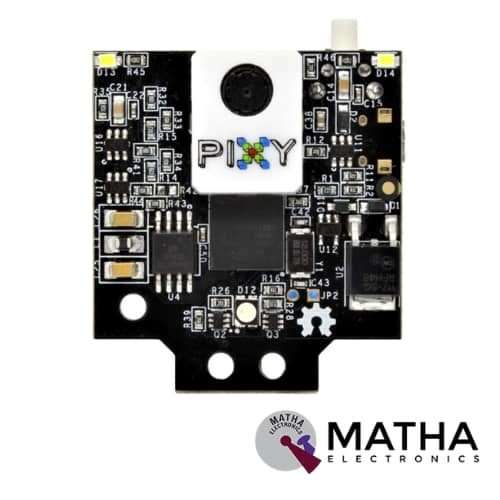
Pixy2 CMUcam5 Smart Vision Sensor - Object Tracking Camera for Arduino, Raspberry Pi, BeagleBone Black
Original price was: ₹7,500.00.₹7,200.00Current price is: ₹7,200.00. inc. GST
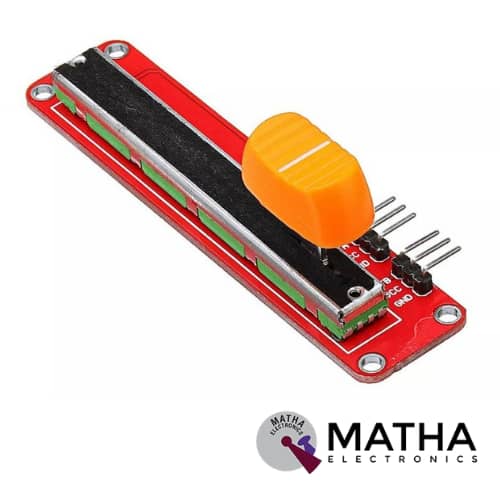
Double Analog Potentiometer Module With Slide Potentiometer Slip Adjustable Resistance For Arduino
Original price was: ₹300.00.₹250.00Current price is: ₹250.00. inc. GST
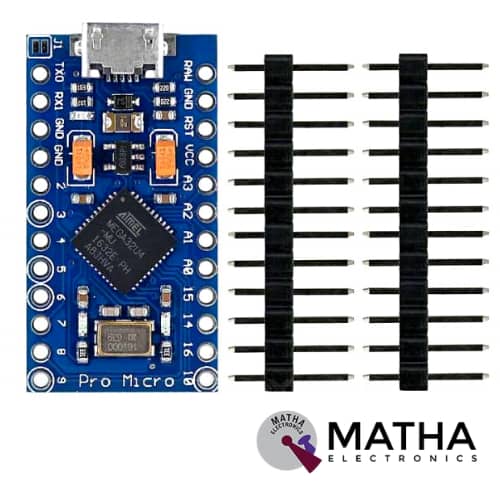
Pro Micro 5V 16M Mini Microcontroller Development Board For Arduino
Original price was: ₹850.00.₹800.00Current price is: ₹800.00. inc. GST
- ATMEGA32U4 chip
- Supply Voltage: 5VDC
- Frequency: 16Mhz
- Support Arduino IDE V1.0.1
- Four 10 bit ADC pins
- 12 pins Digital I/O(5 PWM capability)
- Micro USB interface programming on the board
- Rx and Tx hardware serial connection
- Dimension: 33mm x 18mm
Out of stock
Description
This Pro Micro 5V 16M Mini Leonardo Microcontroller Development Board For Arduino is designed based on integrated microcontroller ATMEGA32U4. It operates at a voltage of 5V and 16MHz frequency. This Arduino development board consists of 4 channel 10 bit ADC, 5 PWM pins, 12 DIO, and a hardware serial connection Transmitter and Receiver. The running features of this development board will remind you of a lot of other Arduino compatible boards that you like.
Moreover, there is a voltage regulator that is capable of accepting the voltage up to 12 VDC. And an extra pin on the board named the “RAW” used in place of VCC. In case if your power supply is not stable or unstable, connect to the “RAW”, not on the VCC pin. There also exists a PTC fuse and diode protection to the power circuit and to correct the RX and LED TX circuits.
The Micro is a microcontroller board based on the ATmega32U4 with 20 digital input/output pins. In which 7 are used as PWM outputs and 12 as analogue inputs. It operates at a frequency of 16 MHz crystal oscillator, micro USB connection, an ICSP header, and a reset button. This module consists of everything required to support the microcontroller. By simply connecting it to a computer with a micro USB cable, the board starts functioning. It has a form factor that enables it to be easily placed on a breadboard. This Micro board is similar to the Arduino Leonardo in that the ATmega32U4 has built-in USB communication. Thereby eliminating the need for a secondary processor. This allows the Micro to appear to a connected computer as a mouse and keyboard, in addition to a virtual (CDC) serial / COM port.
Reviews (0)
Shipping & Delivery

Related products


2.4″ Inch Touch Screen TFT Display Shield for Arduino
- 4″ Touch LCD TFT display module for Arduino
- 240*320 pixels resolution
- Ability to display 262000 different colours
- The shield comes equipped with a microSD card slot.
- SPFD5408 controller with built-in video RAM buffer
- 8-bit digital interface, plus 4 control lines
- 5V compatible. Use with 3.3V or 5V logic
- On-board 3.3V 300mA LDO regulator
- Uses digital pins 5-13 and analogue 0-3. That means you can use digital pins 2, 3, and analog 4 and 5. Pin 12 is available if not using the microSD
- Works with any Arduino Uno and mega compatible boards
- Resolution: 240320 pixels
- Supply voltage: 5V
- Working temperature: -30C ~ 70C
- Dimension: 72*52*12mm

4*4 MATRIX KEYPAD
The maximum voltage across each button: 24v
- The maximum current across each button: 3mA
- Easy communication with any microcontroller
- Ultra-thin design
- Adhesive backing provides easy integration
- High price-performance ratio
- Allows microcontroller to scan 8 output pins to check which 16 button
- Long life
- Maximum operating temperature: 0 degrees to 50 degrees Celsius
- Dimension: 70*77*1mm
- Weight: 7.5gm
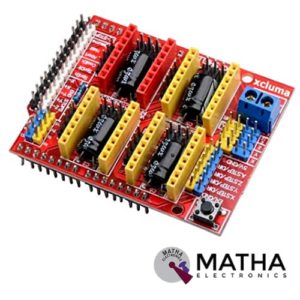

Arduino CNC Shield v3 Engraving Machine/3D Printer/A4988 driver GRBL compatible
- Coolant enable
- Uses removable Pololu A4988 compatible stepper drivers. (A4988, DRV8825, and others) (Not Included)
- Jumpers to set the Micro-Stepping for the stepper drivers. (Some drivers like the DRV8825 can do up to 1/32 micro-stepping )
- Compact design.
- Stepper Motors can be connected with 4 pin Molex connectors or soldered in place.
- Runs on 12-36V DC. (At the moment only the Pololu DRV8825 drivers can handle up to 36V so please consider the operation voltage when powering the board.)
- Please note that this is an unassembled kit and needs soldering.
- Latest Arduino CNC Shield Version 3.10
- GRBL 0.9 compatible. (Open source firmware that runs on an Arduino UNO that turns G-code commands into stepper signals)
- PWM Spindle and direction pins
- 4-Axis support (X, Y, Z, A-Can duplicate X, Y, Z or do a full 4th axis with custom firmware using pins D12 and D13)
- 2 x End stops for each axis (6 in total)
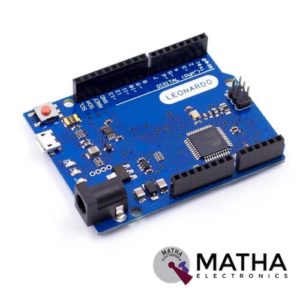

Arduino Leonardo R3
- Board Mode: LEONARDO R3
- Microcontroller: ATmega32u4
- Operating Voltage: 5V
- Input Voltage (Recommended): 7-12V
- Input Voltage (limits): 6-20V
- Digital I/O Pins: 20
- PWM Channels: 7
- Analog Input Channels: 12
- DC Current per I/O Pin: 40 mA
- DC Current for 3.3V Pin: 50 mA
- Flash Memory: 32 KB
- SRAM: 2.5 KB (ATmega32u4)
- EEPROM: 1 KB (ATmega32u4)
- Clock Speed: 16 MHz

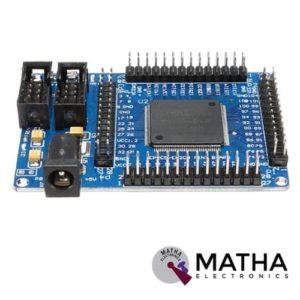
EP2C5T144 Altera Cyclone II FPGA Mini Development Board
- Onboard the EP2C5T144 chip.
- EPROM chip configuration using EPCS4, the size of 4Mbit.
- Onboard 50M active patch crystal (Crystal Slaughter halfback).
- Power supply with a largemouth outlet, single 5V power supply.
- Board has a power indicator and resets the switch.
- Onboard 3 SMD LED, the LED test can be done an experiment, more experiments using lead to complete.
- More IO ports and clock pins through the pin leads through these interfaces can be extended to any memory and peripherals.
- Board using a high-quality tantalum capacitor power filter.
- Support NiosII embedded CPU development.
- Board Dimension (LxWxH) mm: 72 x 52 x 13mm.
- Weight: 26gm.

MEPUNO COMMUNICATION BOARD
- Microcontroller ATMEGA328 P
- Crystal for microcontroller: 16 MHZ
- USB type B connector
- On-Board Power LED Indicator
- 5volt, 12 volt regulated circuit
- Two separate regulated 5volt power supply
- On Board On/Off switch
- On Board DC jack for powering up using adaptors
- On Board Reset Switch
- On Board TX/RX indication LEDs
- On board FTDI Driver for adruino
- Berg headers for external interfacing
- Supports I2C /GSM /GPS/RF/USART serial communication
- Separate berg headers available for PIR, Servo motor, RTC/I2C, GPS_TTL, and USART-TTL
- Four 3pin PBT Connectors
- Four SPDT 12V Relays
- Onboard DB9 connectors for GPS, GSM and USART communication
- Berg slot for 16x4 LCD connections
- Onboard TRIM-POT for LCD
- Onboard RTC IC: IN1307 with crystal 32768 MHZ crystal and CR2302 battery


MINI NODEMCU ESP8266 WIFI DEVELOPMENT BOARD BASED ON ESP-12F
- Communication interface voltage: 3.3V
- Working current: 240mA(MAX)
- Serial port baud rate: 115200 (default), can be modified to other values by AT command
- Serial communication format: 8N1
- Wireless Network Mode: station / softAP / SoftAP + station
- Wireless criteria: 802.11 b / g / n
- WIFI @ 2.4 GHz, support for WPA / WPA2 security mode
- +19.5dBm output power
- Compatible with ESP-12(ESP-202)
- It is very easy to develop projects with AT commands
- Surface Mount Package with 2mm Pitch Pads
- Multiple GPIO’s for all your sensor needs
- Integrated TCP/IP protocol stack
- Integrated TR switch, balun, LNA, power amplifier and matching network
- Integrated PLL, regulators, DCXO and power management unit
- Power down leakage current of <10uA
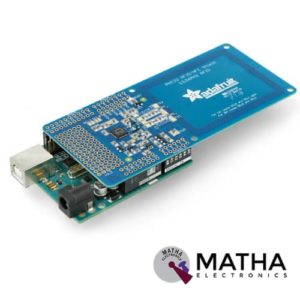

PN532 NFC/RFID Controller Shield for Arduino
- PN532 chip-set
- Operating Voltage : 3.3V ~ 5v
- Support I2C, SPI
- I2C: 3.3V ~ 24V TTL
- SPI: 3.3V TTL with 100-ohm resistors in series
- Plug and play, Arduino compatible
- Built-in PCB Antenna
- Communication distance:10cm
- Easy to change mode
- NFC/RFID PN532 shield including a tuned 13.56MHz stripline antenna
- 36-pin 0.1" header for attaching the shield to an Arduino.
- Compatible with Arduino Mega 1280 & 2560, Diecimila, Duemilanove, and UNO
Reviews
There are no reviews yet.