
I am text block. Click edit button to change this text. Lorem ipsum dolor sit amet, consectetur adipiscing elit. Ut elit tellus, luctus nec ullamcorper mattis, pulvinar dapibus leo.
-25%

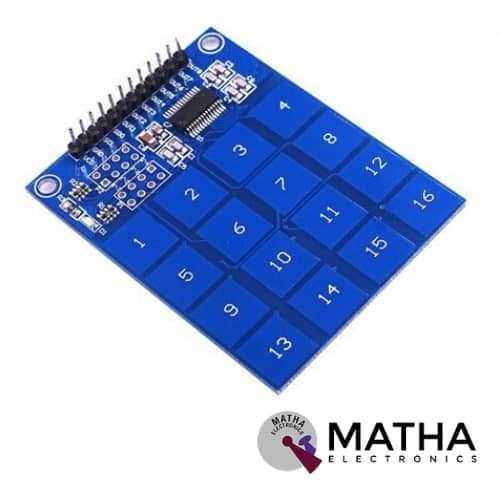
TTP229 16WAY
Original price was: ₹400.00.₹350.00Current price is: ₹350.00. inc. GST
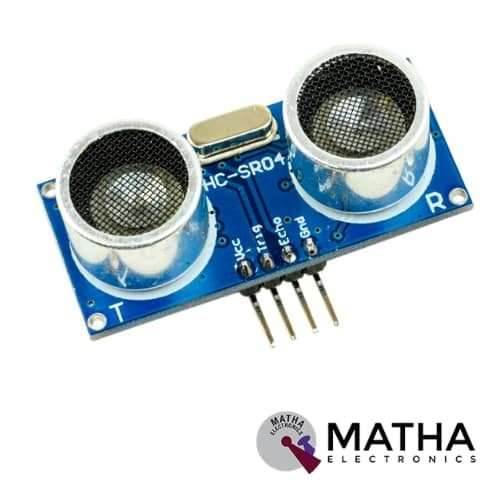
Ultrasonic Module HC-SR-04
Original price was: ₹150.00.₹100.00Current price is: ₹100.00. inc. GST
TURBIDITY SENSOR
Original price was: ₹2,000.00.₹1,500.00Current price is: ₹1,500.00. inc. GST
- Working voltage: DC5V
- Measure water turbidity and estimate water quality
- Operating Current: 30mA (MAX)
- Response time : <500ms
- Digital and analogue output
- High level: 5V, low level: 0V
- Operating temperature: -30 to 80 degrees C
- Storage temperature:-10 to 80 degrees C
- Compatible with Arduino, Raspberry Pi, AVR, PIC, etc.
- Weight: 15g
Description
Turbidity sensors are used to measure water turbidity and to estimate water quality. These sensors are used to measure the particles in wash water/dirt water. Turbidity is the process in which the particles of solid matter is suspended in water, rather than dissolved into it. Turbidity testing is an important process in water quality maintenance. The increased level of turbidity raises water temperature because suspended particles absorb heat. The warm water consists of less dissolved oxygen than cold. So when water temperature increases result in a decreased level of dissolved oxygen.
The turbidity sensor works on the optical principle. By using the Transmittance and Scattering rate of a liquid solution, the turbidity is determined. The sensor uses a phototransistor and a light-emitting diode. The light emitted by the sensor passes through the light-emitting diode source, reflected by sewage, and part of it is transmitted to a phototransistor. And water turbidity calculated based on the light received. When light passes through some amount of water, the amount of light penetrates depending on the amount of dirty water. When the number of dirt increases, the amount of light penetration through the water decreases. And thereby the turbidity sensor measures the amount of light transmitted to calculate the turbidity of wash water.
The sensor ensures the relative turbidity value and provides both analogue and digital output. The analogue voltage varies with respect to the water turbidity between 0V and 5V. The On-Board Potentiometer was used to pre-set the Threshold value. When the measured Turbidity goes above the threshold level the digital output switches to high, else remain in a low state. The analogue and digital output can be easily interfaced to an Arduino, Raspberry Pi, or other Microcontroller to get turbidity.
Reviews (0)
Shipping & Delivery

Related products

1 CHANNEL 5V RELAY
- 1 channel relay board
- Operating voltage: 5V
- Maximum current: 2 A
- Relay contact current capacity of 10A @250 V AC/10A@ 30V AC
- configured as SINGLE POLE DOUBLE THROW( SPDT)
- LED status indicates relay ON/OFF state.
- Standard TTL level logic controlled
- One normally closed and one normally opened contact
- Compatible with any 5V microcontroller
- Dimension: 43*17*17mm
- Weight: 150gm


3.3V/5V MB102 Breadboard Power Supply Module
- Input voltage: 6.5V to 12V
- Output voltage: 3.3V to 5V
- Output current: 700Ma
- Apply to MB102 breadboard
- Sorting jumpers used to switch voltage between 3.3V and 5V
- Onboard LED indicator to show the presence of power
- Short circuit protection
- Fits securely on standard 400 and 830 points on the breadboard
- Dimensions: 53*32*23mm
- Weight: 10gm
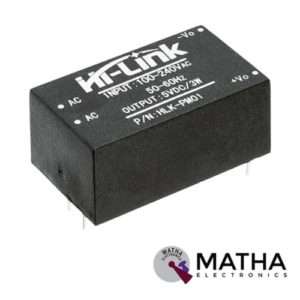
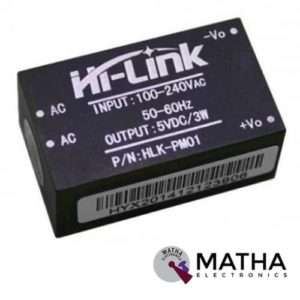
AC-DC Power Module HLK-PM01 230V to 5V /3W
- Meet UL, CE requirements
- Rated input voltage: AC 100V -230V
- Maximum input voltage: <270V AC
- Voltage Regulation: ±0.2%
- Load Regulation: ±0.5%
- High efficiency, high power density
- Ultra-thin and small module
- Low ripple and low noise
- Output overload and short circuit protection
- 100% load ageing and testing
- The product is designed to meet the requirements of the EMC and Safety Test
- Low power consumption, environmental protection, no-load loss <0.1W
- High efficiency, high power density
- Working temperature: – 20 degrees to +60 degrees Celsius
- Storage temperature: + 80-40 -degree
- Relative humidity: 5-95%
- Cooling way: Natural cooling
- Atmospheric pressure: 80-106Kpa
- Weight: 21g
- Size: 38x23x18mm
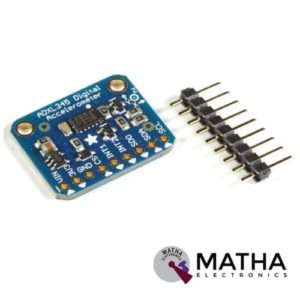

ADXL345
- Supply voltage: 3.3V/5V
- Communication type: I2C/SPI
- Sensing range: +/-2G to +/-16G
- Sensitivity
- X: 28.6 LSB/G
- Y: 31.2 LSB/G
- Z:34.5 LSB/g
- On-board LDO voltage regulator
- Resolution: 13 bit
- Single tap/double-tap detection
- Embedded memory management system with FIFO
- 10000g shock survival
- Low power consumption as low as 23 µA in measurement mode and 0.1 µA in standby mode at VS = 2.5 V (typical)
- 3-axis MEMS accelerometer
- Ideal for noisy power environment
- Operating temperature: -40 degrees to 85 degrees Celsius
- Dimension: 28*14mm
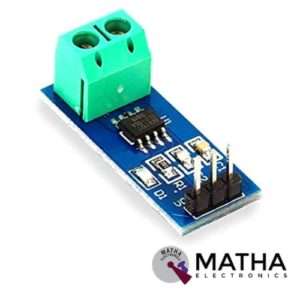

CURRENT SENSOR ACS712 30AMPS
- Current sensor chip: ACS712ELC-30A
- Supply voltage: 4.5V to 5.5V DC
- Current range: -30A to 30A
- Sensitivity: 66 millivolt/ampere
- Low noise analogue signal path
- Output rise time: 5 micro sec
- Extremely stable output offset voltage
- Zero magnetic hysteresis
- Factory trimmed for accuracy
- Easy to interface with a microcontroller, since it outputs an analogue voltage
- Onboard power indicator
- Dimension: 7*5*5cm
- Weight: 400gm
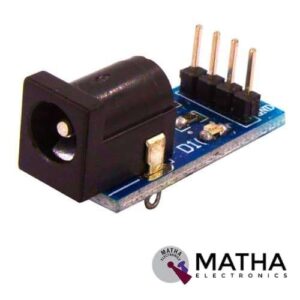


IRF520 MOSFET DRIVER MODULE SENSOR
- Operating Voltage: 3.3v & 5v
- Digital level port
- Output load voltage: 0-24v
- Output load current: <5A
- The heat sink is added for currently more than 1A
- Compatible with Arduino, MCU, ARM, Raspberry pi
- PWM dimming LED used to step-less dimming, variable-speed motor
- Output PWM can be adjusted by the original IFR520 MOS
- Arduino can drive up to 24V, such as led lights, dc motors, miniature pumps, solenoid valves etc.
- Dimension:34*30*18mm
- Size: 10gm

Reviews
There are no reviews yet.