
I am text block. Click edit button to change this text. Lorem ipsum dolor sit amet, consectetur adipiscing elit. Ut elit tellus, luctus nec ullamcorper mattis, pulvinar dapibus leo.
-2%Sold out
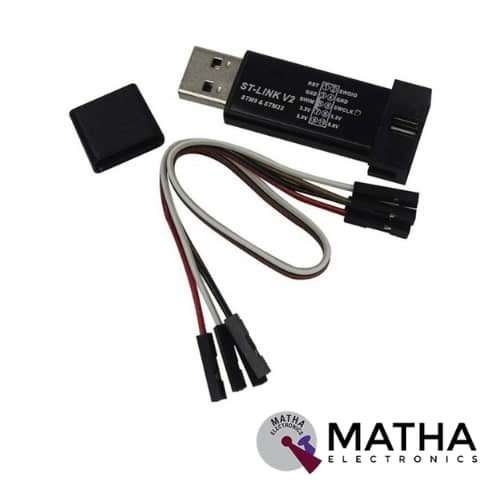
Mini St-Link V2 Stlink Emulator Downloader Stm8 Stm32 with Metal Shell
Original price was: ₹1,150.00.₹950.00Current price is: ₹950.00. inc. GST
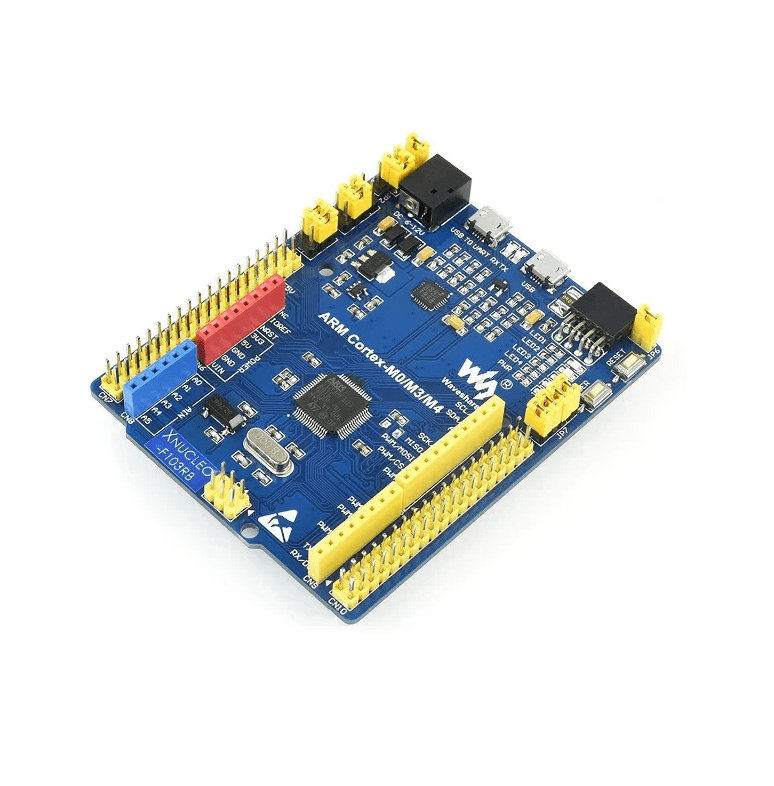
XNUCLEO-F103RB, Improved STM32 NUCLEO Board
Original price was: ₹4,575.00.₹4,500.00Current price is: ₹4,500.00. inc. GST
- Core: ARM® 32-bit Cortex™-M3
- Operating frequency: 72MHz
- Operating voltage: 2.0V-3.6V
- Package: LQFP64
- Memories : 128kB Flash, 20kB SRAM
- Interfaces : 2 x SPI, 3 x USART, 2 x I2C, 1 x CAN, 1 x USB
- AD/DA : 2 x AD (12 bit, 16 channels)
- Compatible with NUCLEO-F103RB, onboard Cortex-M3 microcontroller STM32F103RBT6
- Arduino connectivity support, easy to connect with various Arduino shields and access the massive Arduino resources
- ST Morpho headers provide full access to all STM32 I/Os, easy for peripheral expansion
- Supports mbed, build a prototype quickly by mbed SDK and online tools
- Comprehensive free software HAL library including a variety of software examples
- Comes with a separated ST-LINK/V2 module
Out of stock
Description
This XNUCLEO-F103RB, Improved STM32 NUCLEO Board designed specifically to support users to get familiar with the features of the entire STM32 MCU family. This development board comes with connectors that are compatible with Arduino, and a new standardized ST connector (Morpho). These XNUCLEO-F103RB boards, Compatible with NUCLEO-F103RB.
The XNUCLEO-F103RB board series is based on ARM Cortex-M 32-bit RISC cores microcontroller STM32F103RBT6 optimized for high performance and energy efficiency. ARM Cortex-M features a High-density instruction set and a Nested Vectored Interrupt Controller (NVIC) providing excellent interrupt handling abilities. All parts of the STM32 Xnucleo board and Shield powered from the ST-LINK/V2 (mini) USB connector by the host PC. ST Morpho headers provide full access to all STM32 I/Os, easy for peripheral expansion.
When the ST-LINK/V2 (mini) USB connector used to power the Xnucleo board, the host PC will provide 150mA current at maximum as 3.3V voltage outputted from the ST-LINK/V2 (mini) USB connector to the Xnucleo board. And also 300mA current at maximum provided when 5V voltage is outputted to the Xnucleo board. Under the condition, board requiring the current more than 300mA, it should be mandatory to use an external power supply
The on-board LEDs on the STM32 Xnucleo board provide information about the Xnucleo working status. The red color LED indicates the power status of the STM32 Xnucleo board. Whereas the red LED indicates that the MCU part powered by +5V. The Serial port working status LED indicators with TX indicator is in green and RX indicator in blue. The blinking TX indicator indicates that the MCU of the STM32 Xnucleo board is sending messages to the targeted PC. And also blinking RX indicator means MCU of the STM32 Xnucleo board is receiving a message from the targeted PC.
Reviews (0)
Shipping & Delivery

Related products


2.4″ Inch Touch Screen TFT Display Shield for Arduino
- 4″ Touch LCD TFT display module for Arduino
- 240*320 pixels resolution
- Ability to display 262000 different colours
- The shield comes equipped with a microSD card slot.
- SPFD5408 controller with built-in video RAM buffer
- 8-bit digital interface, plus 4 control lines
- 5V compatible. Use with 3.3V or 5V logic
- On-board 3.3V 300mA LDO regulator
- Uses digital pins 5-13 and analogue 0-3. That means you can use digital pins 2, 3, and analog 4 and 5. Pin 12 is available if not using the microSD
- Works with any Arduino Uno and mega compatible boards
- Resolution: 240320 pixels
- Supply voltage: 5V
- Working temperature: -30C ~ 70C
- Dimension: 72*52*12mm
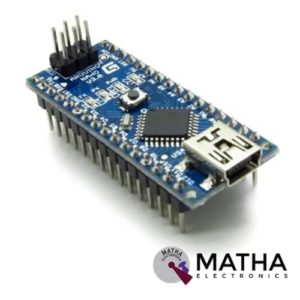

Arduino Nano V3.0
- Microcontroller: Atmel ATmega328 SMD Package
- Operating Voltage (logic level): 5 V
- Input Voltage (recommended): 7-12 V
- Input Voltage (limits): 6-20 V
- Digital I/O Pins: 14 (of which 6 provide PWM output)
- Analog Input Pins: 8
- DC Current per I/O Pin: 40 mA
- Flash Memory: 32 KB (of which 2KB used by bootloader)
- SRAM: 2 KB
- EEPROM: 1 KB
- Clock Speed: 16 MHz
- Automatic reset during program download
- Power OK blue LED
- Green (TX), red (RX) and orange (L) LED
- Auto-sensing/switching power input
- Small mini-B USB for programming and serial monitor
- ICSP header for direct program download
- Standard 0.1” spacing DIP (breadboard friendly)
- Manual reset switch
- Dimensions: 0.70” x 1.70”


L293D Motor Driver Shield
- L293D motor driver chip & 74HC595 shift register
- Four H-bridges
- Terminal blocks and jumper to connect external power, for separate logic/motor supplies
- Up to 4 bi-directional DC motors with individual 8-bit speed selection
- Up to 2 stepper motors (unipolar or bipolar) with single coil, double coil or interleaved stepping.
- 2 connections for 5V ‘hobby’ servos connected to the Arduino’s high-resolution dedicated timer
- 4 H-Bridges: L293D chipset provides 0.6A per bridge (1.2A peak) with thermal shutdown protection, internal kickback protection diodes. Can run motors on 4.5VDC to 25VDC.
- Pull-down resistors keep motors disabled during power-up
- Big terminal block connectors to easily hook up wires (18-26AWG) and power
- Arduino reset button brought up top
- Tested compatible with Arduino Mega 1280 & 2560, Diecimila, Duemilanove, and UNO
- PCB Size: 69 x 53 mm

NUCLEO-64 STM32G071RBT6 Development Board Arduino & ST Morpho Connectivity
- STM32 microcontroller in LQFP64 package
- 1 user LED shared with ARDUINO®
- 1 user and 1 reset push-buttons
- 768 kHz crystal oscillator
- Board connectors: ARDUINO Uno V3 expansion connectors morpho extension pin headers for full access to all STM32 I/Os
- Flexible power-supply options: ST-LINK, USB VBUS, or external sources
- On-board ST-LINK debugger/programmer with USB re-enumeration capability: mass storage, Virtual COM port and debug port
- Comprehensive free software libraries and examples available with the STM32Cube MCU Package
- Support of a wide choice of Integrated Development Environments (IDEs) including IAR Embedded Workbench®, MDK-ARM, and STM32CubeIDE
- Board-specific features
- External SMPS to generate Vcore logic supply
- 24 MHz HSE
- Board connectors: External SMPS experimentation dedicated connector Micro-AB or Mini-AB USB connector for the ST-LINKMIPI® debug connector
- Arm® Mbed Enabled™ compliant


Sensor Shield V5 Expansion Board For Arduino
- Retain the merits of the V4.0 version
- Laminated design
- PCB immersion gold processing technology
- IIC interface
- Bluetooth module communication interface
- SD card module communication interface
- APC220 Wireless RF modules communication interface
- RB URF v1.1 ultrasonic sensors interface
- 12864 LCD string of line and parallel interface
- 32 servo controller interface

STM32 Nucleo-64 development board with STM32F103RB MCU, supports Arduino and ST morpho connectivity
- STM32 microcontroller with LQFP64 package
- Two types of extension resources
- mbed-enabled (mbed.org)
- On-board ST-LINK/V2-1 debugger/programmer with SWD connector
- Flexible board power supply
- Three LEDs
- Two push buttons: USER and RESET
- USB re-enumeration capability: three different interfaces supported on USB
- Comprehensive free software HAL library including a variety of software examples
- Supported by wide choice of Integrated Development Environments (IDEs) including IAR, Keil, GCC-based IDEs


USB Host Shield
- Works with standard (dual 5/3.3V) and 3.3V-only (for example, Pro Arduino) boards.
- Operates over the extended -40°C to +85°C temperature range
- Complies with USB Specification Revision 2.0 (Full-Speed 12Mbps Peripheral, Full-/Low-Speed 12Mbps/1.5Mbps Host)
- Supports HID devices, such as keyboards, mice, joysticks, etc.
- Compatible with Mass storage devices, such as USB sticks, memory card readers, external hard drives (FAT32 Type File System – Mega Arduino only).
Reviews
There are no reviews yet.