
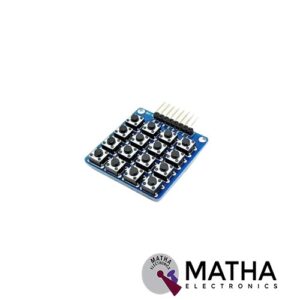

4×4 Keypad Board Matrix Keyboard 16 Key Buttons For Arduino
- 4×4 Matrix Keyboard Module with 16 buttons
- Small in size and hence Save space
- More convenient to use
- Expanded development application modules for single chip
- With 16 keys and an 8 pin
- The maximum voltage across each button: 24v
- The maximum current across each button: 3mA
- Easy communication with any microcontroller
- Ultra-thin design
- Adhesive backing provides easy integration
- High price-performance ratio
- Allows microcontroller to scan 8 output pins to check which 16 button
- Long life
- Maximum operating temperature: 0 degrees to 50 degrees Celsius
- Dimension: 70*77*1mm
- Weight: 7.5gm
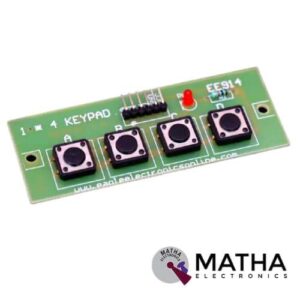
1×4 Key Matrix Switch Keypad
- Key Type: 4×1;
- Voltage: DC 12 Volt
- Mount Style: Self-Adherence
- Circuit Rating: 35 VDC, 100 mA.
- Contact Bounce : <=5ms
- Life Expectancy: 1 million closures
- Operation Temperature : -20 to +40 °C
- 5 pins 2.54mm pitch connector, 4×1 type 4 keys.
- Force: 250-350g
- Contact Bounce: Greater than 1s
- Cable Length: 52mm
- Ultra-thin design & adhesive backing provides easy integration to any project
- Excellent price-performance ratio
- Easy communication with any microcontroller
- Used widely in industrial and home electronic equipment's, instruments, etc.

DB9 BreakOut Board
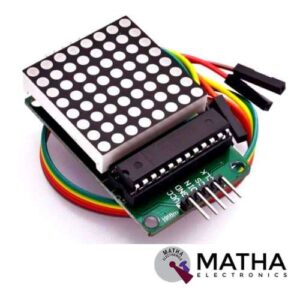
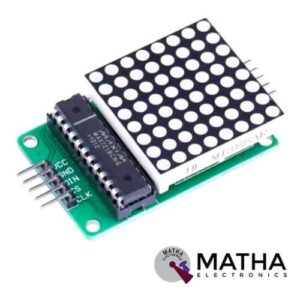
Square MAX7219 8×8 LED Dot Matrix Display Module
- Driver Chip: MAX7219
- Input Voltage: 3.7 to 5.3 V
- Input Current: 320 mA
- Display Dimensions: 32x32x6 mm
- PCD Dimensions: 50×32 mm
- A single module can drive an 8 * 8 common cathode lattice
- Requires only 3 communication wires of MCU
- Cascading multiple Matrix LED Module is very easy
- The size of the display is very compact
- The PCB features M3 holes for mounting.
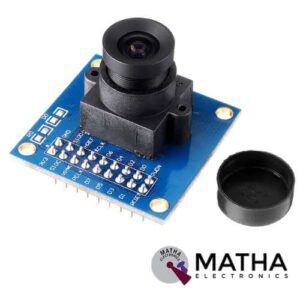
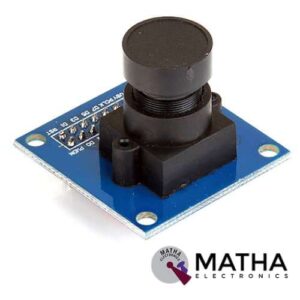
OV7670 Camera Module
- Model: OV7670 640X480 VGA CMOS CAMERA
- I/O Voltage: 2.5V to 3.0V
- Operating Power: 60mW/15fpsVGAYUV
- Sleeping Mode: <20μA
- Operating Temperature: -30 to 70 degrees Celsius
- Pixel Coverage: 3.6um x 3.6um
- Lens Size: 1/6″
- Vision Angle: 25 degrees
- Frame Rate: 30fps VGA
- Sensitivity: 1.3V / (Lux-sec)
- Signal to Noise Ratio: 46 dB
- Dynamic Range: 52 dB
- Browse Mode: By row
- Electronic Exposure: 1 to 510 row
- Duck Current: 12 mV/s at 60℃
- PCB Size (L x W): Approx. 1.4 x 1.4 inch / 3.5 x 3.5 cm
- Support VGA, CIF and from CIF to 40 x 30 format
- Various Pixel methods for sub-sampling; Auto Image Control: AEC, AGC, AWB, ABF, ABLC;
- Image Quality Control: Colour saturation, hue, gamma, sharpness, and anti-blooming;
- DSP includes noise reduction and defect correction; Support image scaling; Lens shading correction;
- Flicker 50/60Hz auto-detection
- Colour saturation level auto adjust
- Edge enhancement level auto adjust
- De-noise level auto adjust
- High sensitivity for low light applications
- Low voltage suitable for embedded applications
- Standard SCCB interface, compatible with I2C interface


TM1637 4 Bits Digital Tube LED Display Module With Clock Display for Arduino
- Driver Chip: MAX7219
- Input Voltage: 3.7 to 5.3 V
- Input Current: 30 mA
- Display Dimensions: 42x24x12 (LxWxH) mm
- Ease to use.
- Ease of multiplexing.
- Can use as a 4 digit display unit.
- Can use as a clock display.
- The counter project uses 7 segment display.
- 4 M2 screws positioning holes for easy installation

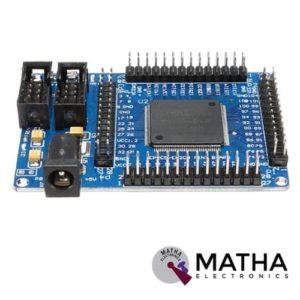
EP2C5T144 Altera Cyclone II FPGA Mini Development Board
- Onboard the EP2C5T144 chip.
- EPROM chip configuration using EPCS4, the size of 4Mbit.
- Onboard 50M active patch crystal (Crystal Slaughter halfback).
- Power supply with a largemouth outlet, single 5V power supply.
- Board has a power indicator and resets the switch.
- Onboard 3 SMD LED, the LED test can be done an experiment, more experiments using lead to complete.
- More IO ports and clock pins through the pin leads through these interfaces can be extended to any memory and peripherals.
- Board using a high-quality tantalum capacitor power filter.
- Support NiosII embedded CPU development.
- Board Dimension (LxWxH) mm: 72 x 52 x 13mm.
- Weight: 26gm.


Altera MAX II EPM240 CPLD Development Board
- Onboard the EPM240T100C5N chip.
- EPROM chip configuration using EPCS4, the size of 8Kbit.
- Onboard 50M active patch crystal (Crystal Slaughter halfback).
- Power supply with a largemouth outlet, single 5V power supply.
- Board has a power indicator and resets switch.
- More IO ports and clock pins through the pin leads through these interfaces can be extended to any memory and peripherals.
- Board Dimension (LxWxH) mm: 72 x 52 x 13mm.
- Weight: 21gm.

STM32 Nucleo-64 development board with STM32F103RB MCU, supports Arduino and ST morpho connectivity
- STM32 microcontroller with LQFP64 package
- Two types of extension resources
- mbed-enabled (mbed.org)
- On-board ST-LINK/V2-1 debugger/programmer with SWD connector
- Flexible board power supply
- Three LEDs
- Two push buttons: USER and RESET
- USB re-enumeration capability: three different interfaces supported on USB
- Comprehensive free software HAL library including a variety of software examples
- Supported by wide choice of Integrated Development Environments (IDEs) including IAR, Keil, GCC-based IDEs

Msp-Exp430G2 Msp430 Launchpad
• 14-/20-pin DIP (N) Socket
• 20 pin Launchpad standard leveraging the Booster Pack ecosystem
• On-Board EZ-FET emulator featuring Energy Trace™ technology
• USB debugging and programming interface featuring a driverless installation and application UART
• serial communication with up to 9600 Baud
• Supports MSP430G2xx2, MSP430G2xx3, and MSP430F20xx devices in PDIP14 or PDIP20 packages
• Two general-purpose digital I/O pins connected to green and red LEDs for visual feedback
• Two push button for user feedback and device reset
• Easily accessible device pins for debugging purposes or as socket for adding customized extension boards
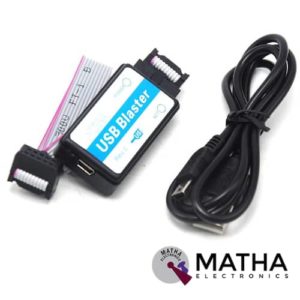

USB Blaster ALTERA CPLD/FPGA Programmer
- Stably support SignalTap II embedded logic analyzer function, no mistake while crawling data.
- Fully support all Altera products such as CPLD: MAX3000, MAX7000, MAX9000, and MAXII.
- FPGA: Stratix, StratixII, StratxIII, Cyclone, CycloneII, CycloneIII, ACEX1K, APEX20K, and FLEX10K, etc.
- Active serial configuration device: EPCS1, EPCS4, EPCS16, EPCS64 etc.
- Enhanced configuration devices: EPC1, EPC4.
- Supports 3 download modes: AS, PS, and JTAG.
- Support and Nios II embedded soft core processor communication and debugging Rev.C latest version Hardware. Support jtag_uart.
- Speed is 6 times faster than parallel port download cable ByteBlasterII.
- Easy to use: MiniUSB interface, easy connection, two status indicator makes debugging more comfortable.
- Fully compatible with ALTERA USB Blaster, functionality and performance are the same as ALTERA original download cable.
- Operating Voltage: 1.5~5V JTAG IO Voltage.
- System configuration: Windows XP, Windows Vista, Windows7, USB interface.


USB AVR ISP 10 Pin Programmer | ATmega8 USB Programmer
- Allows you to read or write the microcontroller EEPROM, firmware, fuse bits and lock bits
- Support for Linux, Mac OS X and Windows XP,7,8
- 5 KB/sec maximum write speed
- Software controlled SCK option to support targets with low clock speed (< 1.5MHz)
- 10 pin ISP interface
- Works under multiple platforms. Linux, Mac OS X and Windows are tested.
- Software controlled SCK option to support targets with low clock speed (less than 1.5MHz).
- 6 Pin Adapter board along with the programmer for Standard ISP connections.
- B-type USB Connector for power.
- Separate Two Different leds for power & programmer status.