
I am text block. Click edit button to change this text. Lorem ipsum dolor sit amet, consectetur adipiscing elit. Ut elit tellus, luctus nec ullamcorper mattis, pulvinar dapibus leo.
-17%
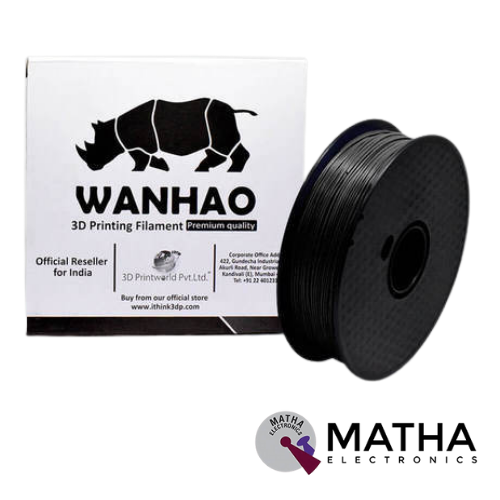
1.75mm PLA 3D Printer Filament Black Wanhao
Original price was: ₹1,800.00.₹1,500.00Current price is: ₹1,500.00. inc. GST
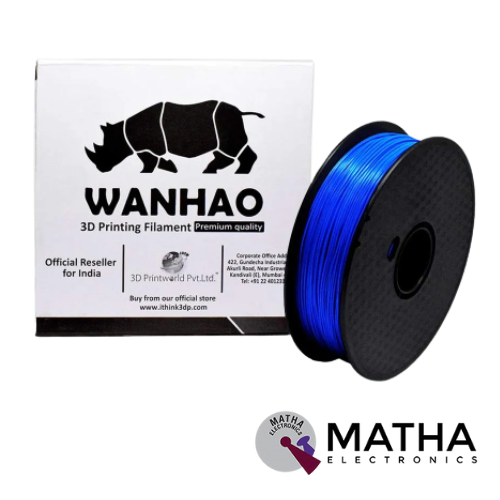
1.75mm PLA 3D Printer Filament Translucent Blue Wanhao
Original price was: ₹1,800.00.₹1,500.00Current price is: ₹1,500.00. inc. GST
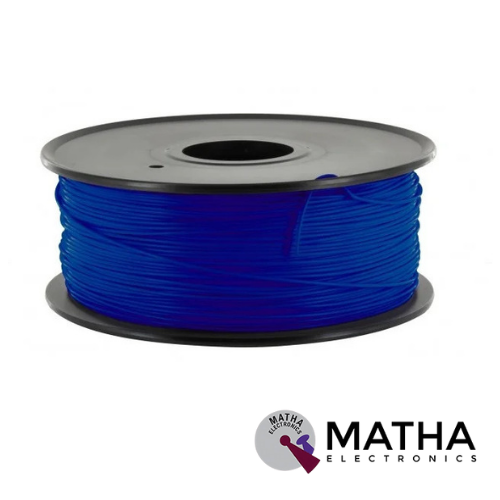
ABS 1.75 mm 1 kg Filament for 3d printer, Dark Blue Wanhao
Original price was: ₹1,800.00.₹1,500.00Current price is: ₹1,500.00. inc. GST
- Material: ABS
- Color: Dark Blue Color ABS.
- Material Diameter: 1.75mm
- Printing Temperature: 220° to 230°C
- Mounted: Spool Mounted
- Net weight: 1kg
- Diameter Accuracy: 1.75mm
- Roundness Accuracy: +/- 0.5mm +/- 0.5mm
- Density: 1.31g/cm3 1.01g/cm3
- Melt Point: 210°C 220°C
- Outer Diameter: 200 mm
- Hub Diameter: 32 mm
- Packaging Vacuum-sealed with desiccant to protect filament from humidity
- Extrusion Speed Tested up to 200mm/s
- Compatible with any FDM 3D Printer.
- ABS is stronger than PLA
- Easy to post-process.
- Environment friendly – ISO 9001 and ROHS certified
Description
This ABS 1.75 mm 1 kg Filament for 3d printer, Dark Blue Wanhao designed to generate a highly detailed and quality output product using ABS filament. ABS, known as Acrylonitrile Butadiene Styrene, defined as a multipurpose material widely used in 3D printing. ABS is the same material that Lego bricks are made out of. And function as a great plastic for working parts. Basically, final products made up of ABS material are very durable, withstand a wide range of temperatures. And also tend to be more flexible and less ‘brittle’ than those made with PLA. This Dark Blue ABS Color ABS comes in a 1 Kg (2.2 lbs) spool of 1.75mm ABS filament.
In order to provide a glossy look to our finished ABS product, acetone can be used for post-processing. ABS works perfectly with a heated bed as ABS contracts when cooled and large parts may pull off of a non-heated bed. This easy-to-process ABS filament comes in a vacuum-sealed bag with desiccant to protect the filament from humidity. Otherwise, it absorbs moisture, thereby affecting the dimensional tolerances of your 3D printer filament. So it is recommended to use the vacuum-sealed bag to keep the material free from humidity. ABS defined as a thermoplastic that easily molds when heated and hardens evenly when cooled.
Recommended temperatures when used with Wanhao 3D printers:
- First Layer: 210 ° C
- Printing temperature: 200 ° C
- Raft temperature: 190 ° C
- Heating bed temperature: 45-60 ° C
Applications Of Wanhao ABS Filament
- Everyday 3D prints
- Architecture mock-ups
- Educational 3D models
- Detailed conceptual models
- Professional quality enclosures
Reviews (0)
Shipping & Delivery

Related products

100K ohm NTC 3950 Thermistor/Temperature Sensor for Reprap 3D printer Extruder
- High-temperature Teflon wire temperature: 200 degrees
- Nominal resistance R25 (25 ℃): 100k
- Resistance accuracy: ± 1%
- B value R25 / 50: 3950k
- B value accuracy: ± 1%
- Operating temperature range: -40 ℃ ~ +300 ℃
- Dissipation power factor: ≥ 5 mW / ℃ (static air)
- Thermal time constant: ≤ 7S (static air)
- Maximum rated power: 45mW
- Wiring length: 1 meter
- Material: glass glaze film
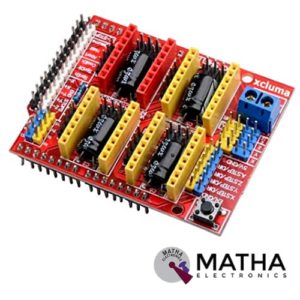

Arduino CNC Shield v3 Engraving Machine/3D Printer/A4988 driver GRBL compatible
- Coolant enable
- Uses removable Pololu A4988 compatible stepper drivers. (A4988, DRV8825, and others) (Not Included)
- Jumpers to set the Micro-Stepping for the stepper drivers. (Some drivers like the DRV8825 can do up to 1/32 micro-stepping )
- Compact design.
- Stepper Motors can be connected with 4 pin Molex connectors or soldered in place.
- Runs on 12-36V DC. (At the moment only the Pololu DRV8825 drivers can handle up to 36V so please consider the operation voltage when powering the board.)
- Please note that this is an unassembled kit and needs soldering.
- Latest Arduino CNC Shield Version 3.10
- GRBL 0.9 compatible. (Open source firmware that runs on an Arduino UNO that turns G-code commands into stepper signals)
- PWM Spindle and direction pins
- 4-Axis support (X, Y, Z, A-Can duplicate X, Y, Z or do a full 4th axis with custom firmware using pins D12 and D13)
- 2 x End stops for each axis (6 in total)
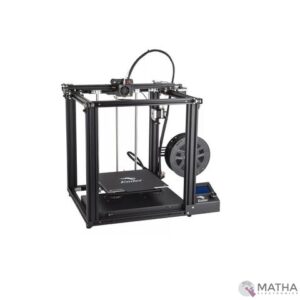
Creality 3D Ender-5 DIY 3D Printer Kit 220*220*300mm Printing Size
- Moulding Technology: FDM.
- Print Dimensions: 220*220*300mm.
- Print Speed: <180mm/s, Normal Printing Speed 40-80 mm/s.
- Print Accuracy: + - 0.1mm.
- Layers Thickness: 0.1-0.4mm.
- Nozzle Diameter: Standard 0.4mm. Convertible 0.2, 0.3mm.
- Nozzle Quantity: 1.
- Nozzle Temperature: <260 Degree C
- Hot Bed Temperature: <135 Degree C
- Working Modes: Online or TF Cards are printed offline.
- File Formats: STL, ODJ, AMF.
- Slicing Software: Cura, Repeti-Host, Simlify 3d.
- Power Parameters: Input:110v/220v. 50/60Hz. Output: DC 24V.
- Machine Power: 270W.
- Printing Materials: PLA, ABS, Soft Glue, Wooden, Copper Containing, Gradient, etc.
- Consumables Diameter: 1.75mm.
- Heating upto 100 deg C in 5 mins,
- Printing with High precision,
- Resume Printing after power-off,
- Soft Magnetic Stickers - Instead of traditional beauty paper & glue, easy to mold, model adhesion is good.
- Built-in Power Supply - 350w high-quality power supply, easy to achieve long time stable printing.
- Dual Y-Axis - synchronization, small moving quality, flexible & reliable.
- Down Shift Z-Axis - for smoother movement.
- Descartes Design - Down Shift Z-axis for smoother movement.
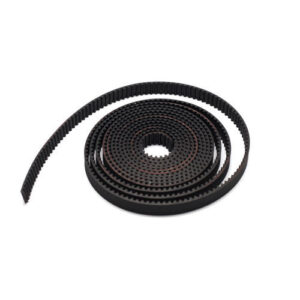
GT2 Open Timing Belt for 3D Printer and CNC
- Pitch: 2mm
- Material: Neoprene Rubber With Fiberglass Core
- Width: 6mm
- Total Length: 1M
- Shape: Open Loop
- Core Wire Material: Glass Fiber
- Precision registration and timing with no loss of high torque carrying capability
- Minimal vibration and chordal effect
- Positive slip proof engagement
- Wide speed range, especially important when the entire speed range is developed from a single source
- Virtually no elongation (stretching) due to wear
- Power transmission efficiency is not lost with the use
- A clean operation, no need for lubrication
- Reduced noise.
- Long, dependable trouble-free service.

PR34 2004 LCD Display Smart Controller W or Adapter for RAMPS1.4 Reprap 3D Printer
- RAMPS 1.4 2004 LCD Display intelligent controller.
- LED background light control circuit, a small function of the intelligent controller,
- With pin short time to decide on all LED turn or steering 30 seconds
- You can turn on the light time to do the long or short form of the adjustment TRIMM R4100K from 10 seconds to 2 minutes.
- Plug and play on the RAMPS, but need to modify the firmware to support.
- The product comes encoder parameter adjustment can be achieved, and the file selection print.
- With an SD card base on the back, put slicing file into the SD card and select the file on the LCD, then can be printing.
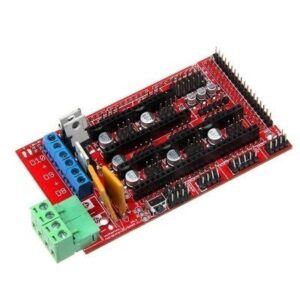
Ramps 1.6 For 3D Printer Parts
- Input voltage: 12V.
- Power: 200W.
- Patch MOS tube: B55NF06.
- Ramps 1.6 is a 4-layer board.
- Can be extended to LCD and other parts.
- There are heater and fan MOSFET outputs and 3 thermistor interfaces
- Support motor drivers: support A4988 DRV8825 and other motor drivers(support five motor drivers Simultaneously).
- 5A additional security and component protection fusion.
- Heated bed controls additional 11A fuses.
- Applied to 5 Pololu stepper drive board.
- Design of Pololu plate pin socket can be easily replaced or removed for future design.
- I2C and SPI pins are available for future expansion.
- Servo connectors are used for connecting limit stops, motors and light-emitting diodes.
- LED will light when the heater has output, choose 2 motors to connect to Z Prusa Mendel.
- Dimension: 101.5 * 60.5mm

Stepper Motor Nema 23 kg 7.2 kg Dual shaft
- Rated Voltage: 6.6 V
- Current/ phase: 1A
- Resistance/ phase: 6.6ohms
- Inductance/ phase: 8.2 mH
- Holding Torque: 7.2 kg-cm
- of Leads - 6
- Rotor Inertia - 275
- Weight: 0.65kg
- Detent Torque: 0.36 kg-cm
- Step Angle - 1.8°
- Step Angle Accuracy - ±5% (full step, no load)
- Resistance Accuracy - ±10%
- Inductance Accuracy - ±20%
- Frame Size (mm) - 57x57
- Shaft Length (mm) - 20.6
- Shaft Diameter (mm) - 6.35
- Comparably more powerful than NEMA17 motors.
- Input pulse decides the rotation angle of the motor.
- High accuracy of around 3 to 5% a step.
- Provides good starting, stopping and reversing.
- Control of this motor is less costly because of exclusion of complex control circuitry.
- The speed is proportional to the frequency of the input pulses.

Reviews
There are no reviews yet.