
I am text block. Click edit button to change this text. Lorem ipsum dolor sit amet, consectetur adipiscing elit. Ut elit tellus, luctus nec ullamcorper mattis, pulvinar dapibus leo.
-5%


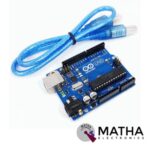
Arduino Leonardo R3
Original price was: ₹750.00.₹600.00Current price is: ₹600.00. inc. GST
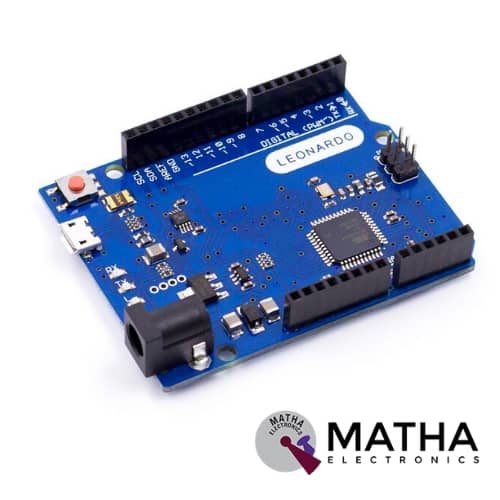
Sensor Shield V5 Expansion Board For Arduino
Original price was: ₹450.00.₹300.00Current price is: ₹300.00. inc. GST
Arduino Duemilanove Development Board with USB Cable
Original price was: ₹950.00.₹900.00Current price is: ₹900.00. inc. GST
- Microcontroller: ATmega168/ATmega 328
- Operating Voltage: 5V
- Input Voltage: 7-12V
- Input Voltage: 6-20V
- Digital I/O Pins: 14 (of which 6 provide PWM output)
- Analog Input Pins: 6
- DC Current per I/O Pin: 40 mA
- DC Current for 3.3V Pin: 50 mA
- Flash Memory: 16 KB (ATmega168) or 32 KB (ATmega328) of which 2 KB used by the bootloader
- SRAM: 1 KB (ATmega168) or 2 KB (ATmega328)
- EEPROM: 512 bytes (ATmega168) or 1 KB (ATmega328)
- Clock Speed: 16 MHz
Description
Arduino Duemilanove is an open-source based on the precise Microchip ATmega168 or ATmega328 developed by Arduino. cc. The current version of Arduino Duemilanove comes with a USB interface, 14 digital I/O pins, 6 analogue pins, an ICSP header, 6 MHz ceramic resonators, a power jack, and a reset button. And a microcontroller is used to connect with external electronics circuits. Out of 14 I/O ports, 6 pins were used for PWM output. Each pin operates at a voltage of 5V providing a maximum of 40mA. Moreover, the Duemilanove automatically selects the appropriate power supply (USB or external power). As a result, eliminates the need for the power selection jumper found on previous boards. It also adds an easiest to cut trace for disabling the auto-reset, along with a solder jumper for re-enabling it.
This board comes with everything needed to support the microcontroller. Simply connects to a computer with a Micro USB cable. Or power it with an AC-to-DC adapter or battery to get started. ATmega168 and Atmega32u4 supports UART TTL (5V) Serial communication via its 0 (RX) and 1 (TX) pins. An FTDI FT232RL on the board channels this serial communication over USB and the FTDI drivers via a virtual serial COM port and allows serial communication.
The ATmega168 features 16 KB of flash memory for storing code (of which 2 KB is used for the bootloader). And the ATmega328 has 32 KB, (also with 2 KB used for the bootloader). The ATmega168 has 1 KB of SRAM and 512 bytes of EEPROM (which can be read and written with the EEPROM library); the ATmega328 has 2 KB of SRAM and 1 KB of EEPROM. Moreover, this microcontroller is programmable with the Arduino IDE common to all our boards.
Reviews (0)
Shipping & Delivery

Related products
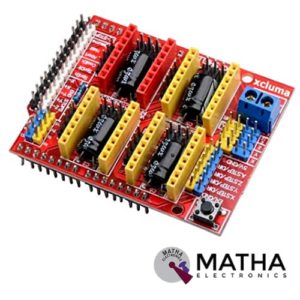

Arduino CNC Shield v3 Engraving Machine/3D Printer/A4988 driver GRBL compatible
- Coolant enable
- Uses removable Pololu A4988 compatible stepper drivers. (A4988, DRV8825, and others) (Not Included)
- Jumpers to set the Micro-Stepping for the stepper drivers. (Some drivers like the DRV8825 can do up to 1/32 micro-stepping )
- Compact design.
- Stepper Motors can be connected with 4 pin Molex connectors or soldered in place.
- Runs on 12-36V DC. (At the moment only the Pololu DRV8825 drivers can handle up to 36V so please consider the operation voltage when powering the board.)
- Please note that this is an unassembled kit and needs soldering.
- Latest Arduino CNC Shield Version 3.10
- GRBL 0.9 compatible. (Open source firmware that runs on an Arduino UNO that turns G-code commands into stepper signals)
- PWM Spindle and direction pins
- 4-Axis support (X, Y, Z, A-Can duplicate X, Y, Z or do a full 4th axis with custom firmware using pins D12 and D13)
- 2 x End stops for each axis (6 in total)

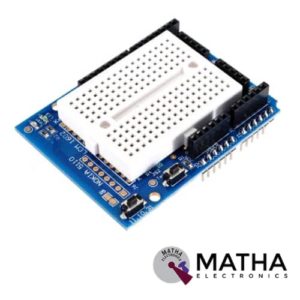
Arduino Compatible Nokia 5110 Prototype Proto Shield Expansion Board
- Supports Nokia5110 display
- Standard 0.1"x0.1" prototyping grid with big pads
- Comes with Stacking headers and plain header, choose whichever you want when soldering together
- IC pattern for adding DIP ICs up to 20 pins
- Power rails down the middle and sides
- Reset button and an extra general use button
- 2 3mm general use LEDs, red and green, as well as 2 matching resistors
- A pass-thru ICSP stacking header so you can stack any kind of shield on top, and/or use an AVR programmer
- Surface-mount chip area for up to 14 SOIC size parts
- Compatible with tiny breadboards
- Every pin is brought out
- Gold plated pads
- 2 x 0.1uF capacitors on either side for extra power stability
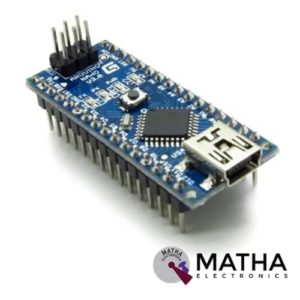

Arduino Nano V3.0
- Microcontroller: Atmel ATmega328 SMD Package
- Operating Voltage (logic level): 5 V
- Input Voltage (recommended): 7-12 V
- Input Voltage (limits): 6-20 V
- Digital I/O Pins: 14 (of which 6 provide PWM output)
- Analog Input Pins: 8
- DC Current per I/O Pin: 40 mA
- Flash Memory: 32 KB (of which 2KB used by bootloader)
- SRAM: 2 KB
- EEPROM: 1 KB
- Clock Speed: 16 MHz
- Automatic reset during program download
- Power OK blue LED
- Green (TX), red (RX) and orange (L) LED
- Auto-sensing/switching power input
- Small mini-B USB for programming and serial monitor
- ICSP header for direct program download
- Standard 0.1” spacing DIP (breadboard friendly)
- Manual reset switch
- Dimensions: 0.70” x 1.70”


ESP8266 WIFI Shield
- Operating voltage 5V (supplied from the Arduino Board)
- Connection via: 802.11b/g networks
- Encryption types: WEP and WPA2 Personal
- Connection with Arduino on SPI port
- on-board micro SD slot
- ICSP headers
- FTDI connection for serial debugging of WiFi shield
- Mini-USB for updating WiFi shield firmware
- 32-bit RISC architecture
- The processor can operate at 80MHz / 160MHz
- 32MB flash memory
- 64kB for instructions
- 96kB for data
- Operates in AP, Station or AP + Station mode
- It has 11 digital pins
- It has 1 analogue pin with 10-bit resolution
- Digital pins except the D0 have interrupts, PWM, I2C and one wire
- Programmable through USB or WiFi (OTA)
- Compatible with Arduino IDE
- Compatible with modules and sensors used in Arduino
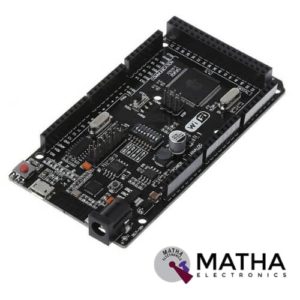
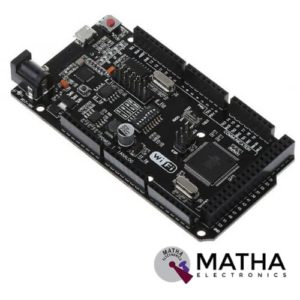
Mega R3 +WiFi ATmega2560+ESP8266 Module CH340G Compatible For Arduino Mega
- Microcontroller:ATmega2560
- IC Wi-Fi : ESP8266
- USB-TTL converter: CH340G
- Power Out: 5V-800mA
- Power Input USB: 5V (500mA max.)
- Power Input VIN/DC Jack: 9-24V
- Power Consumption: 5V 800mA
- Logic Level: 5V
- Wi-Fi 802.11 b/g/n 2.4 GHz
- USB: Micro USB
- Clock Frequency: 16MHz
- Operating Supply Voltage: 5V
- Digital I/O: 54
- Analog I/O: 16
- Memory Size: 256kb
- Data RAM Type/Size: 8Kb
- Data ROM Type/Size: 4Kb
- Interface Type: SerialOTA
- Operating temperature:−40С°/+125С°
- Build in external antenna
- Dimensions:53.361×101.86mm
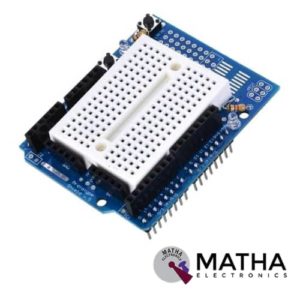
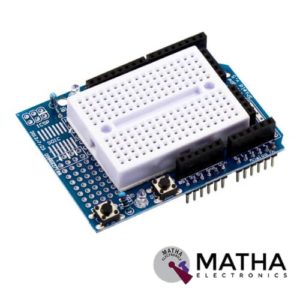
Protosheild For Arduino
- Standard 0.1"x0.1" prototyping grid with big pads
- Comes with Stacking headers and plain header, choose whichever you want when soldering together
- IC pattern for adding DIP ICs up to 20 pins
- Power rails down the middle and sides
- Reset button and an extra general use button
- 2 3mm general use LEDs, red and green, as well as 2 matching resistors
- A pass-thru ICSP stacking header so you can stack any kind of shield on top, and/or use an AVR programmer
- A surface-mount chip area for up to 14 SOIC size parts
- Compatible with tiny breadboards
- Every pin is brought out
- Gold plated pads
- 2 x 0.1uF capacitors on either side for extra power stability
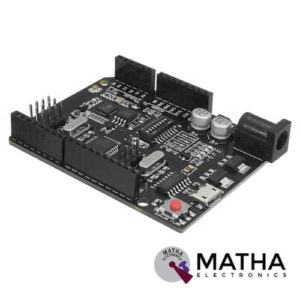

UNO R3 +WiFi ATmega328P+ESP8266 Module CH340G Compatible For Arduino Uno
- Microcontroller: ATmega328IC
- Wi-Fi: ESP8266
- USB-TTL converter: CH340G
- Power Output: 5V-800mA
- Power input USB: 5V (500mA max.)
- Power input VIN/DC Jack: 9-24V
- Power Consumption: 5V 800mA
- Logic Level: 5V
- WiFi: 802.11 b/g/n 2.4 GHz
- USB type: Micro USB
- USB Clock Frequency: 16MHz
- Operating Supply Voltage: 5V
- Digital I/O Pins: 14
- Analog I/O pins: 6
- Memory Size: 32Mb
- Interface Type: serial
- Operating temperature: −40С°/+125С°
- Dimensions (L×W)mm: 53.34×68.58
Reviews
There are no reviews yet.