
I am text block. Click edit button to change this text. Lorem ipsum dolor sit amet, consectetur adipiscing elit. Ut elit tellus, luctus nec ullamcorper mattis, pulvinar dapibus leo.
-17%

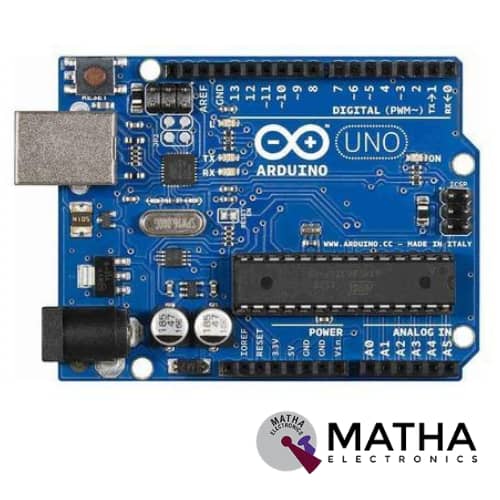


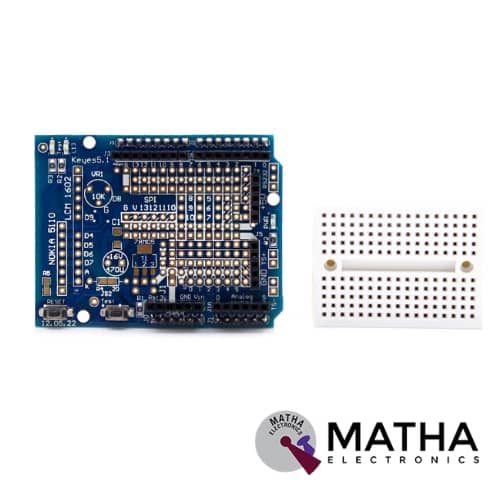
Arduino Compatible Nokia 5110 Prototype Proto Shield Expansion Board
Original price was: ₹650.00.₹550.00Current price is: ₹550.00. inc. GST

Arduino Mega 2560 Board
Original price was: ₹2,000.00.₹1,600.00Current price is: ₹1,600.00.
Arduino UNO R3 Clone
Original price was: ₹1,200.00.₹1,000.00Current price is: ₹1,000.00.
- Microcontroller: ATMEGA328
- Operating voltage: 5V
- Input voltage: 7-12V
- Digital I/O: 14 (6 provide PWM outputs)
- Analogue inputs: 6
- Flash Memory: 32KB
- SRAM: 2KB
- EEPROM: 1KB
- Clock Speed: 16MHz
- DC Current per I/O Pin: 40 mA
- DC Current for 3.3V Pin: 50 mA
Description
Nowadays the electronic devices are becoming compact, flexible, and cheap that are capable of doing more function as compared to their predecessors. A Microcontroller was introduced as a new innovation in the electronics industry. Designed with the purpose of making our tasks easier, with minimum effort, and gives maximum output.
Arduino Uno is an open-source based on the Microchip ATmega328P developed by Arduino. cc. The current version of Arduino Uno comes with a USB interface, 14 digital I/O pins, 6 analogue pins, an ICSP header, 16 MHz ceramic resonators, a power jack, and a reset button. And an Atmega328 microcontroller is used to connect with external electronics circuits. Out of 14 I/O ports, 6 pins were used for PWM output. Each pin operates at a voltage of 5V providing a maximum of 50mA. It also supports serial communication using Tx and Rx pins. Although there are many versions of Arduino like Arduino Uno, Arduino Due, Arduino Leonardo, Arduino Mega, however, most common versions are Arduino Uno and Arduino Mega. For projects related to digital electronics, embedded systems, robotics, or IoT, then using Arduino Uno would be the perfect option.
Moreover, this microcontroller is programmable with the Arduino IDE common to all our boards and running both online and offline. The USB connection with the PC is necessary to program the board and not just to power it up. Arduino Uno is powered either by a USB cable or by an external 9-volt battery, although it operates at voltages between 7 and 20 volts. The ATmega328 on the board comes preprogrammed with a bootloader. Therefore, allows uploading new code to it without the use of an external hardware programmer. Meanwhile, Uno communicates using the original STK500 protocol. Uno uses a programmed Atmega16U2 as a USB to serial converter. This avoids the use of FTDI USB to serial driver chips.
Reviews (1)
1 review for Arduino UNO R3 Clone
Shipping & Delivery

Related products


2.4″ Inch Touch Screen TFT Display Shield for Arduino
- 4″ Touch LCD TFT display module for Arduino
- 240*320 pixels resolution
- Ability to display 262000 different colours
- The shield comes equipped with a microSD card slot.
- SPFD5408 controller with built-in video RAM buffer
- 8-bit digital interface, plus 4 control lines
- 5V compatible. Use with 3.3V or 5V logic
- On-board 3.3V 300mA LDO regulator
- Uses digital pins 5-13 and analogue 0-3. That means you can use digital pins 2, 3, and analog 4 and 5. Pin 12 is available if not using the microSD
- Works with any Arduino Uno and mega compatible boards
- Resolution: 240320 pixels
- Supply voltage: 5V
- Working temperature: -30C ~ 70C
- Dimension: 72*52*12mm
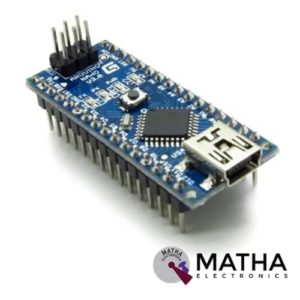

Arduino Nano V3.0
- Microcontroller: Atmel ATmega328 SMD Package
- Operating Voltage (logic level): 5 V
- Input Voltage (recommended): 7-12 V
- Input Voltage (limits): 6-20 V
- Digital I/O Pins: 14 (of which 6 provide PWM output)
- Analog Input Pins: 8
- DC Current per I/O Pin: 40 mA
- Flash Memory: 32 KB (of which 2KB used by bootloader)
- SRAM: 2 KB
- EEPROM: 1 KB
- Clock Speed: 16 MHz
- Automatic reset during program download
- Power OK blue LED
- Green (TX), red (RX) and orange (L) LED
- Auto-sensing/switching power input
- Small mini-B USB for programming and serial monitor
- ICSP header for direct program download
- Standard 0.1” spacing DIP (breadboard friendly)
- Manual reset switch
- Dimensions: 0.70” x 1.70”


DTMF Shield
- MT8870 Decoder IC.
- 4 Output digital pins.
- Operates on 5V
- Includes MT8870 DTMF Receiver IC
- Receives and Converts Standard DTMF Codes
- Remotely Switch Devices from Anywhere Using the Phone
- Easily Connects to Most Microcontrollers or Roboduino Board
- Low Power Consumption
- 5 On-Board LED's For Data Received Indication
- Standard Header Connections for Control System Connection
- Audio socket for application
- Speaker connector for audio sound checking.
- Microphone connector for over the air remote control system( note, due to environmental noise, without any filtering system this method is not recommended)
- Dimension: 37x37x9mm


MEPUNO COMMUNICATION BOARD
- Microcontroller ATMEGA328 P
- Crystal for microcontroller: 16 MHZ
- USB type B connector
- On-Board Power LED Indicator
- 5volt, 12 volt regulated circuit
- Two separate regulated 5volt power supply
- On Board On/Off switch
- On Board DC jack for powering up using adaptors
- On Board Reset Switch
- On Board TX/RX indication LEDs
- On board FTDI Driver for adruino
- Berg headers for external interfacing
- Supports I2C /GSM /GPS/RF/USART serial communication
- Separate berg headers available for PIR, Servo motor, RTC/I2C, GPS_TTL, and USART-TTL
- Four 3pin PBT Connectors
- Four SPDT 12V Relays
- Onboard DB9 connectors for GPS, GSM and USART communication
- Berg slot for 16x4 LCD connections
- Onboard TRIM-POT for LCD
- Onboard RTC IC: IN1307 with crystal 32768 MHZ crystal and CR2302 battery

NUCLEO-64 STM32G071RBT6 Development Board Arduino & ST Morpho Connectivity
- STM32 microcontroller in LQFP64 package
- 1 user LED shared with ARDUINO®
- 1 user and 1 reset push-buttons
- 768 kHz crystal oscillator
- Board connectors: ARDUINO Uno V3 expansion connectors morpho extension pin headers for full access to all STM32 I/Os
- Flexible power-supply options: ST-LINK, USB VBUS, or external sources
- On-board ST-LINK debugger/programmer with USB re-enumeration capability: mass storage, Virtual COM port and debug port
- Comprehensive free software libraries and examples available with the STM32Cube MCU Package
- Support of a wide choice of Integrated Development Environments (IDEs) including IAR Embedded Workbench®, MDK-ARM, and STM32CubeIDE
- Board-specific features
- External SMPS to generate Vcore logic supply
- 24 MHz HSE
- Board connectors: External SMPS experimentation dedicated connector Micro-AB or Mini-AB USB connector for the ST-LINKMIPI® debug connector
- Arm® Mbed Enabled™ compliant

STM32 Nucleo-64 development board with STM32F103RB MCU, supports Arduino and ST morpho connectivity
- STM32 microcontroller with LQFP64 package
- Two types of extension resources
- mbed-enabled (mbed.org)
- On-board ST-LINK/V2-1 debugger/programmer with SWD connector
- Flexible board power supply
- Three LEDs
- Two push buttons: USER and RESET
- USB re-enumeration capability: three different interfaces supported on USB
- Comprehensive free software HAL library including a variety of software examples
- Supported by wide choice of Integrated Development Environments (IDEs) including IAR, Keil, GCC-based IDEs
Emil Shaji –
Clone but its works good as normal uno’s
And Thankyou for your online service ?
muzammil –
your welcome