
I am text block. Click edit button to change this text. Lorem ipsum dolor sit amet, consectetur adipiscing elit. Ut elit tellus, luctus nec ullamcorper mattis, pulvinar dapibus leo.
-20%


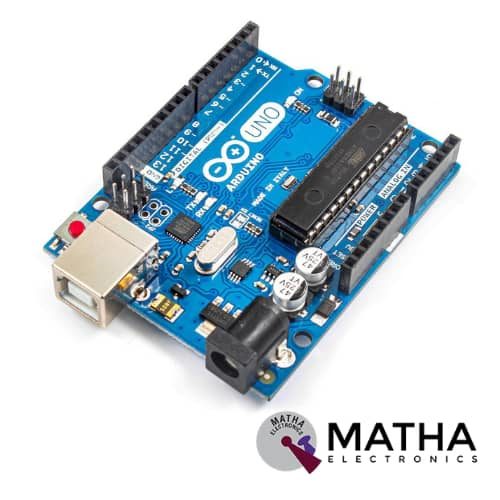
Arduino UNO R3 Clone
Original price was: ₹1,200.00.₹1,000.00Current price is: ₹1,000.00.
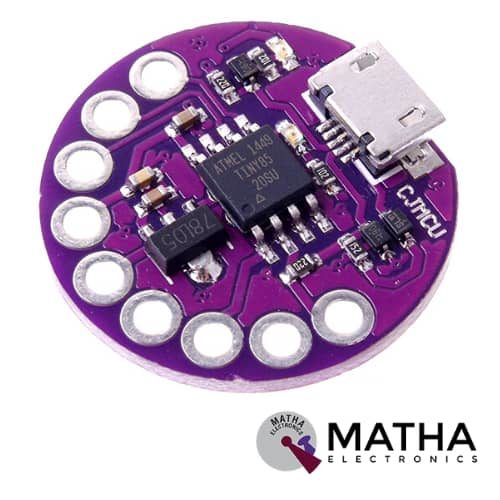
LilyTiny (LilyPad ATTiny85)
Original price was: ₹475.00.₹425.00Current price is: ₹425.00.
Arduino Mega 2560 Board
Original price was: ₹2,000.00.₹1,600.00Current price is: ₹1,600.00.
- Microcontroller: ATmega2560
- Operating Voltage: 5V
- Input Voltage (recommended): 7-12V
- Input Voltage (limits): 6-20V
- Digital I/O Pins: 54 (of which 15 provide PWM output)
- Analog Input Pins: 16
- DC Current per I/O Pin: 40 mA
- DC Current for 3.3V Pin: 50 mA
- Flash Memory: 128 KB of which 4 KB used by the boot loader
- SRAM: 8 KB
- EEPROM: 4 KB
- Clock Speed: 16 MHz
Description
Nowadays the electronic devices are becoming compact, flexible, and cheap that are capable of doing more function as compared to their predecessors. A Microcontroller was introduced as a new innovation in the electronics industry. Designed with the purpose of making our tasks easier, with minimum effort, and gives maximum output.
Arduino Mega 2560 is an open-source based on the Microchip ATmega2560 developed by Arduino. cc. The current version of Arduino Mega 2560 is an updated version of Arduino Mega. It 54 digital input/output pins, 16 analogue inputs, 4 UARTs (hardware serial ports), a 16 MHz crystal oscillator, a USB connection, a power jack, an ICSP header, and a reset button. And an Atmega2560 microcontroller is used to connect with external electronics circuits. Out of 54 I/O ports, 15 pins were used for PWM output. Each pin operates at a voltage of 5V providing a maximum of 50mA. It also supports serial communication using Tx and Rx pins. The board consists of all the essential things needed to support the microcontroller.
Mega 2560 is powered either by connecting to a PC via USB cable or battery or an AC-DC adapter, although it operates at voltages between 7V and 20 volts. The Mega 2560 board is compatible with most shields designed for the Uno and the former boards Duemilanove or Diecimila. This board designed with a base plate protects it from unexpected electrical discharge. Moreover, this microcontroller is programmable with the Arduino IDE common to all our boards and supports C programming. The ATmega2560 on the board comes preprogrammed with a bootloader. This eliminates an external burner utilization to burn the program code into the Arduino board. Finally, the communication of the boot loader can be done using an STK500 protocol.
Reviews (0)
Shipping & Delivery

Related products


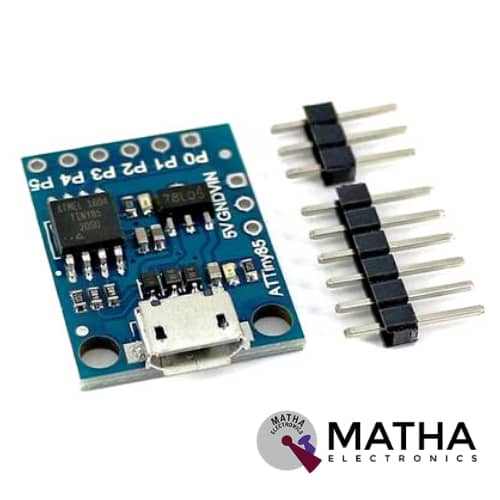

ATtiny85 Arduino-enabled Mini USB Dev Board
- Support for the Arduino IDE 1.0+ (OSX/Win/Linux)
- Power via USB or External Source
- Onboard 5V Regulator
- Built-in USB
- 6 I/O Pins
- 8k Flash Memory (about 6k after bootloader)
- I2C and SPI (vis USI)
- PWM on 3 pins (more possible with Software PWM)
- 10-bit ADC
- ADC on 4 pins
- Power LED and Test/Status LED
- Low Power Consumption
- Active Mode:1 MHz, 1.8V: 300 µA


ESP8266 WIFI Shield
- Operating voltage 5V (supplied from the Arduino Board)
- Connection via: 802.11b/g networks
- Encryption types: WEP and WPA2 Personal
- Connection with Arduino on SPI port
- on-board micro SD slot
- ICSP headers
- FTDI connection for serial debugging of WiFi shield
- Mini-USB for updating WiFi shield firmware
- 32-bit RISC architecture
- The processor can operate at 80MHz / 160MHz
- 32MB flash memory
- 64kB for instructions
- 96kB for data
- Operates in AP, Station or AP + Station mode
- It has 11 digital pins
- It has 1 analogue pin with 10-bit resolution
- Digital pins except the D0 have interrupts, PWM, I2C and one wire
- Programmable through USB or WiFi (OTA)
- Compatible with Arduino IDE
- Compatible with modules and sensors used in Arduino

LilyTiny (LilyPad ATTiny85)
- Program Memory Type: Flash
- Program Memory (KB) : 8
- CPU Speed (MIPS): 20
- Data EEPROM (bytes): 512
- Digital Communication Peripherals: 1-SPI, 1-I2C
- Capture/Compare/PWM Peripherals : 5
- Comparators: 1
- Temperature Range (C) : -40 to 85
- Operating Voltage Range (V): 1.8 to 5.5
- Pin count: 8
- Cap Touch Channels : 3


Screw Shield Expansion board for Arduino
- Arduino terminal to provide the IO, port connection.
- 81 posts quality, reliable, convenient, durable.
- Combined with the Proto Shield, the middle can be used as a prototype expansion board.
- Double-sided PCB Prototyping extended area vias connecting the front sides can be welded components.
- The middle section can be placed small bread plate, convenient test extend
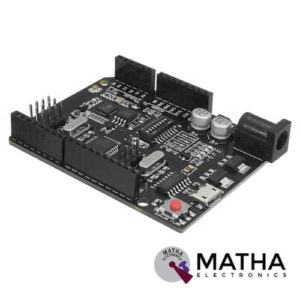

UNO R3 +WiFi ATmega328P+ESP8266 Module CH340G Compatible For Arduino Uno
- Microcontroller: ATmega328IC
- Wi-Fi: ESP8266
- USB-TTL converter: CH340G
- Power Output: 5V-800mA
- Power input USB: 5V (500mA max.)
- Power input VIN/DC Jack: 9-24V
- Power Consumption: 5V 800mA
- Logic Level: 5V
- WiFi: 802.11 b/g/n 2.4 GHz
- USB type: Micro USB
- USB Clock Frequency: 16MHz
- Operating Supply Voltage: 5V
- Digital I/O Pins: 14
- Analog I/O pins: 6
- Memory Size: 32Mb
- Interface Type: serial
- Operating temperature: −40С°/+125С°
- Dimensions (L×W)mm: 53.34×68.58


UNO R3 Transparent Case
- Material: A grade acrylic sheet.
- For Arduino UNO R3 Development Board only.
- With screw copper pillar and installation instructions.
- To protect your little computer against damages, dust and scratches Clear Top and Bottom.
- This case provides easy access to all ports.
- It requires no tools for easy assembly and disassembly.
- Simply Clicks Together Enclosure.


Wemos D1 WiFi Esp8266 Development Board Uno Compatible Program
- Microcontroller: ESP-8266EX
- Operating Voltage: 3.3 V
- Digital I/O Pins: 11
- Analog Input Pins 1(Max input: 3.2V)
- Clock Speed: 80MHz/160MHz
- Flash: 4M bytes
- Good stability.
- 11 digital input/output pins, all pins have interrupt/PWM/I2C/one-wire supported(except for D0)
- 1 analog input(3.2V max input)
- Micro USB connection
- Compatible with Arduino
- Support OTA wireless uploading
- On-Board Switching Power Supply:
- Micro USB connection
- Compatible with Arduino
- Support OTA wireless uploading
Reviews
There are no reviews yet.