
I am text block. Click edit button to change this text. Lorem ipsum dolor sit amet, consectetur adipiscing elit. Ut elit tellus, luctus nec ullamcorper mattis, pulvinar dapibus leo.
-5%Sold out


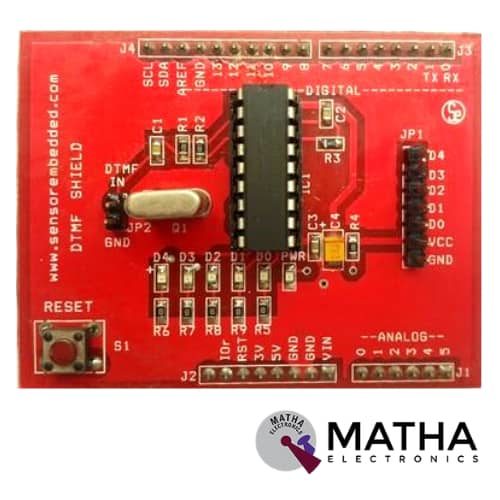
DTMF Shield
Original price was: ₹925.00.₹800.00Current price is: ₹800.00. inc. GST
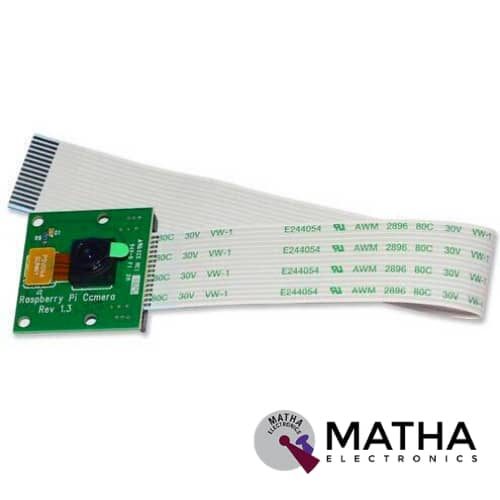
Raspberry PI 5MP V1.3 Camera Module
Original price was: ₹900.00.₹750.00Current price is: ₹750.00. inc. GST
Screw Shield Expansion board for Arduino
Original price was: ₹525.00.₹499.00Current price is: ₹499.00. inc. GST
- Arduino terminal to provide the IO, port connection.
- 81 posts quality, reliable, convenient, durable.
- Combined with the Proto Shield, the middle can be used as a prototype expansion board.
- Double-sided PCB Prototyping extended area vias connecting the front sides can be welded components.
- The middle section can be placed small bread plate, convenient test extend
Out of stock
Description
The Proto Screw Shield was designed as an ultimate breakout board for an Arduino. This shield combines a prototyping shield with a full set of 3.5 mm screw terminal blocks. The proto shield part allows you to build custom circuitry and then you can easily & securely connect wires and sensors to the terminal blocks. This screw shield is said to be a perfect solution for panel mounts, buttons, sensors, enclosures, etc. Proto Screw Shield comes with pre-assembled features so that it can be directly screwed onto the thread posts. This Screw shield is designed as a wing-like structure shield that extends both sides of your Arduino or Arduino variants into sturdy and reliable screw terminal blocks.
The digital pins side of the shield contains 18 terminals of which 16 are normal terminals and 2 extra GND. Similarly on the Analog pins side. 16 terminals connected in which 12 are normal terminals, 4 extra terminals, and 2 breakouts through holes for 2 additional ADC pins. The four extra terminals used for Vin, 2*GND, and 5V. Moreover, a special extension block for the SPI interface is included in this shield. This makes it a truly stackable shield for other shields like the TFT touch screen to mount on.
The Arduino Proto Screw Shield extends all pins of the Arduino out to 3.5mm pitch screw terminals. Arduino Protoshield also provides a lot of utility, including a large prototyping space of both connected and unconnected 0.1″ spaced through-holes, a reset button, LED for D13 pins indicating.
Reviews (0)
Shipping & Delivery

Related products

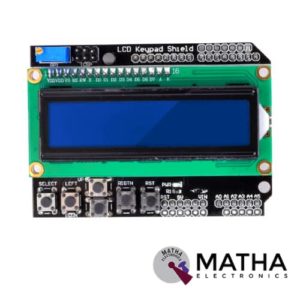
16×2 (1602) LCD Keypad Shield
- Operating Voltage:5V
- 5 Push buttons.
- RST button to reset Arduino program.
- Integrate a potentiometer for adjusting the backlight.
- Expanded available I/O pins.
- Blue light with white characters.
- Uses 4 Bit Arduino LCD Library
- Screen contrast adjustment
- Arduino Reset button
- The keypad consists of 6 keys select, up, right, down, left and reset.
- To save the digital IO pins, the keypad interface only uses one ADC channel.
- The key value is read out through a 5 stage voltage divider.

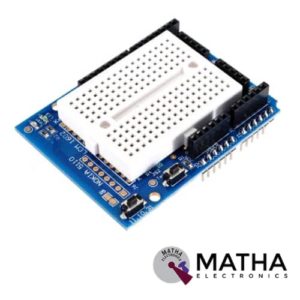
Arduino Compatible Nokia 5110 Prototype Proto Shield Expansion Board
- Supports Nokia5110 display
- Standard 0.1"x0.1" prototyping grid with big pads
- Comes with Stacking headers and plain header, choose whichever you want when soldering together
- IC pattern for adding DIP ICs up to 20 pins
- Power rails down the middle and sides
- Reset button and an extra general use button
- 2 3mm general use LEDs, red and green, as well as 2 matching resistors
- A pass-thru ICSP stacking header so you can stack any kind of shield on top, and/or use an AVR programmer
- Surface-mount chip area for up to 14 SOIC size parts
- Compatible with tiny breadboards
- Every pin is brought out
- Gold plated pads
- 2 x 0.1uF capacitors on either side for extra power stability
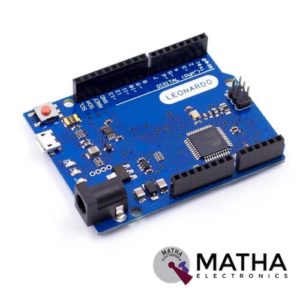

Arduino Leonardo R3
- Board Mode: LEONARDO R3
- Microcontroller: ATmega32u4
- Operating Voltage: 5V
- Input Voltage (Recommended): 7-12V
- Input Voltage (limits): 6-20V
- Digital I/O Pins: 20
- PWM Channels: 7
- Analog Input Channels: 12
- DC Current per I/O Pin: 40 mA
- DC Current for 3.3V Pin: 50 mA
- Flash Memory: 32 KB
- SRAM: 2.5 KB (ATmega32u4)
- EEPROM: 1 KB (ATmega32u4)
- Clock Speed: 16 MHz


Arduino Mega 2560 Board
- Microcontroller: ATmega2560
- Operating Voltage: 5V
- Input Voltage (recommended): 7-12V
- Input Voltage (limits): 6-20V
- Digital I/O Pins: 54 (of which 15 provide PWM output)
- Analog Input Pins: 16
- DC Current per I/O Pin: 40 mA
- DC Current for 3.3V Pin: 50 mA
- Flash Memory: 128 KB of which 4 KB used by the boot loader
- SRAM: 8 KB
- EEPROM: 4 KB
- Clock Speed: 16 MHz


CAN Bus Shield
- Implements CAN V2.0B at up to 1 Mb/s
- Industrial standard 9 pin sub-D connector
- OBD-II and CAN standard pinout selectable.
- Changeable chip select pin
- Changeable CS pin for TF card slot
- Changeable INT pin
- Screw terminal that easily to connect CAN_H and CAN_L
- Arduino Uno pin headers
- Grove connectors (I2C and UART)
- SPI Interface up to 10 MHz
- Standard (11 bit) and extended (29 bit) data and remote frames
- Two receive buffers with prioritized message storage


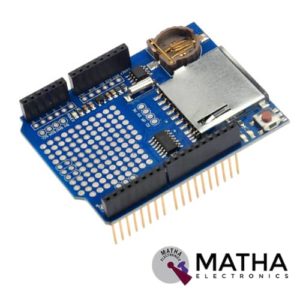

SD Card shield V4.0 for Arduino UNO
- Standard SD card, SDHC card and TF card compatible
- 3.3v and 5v logical voltage compatible
- 2.6-3.6v DC power supply
- UART Grove & I2C connection compatible
- Fully supported SD Library
- Minimal number of SPI port
- Jumpers provided for configuring Arduino SPI port pins
- Onboard toggle switch for SD card select type
- Truly stackable
- Prototype expand Library support
- Size: 53mm x 47mm
- Weight: 35g


USB Host Shield
- Works with standard (dual 5/3.3V) and 3.3V-only (for example, Pro Arduino) boards.
- Operates over the extended -40°C to +85°C temperature range
- Complies with USB Specification Revision 2.0 (Full-Speed 12Mbps Peripheral, Full-/Low-Speed 12Mbps/1.5Mbps Host)
- Supports HID devices, such as keyboards, mice, joysticks, etc.
- Compatible with Mass storage devices, such as USB sticks, memory card readers, external hard drives (FAT32 Type File System – Mega Arduino only).
Reviews
There are no reviews yet.