
I am text block. Click edit button to change this text. Lorem ipsum dolor sit amet, consectetur adipiscing elit. Ut elit tellus, luctus nec ullamcorper mattis, pulvinar dapibus leo.
-2%


GSM/GPRS/GPS SIM 808 IOT Modem
Original price was: ₹3,000.00.₹2,500.00Current price is: ₹2,500.00. inc. GST
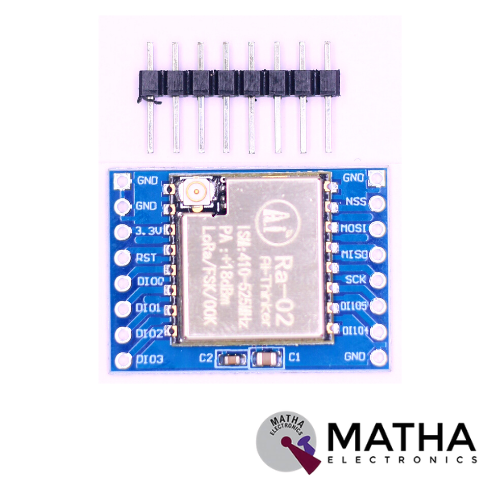
LoRa SX1278 433M 10KM Wireless Spread Spectrum Transmission Module Ra-02 SX1278 Socket IOT
Original price was: ₹800.00.₹750.00Current price is: ₹750.00. inc. GST
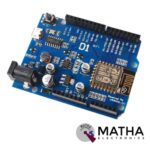
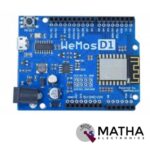
Wemos D1 WiFi Esp8266 Development Board Uno Compatible Program
Original price was: ₹790.00.₹775.00Current price is: ₹775.00. inc. GST
- Microcontroller: ESP-8266EX
- Operating Voltage: 3.3 V
- Digital I/O Pins: 11
- Analog Input Pins 1(Max input: 3.2V)
- Clock Speed: 80MHz/160MHz
- Flash: 4M bytes
- Good stability.
- 11 digital input/output pins, all pins have interrupt/PWM/I2C/one-wire supported(except for D0)
- 1 analog input(3.2V max input)
- Micro USB connection
- Compatible with Arduino
- Support OTA wireless uploading
11 x I/O pins,1 x ADC pin~!
- On-Board Switching Power Supply:
-Input Voltage Range: 9V to 12V
-Output: 5V at 1A Max
- Micro USB connection
- Compatible with Arduino
- Support OTA wireless uploading
Description
This is Wemos ESP8266 D1 R2 V2.1.0 Wi-Fi Development Board based on ESP8266 designed as an Arduino Uno Compatible Mini wifi board. The Wemos D1 is an ESP8266 Wi-Fi-based board that uses the Arduino layout with an operating voltage of 3.3V controlled by the ESP8266 chip (a 32-Bit processor). This Wi-Fi board with a 4MB flash specifically fulfil the needs of a new connected world. It gives access to any microcontroller to your Wi-Fi network. This D1 mini board consists of 11 digital input/output pins, with all pins having interrupt/PWM/I2C/one-wire supported (except D0) 1 analogue input(3.3V max input), and board connected via Micro B USB connection. Also, Wemos D1 provides a board switching power supply in which the board is powered using a 12v power supply.
The D1 R2 is a WiFi capable ESP8266EX based development board in the form of the Arduino UNO board format. In short D1 mini is an ESP8266 development board that is compact, versatile, and very easy to use with the Arduino IDE withNodeMCU. The development board features with self-contained SOC and an integrated TCP/IP protocol stack. Thus It gives access to any microcontroller to your WiFi network. This module flashed with the latest firmware version and using the onboard micro USB connection can be set up and programmed right away. While providing a wireless internet connection for embedded devices it comparatively consumes low power. Moreover, due to its small form factor, it’s easily integrated into resource-limited devices.
APPLICATIONS:
- Wireless communication between two microcontrollers
- Communicate with Laptop, Desktops and mobile phones
- Data Logging application
- Consumer applications
- Wireless Robots
- Home Automation
Reviews (0)
Shipping & Delivery

Related products

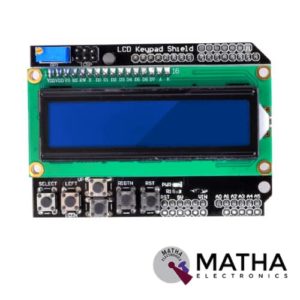
16×2 (1602) LCD Keypad Shield
- Operating Voltage:5V
- 5 Push buttons.
- RST button to reset Arduino program.
- Integrate a potentiometer for adjusting the backlight.
- Expanded available I/O pins.
- Blue light with white characters.
- Uses 4 Bit Arduino LCD Library
- Screen contrast adjustment
- Arduino Reset button
- The keypad consists of 6 keys select, up, right, down, left and reset.
- To save the digital IO pins, the keypad interface only uses one ADC channel.
- The key value is read out through a 5 stage voltage divider.


2.4″ Inch Touch Screen TFT Display Shield for Arduino
- 4″ Touch LCD TFT display module for Arduino
- 240*320 pixels resolution
- Ability to display 262000 different colours
- The shield comes equipped with a microSD card slot.
- SPFD5408 controller with built-in video RAM buffer
- 8-bit digital interface, plus 4 control lines
- 5V compatible. Use with 3.3V or 5V logic
- On-board 3.3V 300mA LDO regulator
- Uses digital pins 5-13 and analogue 0-3. That means you can use digital pins 2, 3, and analog 4 and 5. Pin 12 is available if not using the microSD
- Works with any Arduino Uno and mega compatible boards
- Resolution: 240320 pixels
- Supply voltage: 5V
- Working temperature: -30C ~ 70C
- Dimension: 72*52*12mm


DTMF Shield
- MT8870 Decoder IC.
- 4 Output digital pins.
- Operates on 5V
- Includes MT8870 DTMF Receiver IC
- Receives and Converts Standard DTMF Codes
- Remotely Switch Devices from Anywhere Using the Phone
- Easily Connects to Most Microcontrollers or Roboduino Board
- Low Power Consumption
- 5 On-Board LED's For Data Received Indication
- Standard Header Connections for Control System Connection
- Audio socket for application
- Speaker connector for audio sound checking.
- Microphone connector for over the air remote control system( note, due to environmental noise, without any filtering system this method is not recommended)
- Dimension: 37x37x9mm

MEPUNO COMMUNICATION BOARD
- Microcontroller ATMEGA328 P
- Crystal for microcontroller: 16 MHZ
- USB type B connector
- On-Board Power LED Indicator
- 5volt, 12 volt regulated circuit
- Two separate regulated 5volt power supply
- On Board On/Off switch
- On Board DC jack for powering up using adaptors
- On Board Reset Switch
- On Board TX/RX indication LEDs
- On board FTDI Driver for adruino
- Berg headers for external interfacing
- Supports I2C /GSM /GPS/RF/USART serial communication
- Separate berg headers available for PIR, Servo motor, RTC/I2C, GPS_TTL, and USART-TTL
- Four 3pin PBT Connectors
- Four SPDT 12V Relays
- Onboard DB9 connectors for GPS, GSM and USART communication
- Berg slot for 16x4 LCD connections
- Onboard TRIM-POT for LCD
- Onboard RTC IC: IN1307 with crystal 32768 MHZ crystal and CR2302 battery



Sensor Shield V5 Expansion Board For Arduino
- Retain the merits of the V4.0 version
- Laminated design
- PCB immersion gold processing technology
- IIC interface
- Bluetooth module communication interface
- SD card module communication interface
- APC220 Wireless RF modules communication interface
- RB URF v1.1 ultrasonic sensors interface
- 12864 LCD string of line and parallel interface
- 32 servo controller interface

STM32 Nucleo-64 development board with STM32F103RB MCU, supports Arduino and ST morpho connectivity
- STM32 microcontroller with LQFP64 package
- Two types of extension resources
- mbed-enabled (mbed.org)
- On-board ST-LINK/V2-1 debugger/programmer with SWD connector
- Flexible board power supply
- Three LEDs
- Two push buttons: USER and RESET
- USB re-enumeration capability: three different interfaces supported on USB
- Comprehensive free software HAL library including a variety of software examples
- Supported by wide choice of Integrated Development Environments (IDEs) including IAR, Keil, GCC-based IDEs
Reviews
There are no reviews yet.