
I am text block. Click edit button to change this text. Lorem ipsum dolor sit amet, consectetur adipiscing elit. Ut elit tellus, luctus nec ullamcorper mattis, pulvinar dapibus leo.
-2%Sold out
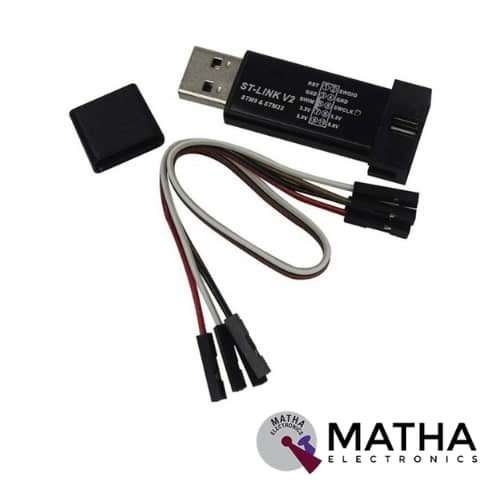
Mini St-Link V2 Stlink Emulator Downloader Stm8 Stm32 with Metal Shell
Original price was: ₹1,150.00.₹950.00Current price is: ₹950.00. inc. GST
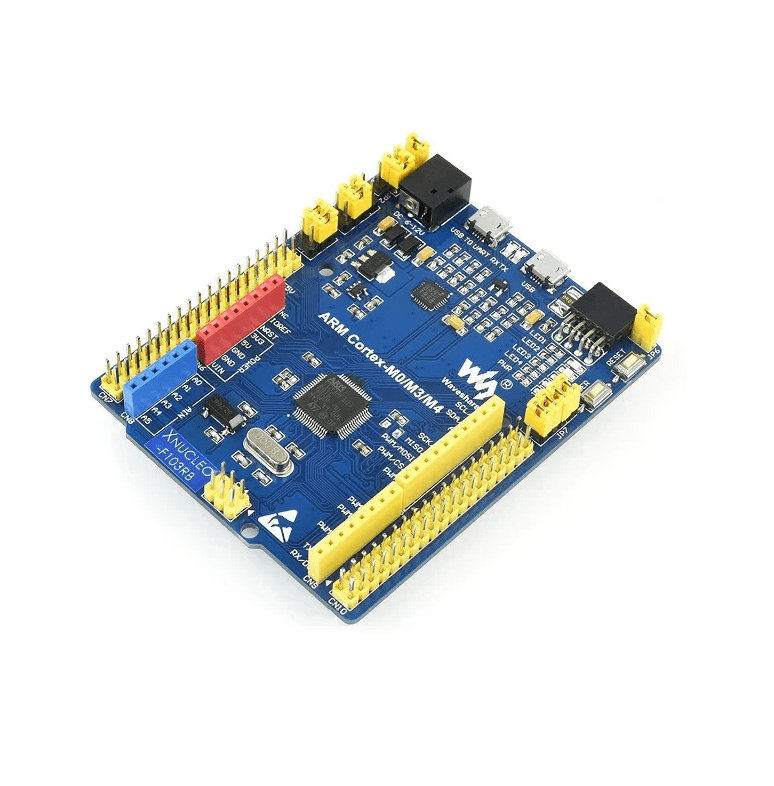
XNUCLEO-F103RB, Improved STM32 NUCLEO Board
Original price was: ₹4,575.00.₹4,500.00Current price is: ₹4,500.00. inc. GST
- Core: ARM® 32-bit Cortex™-M3
- Operating frequency: 72MHz
- Operating voltage: 2.0V-3.6V
- Package: LQFP64
- Memories : 128kB Flash, 20kB SRAM
- Interfaces : 2 x SPI, 3 x USART, 2 x I2C, 1 x CAN, 1 x USB
- AD/DA : 2 x AD (12 bit, 16 channels)
- Compatible with NUCLEO-F103RB, onboard Cortex-M3 microcontroller STM32F103RBT6
- Arduino connectivity support, easy to connect with various Arduino shields and access the massive Arduino resources
- ST Morpho headers provide full access to all STM32 I/Os, easy for peripheral expansion
- Supports mbed, build a prototype quickly by mbed SDK and online tools
- Comprehensive free software HAL library including a variety of software examples
- Comes with a separated ST-LINK/V2 module
Out of stock
Description
This XNUCLEO-F103RB, Improved STM32 NUCLEO Board designed specifically to support users to get familiar with the features of the entire STM32 MCU family. This development board comes with connectors that are compatible with Arduino, and a new standardized ST connector (Morpho). These XNUCLEO-F103RB boards, Compatible with NUCLEO-F103RB.
The XNUCLEO-F103RB board series is based on ARM Cortex-M 32-bit RISC cores microcontroller STM32F103RBT6 optimized for high performance and energy efficiency. ARM Cortex-M features a High-density instruction set and a Nested Vectored Interrupt Controller (NVIC) providing excellent interrupt handling abilities. All parts of the STM32 Xnucleo board and Shield powered from the ST-LINK/V2 (mini) USB connector by the host PC. ST Morpho headers provide full access to all STM32 I/Os, easy for peripheral expansion.
When the ST-LINK/V2 (mini) USB connector used to power the Xnucleo board, the host PC will provide 150mA current at maximum as 3.3V voltage outputted from the ST-LINK/V2 (mini) USB connector to the Xnucleo board. And also 300mA current at maximum provided when 5V voltage is outputted to the Xnucleo board. Under the condition, board requiring the current more than 300mA, it should be mandatory to use an external power supply
The on-board LEDs on the STM32 Xnucleo board provide information about the Xnucleo working status. The red color LED indicates the power status of the STM32 Xnucleo board. Whereas the red LED indicates that the MCU part powered by +5V. The Serial port working status LED indicators with TX indicator is in green and RX indicator in blue. The blinking TX indicator indicates that the MCU of the STM32 Xnucleo board is sending messages to the targeted PC. And also blinking RX indicator means MCU of the STM32 Xnucleo board is receiving a message from the targeted PC.
Reviews (0)
Shipping & Delivery

Related products
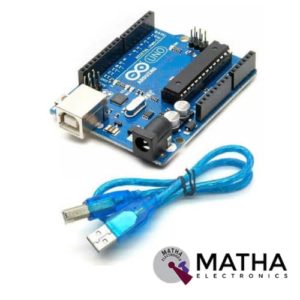

Arduino Duemilanove Development Board with USB Cable
- Microcontroller: ATmega168/ATmega 328
- Operating Voltage: 5V
- Input Voltage: 7-12V
- Input Voltage: 6-20V
- Digital I/O Pins: 14 (of which 6 provide PWM output)
- Analog Input Pins: 6
- DC Current per I/O Pin: 40 mA
- DC Current for 3.3V Pin: 50 mA
- Flash Memory: 16 KB (ATmega168) or 32 KB (ATmega328) of which 2 KB used by the bootloader
- SRAM: 1 KB (ATmega168) or 2 KB (ATmega328)
- EEPROM: 512 bytes (ATmega168) or 1 KB (ATmega328)
- Clock Speed: 16 MHz


CAN Bus Shield
- Implements CAN V2.0B at up to 1 Mb/s
- Industrial standard 9 pin sub-D connector
- OBD-II and CAN standard pinout selectable.
- Changeable chip select pin
- Changeable CS pin for TF card slot
- Changeable INT pin
- Screw terminal that easily to connect CAN_H and CAN_L
- Arduino Uno pin headers
- Grove connectors (I2C and UART)
- SPI Interface up to 10 MHz
- Standard (11 bit) and extended (29 bit) data and remote frames
- Two receive buffers with prioritized message storage


ESP8266 WIFI Shield
- Operating voltage 5V (supplied from the Arduino Board)
- Connection via: 802.11b/g networks
- Encryption types: WEP and WPA2 Personal
- Connection with Arduino on SPI port
- on-board micro SD slot
- ICSP headers
- FTDI connection for serial debugging of WiFi shield
- Mini-USB for updating WiFi shield firmware
- 32-bit RISC architecture
- The processor can operate at 80MHz / 160MHz
- 32MB flash memory
- 64kB for instructions
- 96kB for data
- Operates in AP, Station or AP + Station mode
- It has 11 digital pins
- It has 1 analogue pin with 10-bit resolution
- Digital pins except the D0 have interrupts, PWM, I2C and one wire
- Programmable through USB or WiFi (OTA)
- Compatible with Arduino IDE
- Compatible with modules and sensors used in Arduino
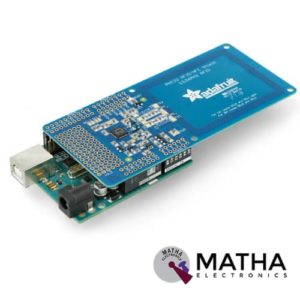

PN532 NFC/RFID Controller Shield for Arduino
- PN532 chip-set
- Operating Voltage : 3.3V ~ 5v
- Support I2C, SPI
- I2C: 3.3V ~ 24V TTL
- SPI: 3.3V TTL with 100-ohm resistors in series
- Plug and play, Arduino compatible
- Built-in PCB Antenna
- Communication distance:10cm
- Easy to change mode
- NFC/RFID PN532 shield including a tuned 13.56MHz stripline antenna
- 36-pin 0.1" header for attaching the shield to an Arduino.
- Compatible with Arduino Mega 1280 & 2560, Diecimila, Duemilanove, and UNO
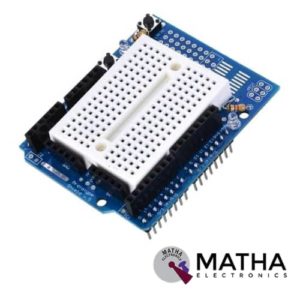
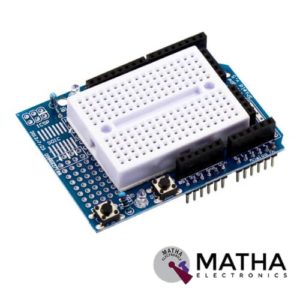
Protosheild For Arduino
- Standard 0.1"x0.1" prototyping grid with big pads
- Comes with Stacking headers and plain header, choose whichever you want when soldering together
- IC pattern for adding DIP ICs up to 20 pins
- Power rails down the middle and sides
- Reset button and an extra general use button
- 2 3mm general use LEDs, red and green, as well as 2 matching resistors
- A pass-thru ICSP stacking header so you can stack any kind of shield on top, and/or use an AVR programmer
- A surface-mount chip area for up to 14 SOIC size parts
- Compatible with tiny breadboards
- Every pin is brought out
- Gold plated pads
- 2 x 0.1uF capacitors on either side for extra power stability
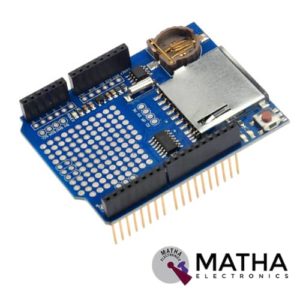

SD Card shield V4.0 for Arduino UNO
- Standard SD card, SDHC card and TF card compatible
- 3.3v and 5v logical voltage compatible
- 2.6-3.6v DC power supply
- UART Grove & I2C connection compatible
- Fully supported SD Library
- Minimal number of SPI port
- Jumpers provided for configuring Arduino SPI port pins
- Onboard toggle switch for SD card select type
- Truly stackable
- Prototype expand Library support
- Size: 53mm x 47mm
- Weight: 35g


Sensor Shield V5 Expansion Board For Arduino
- Retain the merits of the V4.0 version
- Laminated design
- PCB immersion gold processing technology
- IIC interface
- Bluetooth module communication interface
- SD card module communication interface
- APC220 Wireless RF modules communication interface
- RB URF v1.1 ultrasonic sensors interface
- 12864 LCD string of line and parallel interface
- 32 servo controller interface

STM32 Nucleo-64 development board with STM32F103RB MCU, supports Arduino and ST morpho connectivity
- STM32 microcontroller with LQFP64 package
- Two types of extension resources
- mbed-enabled (mbed.org)
- On-board ST-LINK/V2-1 debugger/programmer with SWD connector
- Flexible board power supply
- Three LEDs
- Two push buttons: USER and RESET
- USB re-enumeration capability: three different interfaces supported on USB
- Comprehensive free software HAL library including a variety of software examples
- Supported by wide choice of Integrated Development Environments (IDEs) including IAR, Keil, GCC-based IDEs
Reviews
There are no reviews yet.