
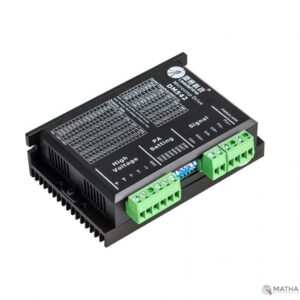
Leadshine DM542
- Good high-speed performance
- Supply voltage up to +50VDC
- Output current up to 4.2A
- Pulse frequency up to 300 KHz
- Extremely cost-effective
- Automatic idle-current reduction
- 3-state current control technology
- Self-adjustment technology
- Pure-sinusoidal current control technology
- TTL compatible and optically isolated input
- 15 selectable resolutions in decimal and binary, up to 25,600 steps/rev
- Suitable for 2-phase and 4-phase motors
- DIP switch current setting with 8 different values
- Support PUL/DIR and CW/CCW modes
- Short-voltage, over-voltage, over-current protection

Leadshine DM320C
- Supply voltage up to +30 VDC
- Output current programmable, from 0.3A to 2.0A
- Pulse input frequency up to 70 kHz
- TTL compatible and optically isolated input
- Automatic idle-current reduction
- Suitable for 2-phase and 4-phase motors
- Support PUL/DIR and CW/CCW modes
- Over-voltage, over-current, phase-error protection
- Anti-Resonance provides optimum torque and nulls mid-range instability
- Self-test and Auto-configuration technology offers optimum responses with different motors
- Microstep resolutions programmable, from full-step to 102,400 steps/rev
- Support PUL/DIR and CW/CCW modes
- Over-voltage, over-current, phase-error protection
- Its unique features make the DM320C an ideal solution for applications that require low-speed smoothness

DRV8825 Stepper Motor
- Operating voltage: 8.2V to 45V
- Continuous current per phase: 1.5 Amp
- Maximum current per phase: 2.2 Amp
- Minimum logic voltage: 2.5V
- Maximum logic voltage: 5.25V
- Six different step resolutions: full-step, half-step, 1/4-step, 1/8-step, 1/16-step, and 1/32-step
- Compatible with 3V3 and 5V microcontrollers
- Our Board comes with 0.1 Ohm Sensor resistors
- The Correct current decay mode (fast decay or slow decay) selected by chopping control
- Over-temperature thermal shutdown, under-voltage lockout, and crossover-current protection
- Short-to-ground and shorted-load protection
- 4-layer, 2 oz copper PCB for improved heat dissipation
- Exposed solderable ground pad below the driver IC on the bottom of the PCB
- Dimensions : 15 x 20 mm.
- Weight: 4 gm.

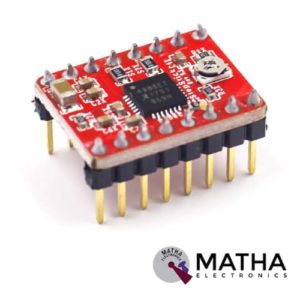
A4988 Stepper Motor
- Operating voltage supply: 8 V to 35 V
- Continuous current per phase: 1 Amp
- Maximum current per phase: 2 Amp
- Minimum logic voltage: 3V
- Maximum logic voltage: 5.5V
- Microstep resolutions: Full, 1/2, 1/4, 1/8, and 1/16
- Logic Voltage supply: 3.3 V to 5 V
- Compatible with 3V3 and 5V microcontrollers
- Our Board comes with 0.1 Ohm Sensor resistors
- Five different step resolutions: full-step, half-step, quarter-step, eighth-step, and sixteenth-step
- The Correct current decay mode (fast decay or slow decay) is selected by chopping the control
- Over-temperature thermal shutdown, under-voltage lockout, and crossover-current protection
- Short-to-ground and shorted-load protection
- 4-layer, 2 oz copper PCB for improved heat dissipation
- Exposed solderable ground pad below the driver IC on the bottom of the PCB
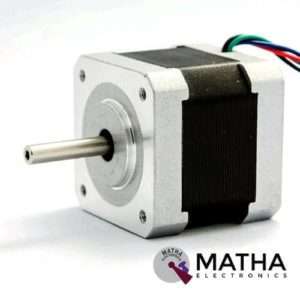

NEMA 17 1.6 kgcm
- Operating Voltage : 12~16 V
- Step Angle : 1.8°
- Holding Torque : 1.6 KgCm
- Operating Voltage : 12 - 16 volts
- Supply Current (A) :0.31 Ampere
- Number of Leads : 6
- Frame Size (mm) : 42 x 42
- Shaft Diameter (mm) : 5
- Shaft Length (mm) : 20
- Input pulse decides the rotation angle of the motor.
- High accuracy of around 3 to 5% a step.
- Provides good starting, stopping and reversing.
- Control of this motor is less costly because of the exclusion of complex control circuitry.
- The speed is proportional to the frequency of the input pulses.
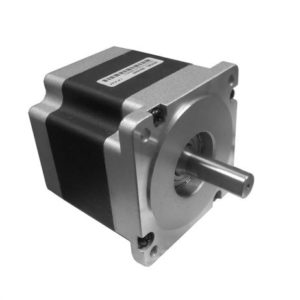
Stepper Motor NEMA 34 68 kg-cm Hybrid Bipolar
- Rated Voltage:4.2V
- Current/ phase: 4A
- Holding Torque: 68 kg-cm
- Number of Leads: 4
- Step Angle: 1.8°
- Step Angle Accuracy: ±5% (full step, no load)
- Resistance Accuracy: ±10%
- Inductance Accuracy: ±20%
- Frame Size: 85x85mm
- Shaft Length: 32mm
- Shaft Diameter: 12mm
- Long-lasting life
- Low cost for control achieved
- High torque at startup and low speeds
- Ruggedness
- Simplicity of construction
- Can operate in an open-loop control system
- Low maintenance
- Less likely to stall or slip

Stepper Motor NEMA 34 122 kg-cm Hybrid Bipolar
- Rated Voltage:4.08V
- Phase: 2
- Current/ phase: 4A
- Holding Torque: 122 kg-cm
- Number of Leads: 4
- Step Angle: 1.8°
- Step Angle Accuracy: ±5% (full step, no load)
- Resistance Accuracy: ±10%
- Inductance Accuracy: ±20%
- Frame Size: 85x85mm
- Shaft Length: 37mm
- Shaft Diameter: 13mm
- Long-lasting life
- Low cost for control achieved
- High torque at startup and low speeds
- Ruggedness
- Simplicity of construction
- Can operate in an open-loop control system
- Low maintenance
- Less likely to stall or slip

Stepper Motor NEMA 34 46 kg-cm Hybrid Bipolar
- Rated Voltage:4.2V
- Current/ phase: 4A
- Inductance/ phase: 7.3mH
- Resistance/ phase: 0.87ohms
- Holding Torque: 46 kg-cm
- Number of Leads: 4
- Step Angle: 1.8°
- Step Angle Accuracy: ±5% (full step, no load)
- Resistance Accuracy: ±10%
- Inductance Accuracy: ±20%
- Frame Size: 85x85mm
- Shaft Length: 32mm
- Shaft Diameter: 12mm
- They are high torque stepper motors.
- Input pulse decides the rotation angle of the motor.
- High accuracy of around 3 to 5% a step.
- Provides good starting, stopping and reversing
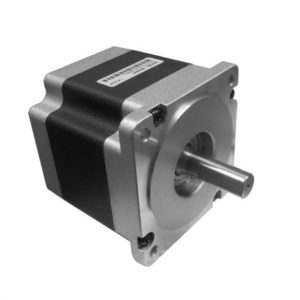
NEMA 34 34 kg-cm Bipolar Hybrid Stepper Motor
- Rated Voltage:4.2V
- Current/ phase: 3A
- Inductance/ phase: 3.6mH
- Resistance/ phase: 1.4ohms
- Holding Torque: 34 kg-cm
- of Leads: 4
- Weight: 1.7kg
- Length: 66mm
- Step Angle: 1.8°
- Step Angle Accuracy: ±5% (full step, no load)
- Resistance Accuracy: ±10%
- Inductance Accuracy: ±20%
- Frame Size: 85x85mm
- Shaft Length: 32mm
- Shaft Diameter: 12mm

Stepper Motor Nema 23 kg 7.2 kg Dual shaft
- Rated Voltage: 6.6 V
- Current/ phase: 1A
- Resistance/ phase: 6.6ohms
- Inductance/ phase: 8.2 mH
- Holding Torque: 7.2 kg-cm
- of Leads - 6
- Rotor Inertia - 275
- Weight: 0.65kg
- Detent Torque: 0.36 kg-cm
- Step Angle - 1.8°
- Step Angle Accuracy - ±5% (full step, no load)
- Resistance Accuracy - ±10%
- Inductance Accuracy - ±20%
- Frame Size (mm) - 57x57
- Shaft Length (mm) - 20.6
- Shaft Diameter (mm) - 6.35
- Comparably more powerful than NEMA17 motors.
- Input pulse decides the rotation angle of the motor.
- High accuracy of around 3 to 5% a step.
- Provides good starting, stopping and reversing.
- Control of this motor is less costly because of exclusion of complex control circuitry.
- The speed is proportional to the frequency of the input pulses.

NEMA 23 18.9 kg-cm
- Step Angle : 1.8 °
- Holding Torque : 18.9 kg-cm
- Operating Voltage : 3.2 Volts
- Supply Current (A) : 2.8 A/Phase
- No. of Leads : 4
- Inductance: 3.6 mH/Phase
- Resistance : 1.13 O/Phase
- Rotor Inertia : 480 gm-cm2
- Inductance Accuracy : ±20%
- Resistance Accuracy : ±10%
- Shaft Diameter (mm) : 6.35
- Shaft Length (mm) : 20.6
- Cable Length: 30 CM
- Comparably more powerful than NEMA17 motors.
- Input pulse decides the rotation angle of the motor.
- High accuracy of around 3 to 5% a step.
- Provides good starting, stopping and reversing.
- Control of this motor is less costly because of exclusion of complex control circuitry.
- The speed is proportional to the frequency of the input pulses.

NEMA 23 10.1 kg-cm
- Operating Voltage : 2.3 Volts
- Step Angle : 1.8°
- Holding Torque : 10.1 kg-cm
- Supply Current (A) : 2.8 Ampere/Phase
- Number of Leads : 4
- Inductance : 2.2 mH/Phase
- Resistance : 0.83 Ohm
- Rotor Inertia : 275 gm-cm2
- Weight (gm) : 650
- Detent Torque (kg-cm) : 0.36
- Frame Size (mm) : 57 x 57
- Inductance Accuracy : ±20%
- Resistance Accuracy : ±10%
- Shaft Diameter (mm) : 6.35
- Shaft Length (mm) : 20.6
- Step Angle Accuracy : ±5%
- Comparably more powerful than NEMA17 motors.
- The input pulse decides the rotation angle of the motor.
- High accuracy of around 3 to 5% a step.
- It provides good starting, stopping, and reversing.
- Control of this motor is less costly because of the exclusion of complex control circuitry.
- The speed is proportional to the frequency of the input pulses.