
I am text block. Click edit button to change this text. Lorem ipsum dolor sit amet, consectetur adipiscing elit. Ut elit tellus, luctus nec ullamcorper mattis, pulvinar dapibus leo.
-13%


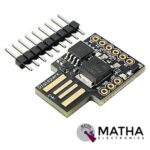

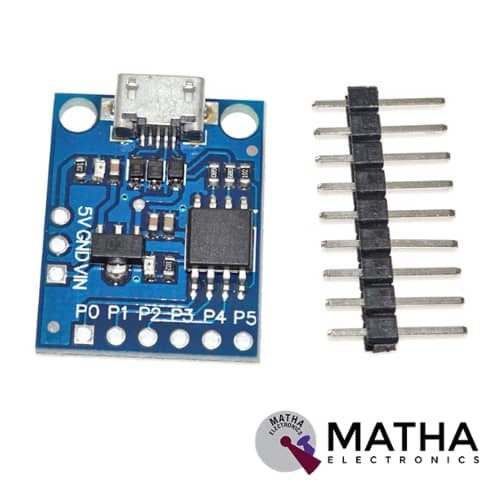
Attiny 5 Version 1
Original price was: ₹300.00.₹250.00Current price is: ₹250.00. inc. GST
STM32F103C8T6 ARM board
Original price was: ₹1,000.00.₹915.00Current price is: ₹915.00. inc. GST
Attiny 85
Original price was: ₹400.00.₹350.00Current price is: ₹350.00. inc. GST
- High Performance, Low Power AVR® 8-Bit Microcontroller
- Non-volatile Program and Data Memories
- 8K Bytes of In-System Programmable Program Memory Flash
- Endurance: 10,000 Write/Erase Cycles
- 512 Bytes In-System Programmable EEPROM
- Endurance: 100,000 Write/Erase Cycles
- 512 Bytes Internal SRAM
- Peripheral Features
- High-Frequency PWM Outputs with Separate Output Compare Registers
- USI – Universal Serial Interface (12C, SPI, 1-wire) with Start Condition Detector
- 10-bit ADC
- Single-Ended Channels
- 2 Differential ADC Channel Pairs with Programmable Gain (1x, 20x)
- Speed Grade: 0 – 10 MHz @ 2.7 – 5.5V, 0 – 20 MHz @ 4.5 – 5.5V
- Low Power Consumption
- Active Mode:1 MHz, 1.8V: 300 µA
Description
Attiny 85 Version 1 was designed as a low-power CMOS 8-bit microcontroller based on the AVR enhanced RISC architecture. the ATtiny 85 achieves throughputs close to 1 MIPS per MHz, by executing powerful instructions in a single clock cycle. This helps the system designer to optimize the device for power consumption versus processing speed. This development board features a 20MHz, AVR 8-bit microcontroller with 8 KB flash, 512 bytes of RAM. It comes with 5 GPIOs, 4 ADCs, 2 PWMs, 1 SPI, and 1 I2C. Moreover, this board is fully compatible with Arduino and it is directly programmed via USB without needing any other programmer. As there is only a total of 6 pins, it is not possible to get everything at the same time. Attiny 85 Version 1 differs from its upgraded version 2 in socket out, as it consists of a USB OUT socket.
This device provides 512/1024 bytes of In-System Programmable Flash, with 32 bytes of SRAM, four general-purpose I/O lines, 16 general purpose working registers, a 16-bit timer/counter with two PWM channels, internal and external interrupts, a programmable watchdog timer with internal oscillator, an internal calibrated oscillator, and four software selectable power saving modes. Moreover, ATtiny 85 are also equipped with a four-channel and 8-bit Analog to Digital Converter (ADC). This development board has a wide range of applications in Wearable ring watches, POV Display, Mini Weather Station, Mood Light.
Attiny 85 was manufactured using Atmel’s high-density Non-Volatile Memory (NVM) technology. Moreover, the on-chip, in-system programmable Flash allows the program memory to be re-programmed in-system by a conventional, non-volatile memory programmer. A suite of program and system development tools, including Macro assemblers and evaluation kits, supports this device.
Reviews (0)
Shipping & Delivery

Related products
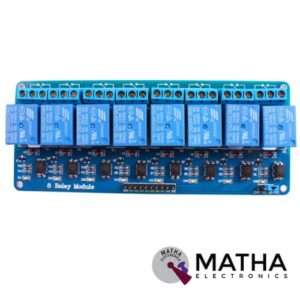
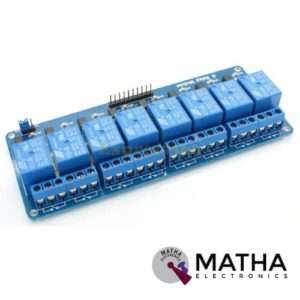
8 CHANNEL 5V RELAY
- Relay operating voltage: 5V
- 8 channel
- High impedance controller pin
- One normally closed contact and one normally opened
- Useful for appliances control
- Power supply indicator and control indicator lamp
- Pull-down circuit to avoid malfunction
- Can control both DC and AC to 220v AC load
- Works with both 3.3 V and 5 V logic with the less current drive
- 3 terminals per SPDT relay
- Standard interface can be directly controlled by a microcontroller like Arduino, 8051, AVR, PIC, DSP, ARM, MSP430, TTL logic
- Dimension: 7*6.4*1 inch


Arduino Mega 2560 Board
- Microcontroller: ATmega2560
- Operating Voltage: 5V
- Input Voltage (recommended): 7-12V
- Input Voltage (limits): 6-20V
- Digital I/O Pins: 54 (of which 15 provide PWM output)
- Analog Input Pins: 16
- DC Current per I/O Pin: 40 mA
- DC Current for 3.3V Pin: 50 mA
- Flash Memory: 128 KB of which 4 KB used by the boot loader
- SRAM: 8 KB
- EEPROM: 4 KB
- Clock Speed: 16 MHz


HC-05 Bluetooth Shield for Arduino
- Bluetooth serial port Profile
- Bluetooth protocol: Bluetooth Specification v2.0+EDR
- Frequency: 2.4GHz ISM band
- Communication Range: 10M
- Serial Bluetooth module for Arduino
- Can operate in Master, Slave or Master/Slave mode
- UART interface (TTL) with programmable baud rate (SPP firmware installed)
- Default baud rate: 38400(CMD MODE) / 9600(DATA MODE), data bits: 8, stop bit: 1, Parity: No parity
- Onboard PCB antenna
- FCC ID certificated

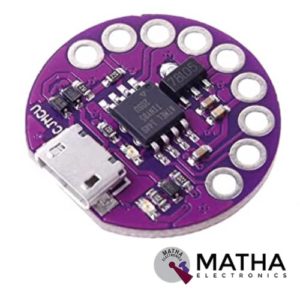
LilyTiny (LilyPad ATTiny85)
- Program Memory Type: Flash
- Program Memory (KB) : 8
- CPU Speed (MIPS): 20
- Data EEPROM (bytes): 512
- Digital Communication Peripherals: 1-SPI, 1-I2C
- Capture/Compare/PWM Peripherals : 5
- Comparators: 1
- Temperature Range (C) : -40 to 85
- Operating Voltage Range (V): 1.8 to 5.5
- Pin count: 8
- Cap Touch Channels : 3
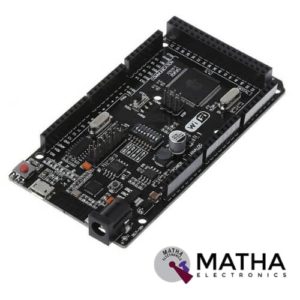
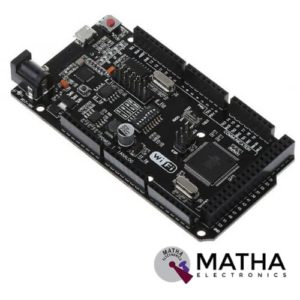
Mega R3 +WiFi ATmega2560+ESP8266 Module CH340G Compatible For Arduino Mega
- Microcontroller:ATmega2560
- IC Wi-Fi : ESP8266
- USB-TTL converter: CH340G
- Power Out: 5V-800mA
- Power Input USB: 5V (500mA max.)
- Power Input VIN/DC Jack: 9-24V
- Power Consumption: 5V 800mA
- Logic Level: 5V
- Wi-Fi 802.11 b/g/n 2.4 GHz
- USB: Micro USB
- Clock Frequency: 16MHz
- Operating Supply Voltage: 5V
- Digital I/O: 54
- Analog I/O: 16
- Memory Size: 256kb
- Data RAM Type/Size: 8Kb
- Data ROM Type/Size: 4Kb
- Interface Type: SerialOTA
- Operating temperature:−40С°/+125С°
- Build in external antenna
- Dimensions:53.361×101.86mm
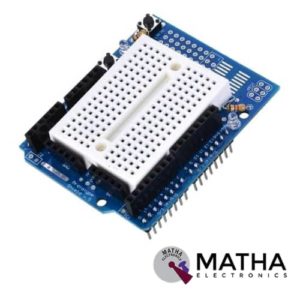
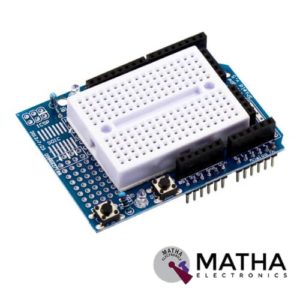
Protosheild For Arduino
- Standard 0.1"x0.1" prototyping grid with big pads
- Comes with Stacking headers and plain header, choose whichever you want when soldering together
- IC pattern for adding DIP ICs up to 20 pins
- Power rails down the middle and sides
- Reset button and an extra general use button
- 2 3mm general use LEDs, red and green, as well as 2 matching resistors
- A pass-thru ICSP stacking header so you can stack any kind of shield on top, and/or use an AVR programmer
- A surface-mount chip area for up to 14 SOIC size parts
- Compatible with tiny breadboards
- Every pin is brought out
- Gold plated pads
- 2 x 0.1uF capacitors on either side for extra power stability


USB Host Shield
- Works with standard (dual 5/3.3V) and 3.3V-only (for example, Pro Arduino) boards.
- Operates over the extended -40°C to +85°C temperature range
- Complies with USB Specification Revision 2.0 (Full-Speed 12Mbps Peripheral, Full-/Low-Speed 12Mbps/1.5Mbps Host)
- Supports HID devices, such as keyboards, mice, joysticks, etc.
- Compatible with Mass storage devices, such as USB sticks, memory card readers, external hard drives (FAT32 Type File System – Mega Arduino only).
Reviews
There are no reviews yet.