
I am text block. Click edit button to change this text. Lorem ipsum dolor sit amet, consectetur adipiscing elit. Ut elit tellus, luctus nec ullamcorper mattis, pulvinar dapibus leo.
-4%


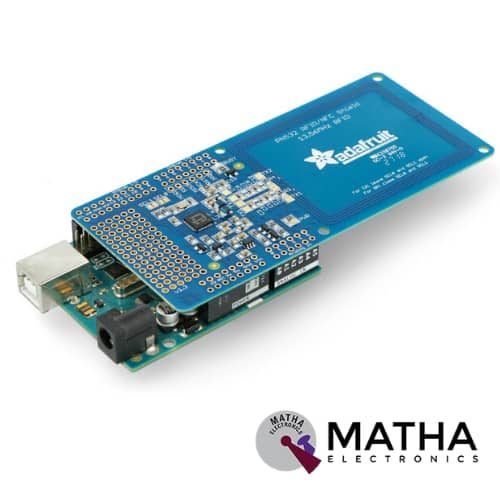
PN532 NFC/RFID Controller Shield for Arduino
₹1,500.00 inc. GST
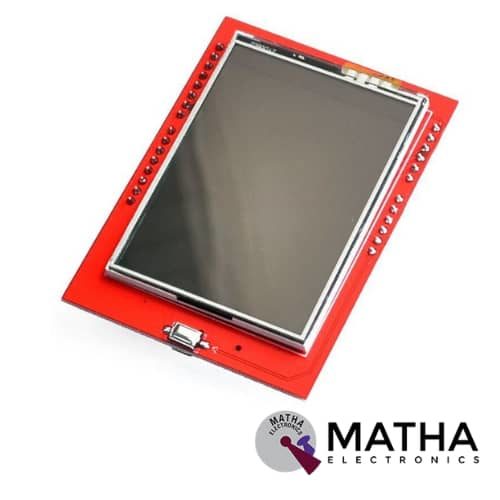
2.4″ Inch Touch Screen TFT Display Shield for Arduino
Original price was: ₹850.00.₹800.00Current price is: ₹800.00. inc. GST
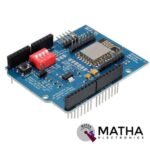
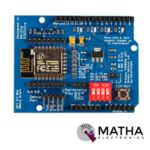
ESP8266 WIFI Shield
Original price was: ₹935.00.₹899.00Current price is: ₹899.00. inc. GST
- Operating voltage 5V (supplied from the Arduino Board)
- Connection via: 802.11b/g networks
- Encryption types: WEP and WPA2 Personal
- Connection with Arduino on SPI port
- on-board micro SD slot
- ICSP headers
- FTDI connection for serial debugging of WiFi shield
- Mini-USB for updating WiFi shield firmware
- 32-bit RISC architecture
- The processor can operate at 80MHz / 160MHz
- 32MB flash memory
- 64kB for instructions
- 96kB for data
- Operates in AP, Station or AP + Station mode
- It has 11 digital pins
- It has 1 analogue pin with 10-bit resolution
- Digital pins except the D0 have interrupts, PWM, I2C and one wire
- Programmable through USB or WiFi (OTA)
- Compatible with Arduino IDE
- Compatible with modules and sensors used in Arduino
Description
This ESP8266 WiFi Shield is designed specifically to connect your Arduino to the internet wirelessly through ESP8266. When working with esp8266, it is not necessary to mount a circuit with several components and wires to interconnect an ESP8266 to the Arduino. By simply connecting the board to the Arduino, position the DIP switch path according to the shield operating mode, and program the Arduino to connect to WiFi networks. Moreover, the board can be operated without the Arduino, as it has all the pin-outs of the ESP-12E available.
This shield allows an Arduino board to connect to the internet using the Wi-Fi library. And to read and write to an SD card using the SD library. This ESP8266 shield is mounted on the top of an Arduino board (e.g. the Uno). And connects it to your computer with a USB cable as normally to upload the sketches to the board. Once the sketch has been uploaded, disconnect the board from your computer and power it with an external power supply. The WiFi Shield supports wireless networks that operate according to the 802.11b and 802.11g. The Digital pin 7 functions as a handshake pin between the WiFi shield and the Arduino, and should not be used.
The ESP8266 Wifi module was designed based on an integrated chip specifically to fulfil the needs of a new connected world. It can handle all the necessary overhead for communicating with your network, such as TCP/IP stack and communicating with your 802.11 networks. ESP8266 was designed as a Serial Wifi Wireless Transceiver Module with self-contained SOC and integrated TCP/IP protocol stack. It gives access to any microcontroller to your WiFi network. This wireless module is completely addressable over SPI and UART protocols.
Reviews (0)
Shipping & Delivery

Related products

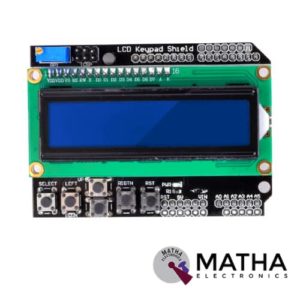
16×2 (1602) LCD Keypad Shield
- Operating Voltage:5V
- 5 Push buttons.
- RST button to reset Arduino program.
- Integrate a potentiometer for adjusting the backlight.
- Expanded available I/O pins.
- Blue light with white characters.
- Uses 4 Bit Arduino LCD Library
- Screen contrast adjustment
- Arduino Reset button
- The keypad consists of 6 keys select, up, right, down, left and reset.
- To save the digital IO pins, the keypad interface only uses one ADC channel.
- The key value is read out through a 5 stage voltage divider.

37 IN 1 Sensor Kit For Arduino
- For beginners who are interested in Arduino
- A complete set of Arduino’s most common and useful electronic components
- Infrared sensor receiving module
- Laser sensor module
- Temperature and humidity sensor module
- Infrared sensor module
- 5v relay module
- Obstacle avoidance sensor module. For beginners who are interested in Arduino
- A complete set of Arduino’s most common and useful electronic components
- Packaging Type: Box
- Material: Circuit board
- Dimensions: 98 x 0.59 x 0.24 inch
- Weight: 428 g

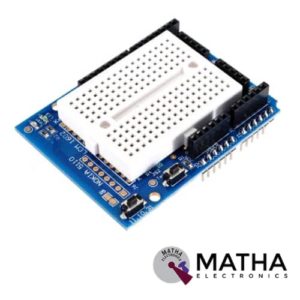
Arduino Compatible Nokia 5110 Prototype Proto Shield Expansion Board
- Supports Nokia5110 display
- Standard 0.1"x0.1" prototyping grid with big pads
- Comes with Stacking headers and plain header, choose whichever you want when soldering together
- IC pattern for adding DIP ICs up to 20 pins
- Power rails down the middle and sides
- Reset button and an extra general use button
- 2 3mm general use LEDs, red and green, as well as 2 matching resistors
- A pass-thru ICSP stacking header so you can stack any kind of shield on top, and/or use an AVR programmer
- Surface-mount chip area for up to 14 SOIC size parts
- Compatible with tiny breadboards
- Every pin is brought out
- Gold plated pads
- 2 x 0.1uF capacitors on either side for extra power stability
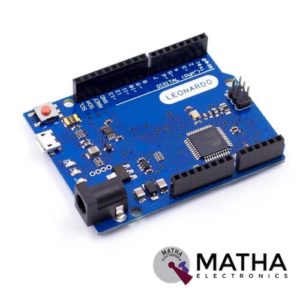

Arduino Leonardo R3
- Board Mode: LEONARDO R3
- Microcontroller: ATmega32u4
- Operating Voltage: 5V
- Input Voltage (Recommended): 7-12V
- Input Voltage (limits): 6-20V
- Digital I/O Pins: 20
- PWM Channels: 7
- Analog Input Channels: 12
- DC Current per I/O Pin: 40 mA
- DC Current for 3.3V Pin: 50 mA
- Flash Memory: 32 KB
- SRAM: 2.5 KB (ATmega32u4)
- EEPROM: 1 KB (ATmega32u4)
- Clock Speed: 16 MHz


DTMF Shield
- MT8870 Decoder IC.
- 4 Output digital pins.
- Operates on 5V
- Includes MT8870 DTMF Receiver IC
- Receives and Converts Standard DTMF Codes
- Remotely Switch Devices from Anywhere Using the Phone
- Easily Connects to Most Microcontrollers or Roboduino Board
- Low Power Consumption
- 5 On-Board LED's For Data Received Indication
- Standard Header Connections for Control System Connection
- Audio socket for application
- Speaker connector for audio sound checking.
- Microphone connector for over the air remote control system( note, due to environmental noise, without any filtering system this method is not recommended)
- Dimension: 37x37x9mm
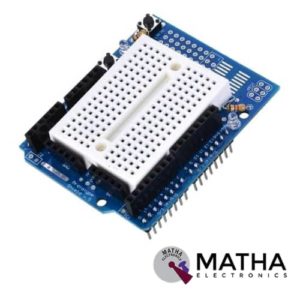
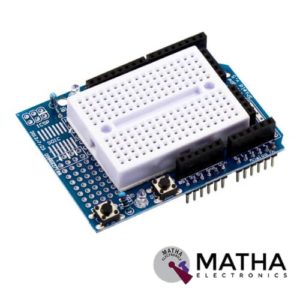
Protosheild For Arduino
- Standard 0.1"x0.1" prototyping grid with big pads
- Comes with Stacking headers and plain header, choose whichever you want when soldering together
- IC pattern for adding DIP ICs up to 20 pins
- Power rails down the middle and sides
- Reset button and an extra general use button
- 2 3mm general use LEDs, red and green, as well as 2 matching resistors
- A pass-thru ICSP stacking header so you can stack any kind of shield on top, and/or use an AVR programmer
- A surface-mount chip area for up to 14 SOIC size parts
- Compatible with tiny breadboards
- Every pin is brought out
- Gold plated pads
- 2 x 0.1uF capacitors on either side for extra power stability


Sensor Shield V5 Expansion Board For Arduino
- Retain the merits of the V4.0 version
- Laminated design
- PCB immersion gold processing technology
- IIC interface
- Bluetooth module communication interface
- SD card module communication interface
- APC220 Wireless RF modules communication interface
- RB URF v1.1 ultrasonic sensors interface
- 12864 LCD string of line and parallel interface
- 32 servo controller interface
Reviews
There are no reviews yet.