
I am text block. Click edit button to change this text. Lorem ipsum dolor sit amet, consectetur adipiscing elit. Ut elit tellus, luctus nec ullamcorper mattis, pulvinar dapibus leo.
-2%Sold out


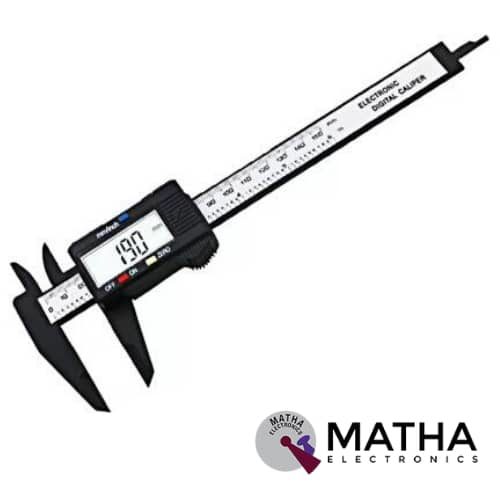
150mm 6 inch LCD Digital Electronic Vernier Caliper
Original price was: ₹900.00.₹850.00Current price is: ₹850.00. inc. GST
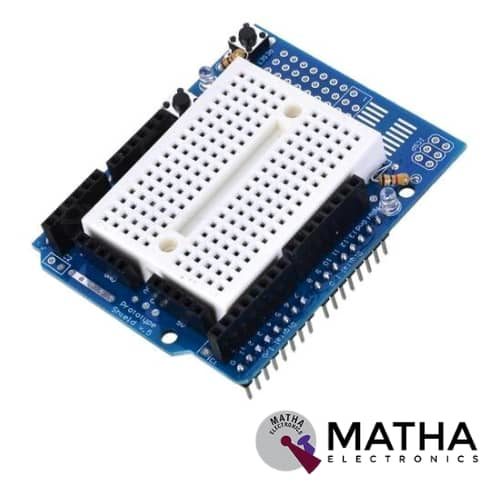
Protosheild For Arduino
Original price was: ₹355.00.₹250.00Current price is: ₹250.00. inc. GST
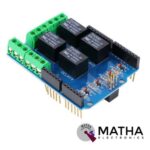
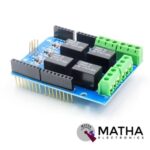
RELAY SHEILD
Original price was: ₹510.00.₹499.00Current price is: ₹499.00. inc. GST
- Every channel maximum convert voltage: AC 125V / DC 24V
- Every channel maximum converts current: 3A
- Interface via digital I/O pins 4,5,6, and 7
- Relay screw terminals
- Standardized shield shape and design
- LED working status indicators for each relay
- High quality relays
- COM, NO (Normally Open), and NC (Normally Closed) relay pins for each relay
- Update pin SCL, SDA, IOREF, NC.
- Arduino,Crowduino,Seeeduino,Arduino Mega compatible
- Automatic control and manual control
- 4 mechanical relays with photo-coupled circuit
- 3-M3 screw hole easy to install
- Driven by 5V / 3.3V normally open contact close
Out of stock
Description
The Relay Shield is designed as an Arduino compatible smart module with 4 mechanical relays. This is a simpler and easier way to control high voltage with maximum switching power of 35VDC 70W for each channel. This Relay Shield module is controlled directly by Arduino/Crowduino through digital IOs with an external 6.5 to 12V DC supply. The 4 onboard control keys used to control the high voltage without programming. It features four high-quality relays and provides NO/NC interfaces. And four dynamic LED indicators to show the on/off state of each relay. And the standardized shield form factor to provide a smooth connection to the Arduino/Seeeduino board or other Arduino compatible boards.
The Relays are basically electromagnetic switches in which the relay is energized by the control circuit. When a voltage and current are applied to the coil, the current and coil create a magnetic field. As a result, it attracts the COM terminal towards the NO terminal. When the applied voltage and current are removed from the control circuit, the COM terminal returns to contact the NC terminal due to a mechanical force (usually a spring). The two “Control Circuit” terminals for each of four relays are controlled by only one Arduino Digital I/O pin. The Pins 4, 5, 6, and 7 control relays 4, 3, 2, and 1 respectively. These relay shields are used to control high voltage using low voltage, motor control, remote control, anti-hearing alarm, automatic temperature alarm, incubators, and so on.
Note: The pins on the Shield should not touch the USB connector of Arduino UNO when they are connected.
J1 Interface/Terminal Pin Description:
- COM1 (Common Pin): The relay pin is controlled from the digital pin.
- NC1 (Normally Closed): This terminal is connected to COM1 when the RELAY1 control pin (Digital 7 I/O pin) is set to low and disconnected when the RELAY1 control pin set to high.
- NO1 (Normally Open): This terminal connected to COM1 when the RELAY1 control pin (Digital 7 I/O pin)set to high and disconnected when the RELAY1 control pin set to low.
Terminals J2-4 are similar to J1 except that they control RELAY2-RELAY4 respectively.
Reviews (0)
Shipping & Delivery

Related products
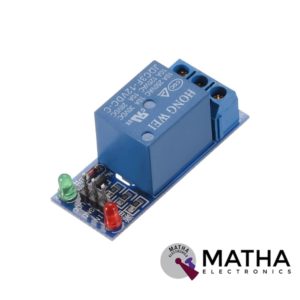
1 CHANNEL 12V RELAY
- 1-Channel relay interface board
- Operating voltage: 12V DC
- Provide high current relay of 15A
- For quick and easy connection high-quality screw terminals provided
- Can control both AC & DC appliances
- LED status indicates relay ON/OFF state.
- High current relay of 10A @250 V AC/10A@ 30V DC
- Standard interface that can be controlled by a microcontroller (Arduino, 8051, PIC, AVR, DSP, ARM)
- For easy accessibility input signal pin connected to burg sticks
- Dimension: 43*17*17mm
- Weight: 150gm

1 CHANNEL 5V RELAY
- 1 channel relay board
- Operating voltage: 5V
- Maximum current: 2 A
- Relay contact current capacity of 10A @250 V AC/10A@ 30V AC
- configured as SINGLE POLE DOUBLE THROW( SPDT)
- LED status indicates relay ON/OFF state.
- Standard TTL level logic controlled
- One normally closed and one normally opened contact
- Compatible with any 5V microcontroller
- Dimension: 43*17*17mm
- Weight: 150gm
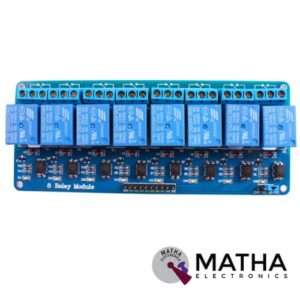
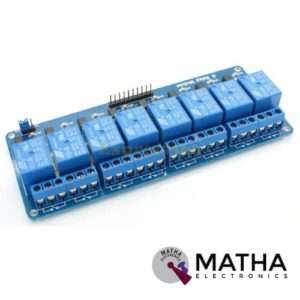
8 CHANNEL 5V RELAY
- Relay operating voltage: 5V
- 8 channel
- High impedance controller pin
- One normally closed contact and one normally opened
- Useful for appliances control
- Power supply indicator and control indicator lamp
- Pull-down circuit to avoid malfunction
- Can control both DC and AC to 220v AC load
- Works with both 3.3 V and 5 V logic with the less current drive
- 3 terminals per SPDT relay
- Standard interface can be directly controlled by a microcontroller like Arduino, 8051, AVR, PIC, DSP, ARM, MSP430, TTL logic
- Dimension: 7*6.4*1 inch

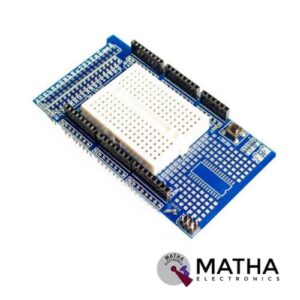

Prototype Shield V3.0 For Arduino Mega with breadboard
- The shield can support being fully assembled with Arduino MEGA
- Support soldering components directly on this shield
- Support sticking the mini breadboards on this shield
- Reset button up top
- Mainboard aureate quadrate
- With SOP28 SMT components encapsulation
- With PWR & STAT indicator
- Breadboard Points : 170
- Shield Size (mm) : 102×56
- Breadboard Size (mm) : 48×34
- Weight (gm) :35


Screw Shield Expansion board for Arduino
- Arduino terminal to provide the IO, port connection.
- 81 posts quality, reliable, convenient, durable.
- Combined with the Proto Shield, the middle can be used as a prototype expansion board.
- Double-sided PCB Prototyping extended area vias connecting the front sides can be welded components.
- The middle section can be placed small bread plate, convenient test extend
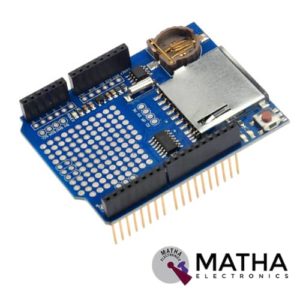

SD Card shield V4.0 for Arduino UNO
- Standard SD card, SDHC card and TF card compatible
- 3.3v and 5v logical voltage compatible
- 2.6-3.6v DC power supply
- UART Grove & I2C connection compatible
- Fully supported SD Library
- Minimal number of SPI port
- Jumpers provided for configuring Arduino SPI port pins
- Onboard toggle switch for SD card select type
- Truly stackable
- Prototype expand Library support
- Size: 53mm x 47mm
- Weight: 35g

SIM800A Quadband GSM / GPRS Module convertible as Shield for Arduino
- Quad-Band GSM/GPRS 850/ 900/ 1800/ 1900 MHz.
- GPRS class 2/10.
- Input Voltage: 9V-12V DC.
- Control via AT commands (3GPP TS 27.007, 27.005 and SIMCOM enhanced AT command set).
- Configurable baud rate.
- Built-in SIM Cardholder.
- Built-in Network Status LED.
- 5V interface for direct communication with MCU kit.
- Inbuilt Powerful TCP/IP protocol stack for internet data transfer over GPRS.
- Low power.
- SMA connector with GSM L Type Antenna.
- Headphone jack for audio out.
- Li-Po battery 3.7-volt pins for supply.
- Li-Po battery USB charger (3.7volts).
- CP2102 port for communication with a laptop.
Reviews
There are no reviews yet.